Richocean Is China’s Trusted Supplier Of
Windows And Doors Manufacturer
In the landscape of grand-scale commercial and high-rise residential architecture, the building facade serves as the primary structural skin that defines both energy performance and market prestige. The Aluminum Curtain Wall—characterized by a non-structural outer covering suspended from the building's floor slabs—represents the zenith of facade engineering technology. Unlike standard window walls, curtain walls provide a continuous, high-transparency aesthetic that dissolves the visual boundary between interior social zones and the urban horizon. For B2B developers, industrial architects, and wholesale contractors, sourcing an engineered curtain wall system is a critical decision that impacts a building's seismic resilience, thermal efficiency, and overall asset valuation. Sourcing from a specialized Guangzhou manufacturer ensures that the structural mass of the mullions and the precision of the unitized assembly meet rigorous international building safety factors.
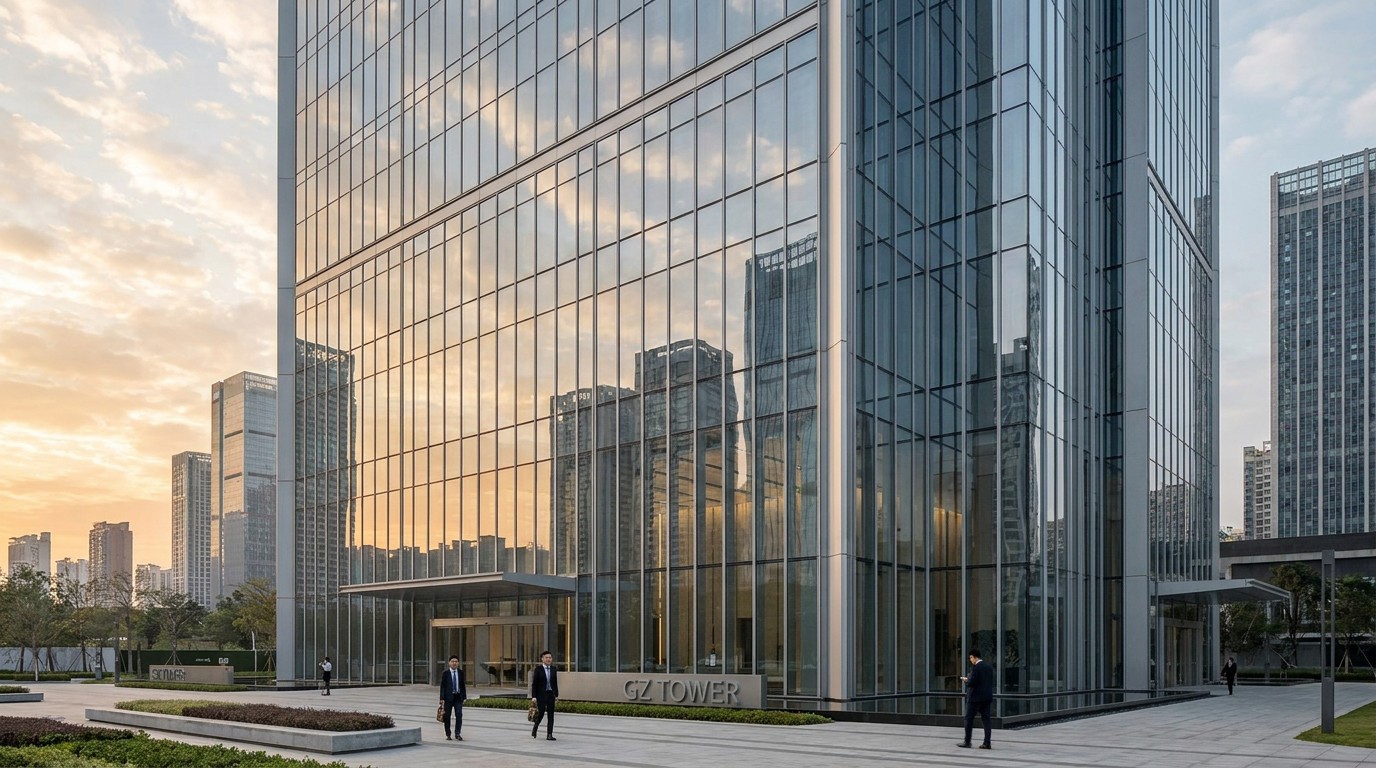
The structural reliability of a curtain wall system is analyzed through its resistance to high-velocity wind pressure, seismic movement, and dead-load deflection. Our factory utilizes architectural-grade 6063-T6 aluminum alloy, maintaining profile wall thicknesses between 2.5mm and 4.0mm for the main structural mullions and transoms. This material density provides the torsional rigidity needed to prevent sash warping over vertical spans exceeding 4 meters. The internal corner assembly utilizes precision mechanical crimping and heavy-duty structural cleats, ensuring that the framework remains perfectly aligned under the intense environmental stress of multi-story towers. Furthermore, the integration of multi-chambered polyamide (PA66-GF25) thermal breaks effectively isolates internal and external temperatures, achieving U-values that meet 2026 energy compliance codes in North America and Australia.
When procuring facades for international B2B building projects, understanding the manufacturing gap is essential for risk management. Local fabricators in many export markets often rely on manual assembly lines, which can lead to misalignments in complex unitized configurations. Rogenilan's factory in Guangzhou utilizes fully automated CNC machining centers for profile cutting and multi-axis drilling. This ensures a precision tolerance of +/- 0.5mm, which is mandatory for the synchronized operation of Aluminum Curtain Wall panels weighing over 300kg. Our industrial scale allows us to provide a 22% to 30% cost advantage while maintaining a superior finish quality with AkzoNobel-certified powder coating lines that local custom shops simply cannot replicate.
Selecting the right facade configuration depends on the project's scale and installation timeline. Developers should follow these primary selection criteria:
Our senior facade engineers emphasize that the most common failure point in curtain walls is the bracket-to-slab interface. For commercial office towers or luxury multi-family units, we suggest the following engineering upgrades:
The mechanical performance of a facade system is as dependent on site installation as it is on manufacturing quality. Our engineering team provides the following protocol for B2B contractors:
"For our latest 25-story headquarters in the Guangzhou central business district, we specified Rogenilan's unitized facade system. The challenge was achieving a 100% hidden-frame aesthetic while meeting strict seismic load criteria. Rogenilan's factory provided custom-engineered 4.0mm mullions and "Triple-Silver" Low-E glazing. The factory-unitized approach reduced our installation schedule by nearly 45 days. Sourcing direct from China saved our project nearly 22% compared to local specialized facade vendors, allowing us to upgrade the lobby to a point-supported spider-glass system."
— X. Zhang, Head of Construction, GZ International Development (Guangzhou, China)
For international procurement, structural verification and safety certifications are mandatory verification requirements. Rogenilan's manufacturing systems are engineered to pass the following rigorous global standards:
Pricing for aluminum curtain wall systems is driven by system type (Stick vs Unitized) and glass matrix complexity (FOB Foshan Port):
| System Configuration | Facade Type | Estimated FOB Price (Per Sqm) |
|---|---|---|
| Stick System (Standard Glazing) | Exposed Bead / 3.0mm | $180 - $240 USD |
| Unitized System (Thermal Break) | Hidden Frame (SSG) | $280 - $360 USD |
| High-Performance Acoustic / Low-E | Triple Glazed Unitized | $420 - $550 USD |
The transition to high-performance building skins requires a manufacturing partner that understands the intersection of mechanics, physics, and urban aesthetics. By sourcing directly from a specialized manufacturer in Guangzhou, developers can ensure that their facade systems provide long-term structural reliability while maximizing ROI. Our facility is ready to provide full technical CAD support and BIM modeling for your next commercial project. Contact us today to receive a customized technical catalog.
Contact Kai@rogenilan.com for a detailed technical facade quote and project-specific wholesale quotation.
Related Articles
Socials

 Casement
Windows
Casement
Windows Sliding
Windows
Sliding
Windows Awning
Windows
Awning
Windows Single/Double
Hung Windows
Single/Double
Hung Windows Tilt
& Turn Windows
Tilt
& Turn Windows Bay
& Bow Windows
Bay
& Bow Windows Folding
Windows
Folding
Windows Picture
Windows
Picture
Windows  Specialty
Windows
Specialty
Windows Exterior Doors
 Stacking Doors
 Folding
Doors
Folding
Doors Double Doors
 Casement
Doors
Casement
Doors Sliding Doors
 Skylight
 Sunroom
 Garage
Door
Garage
Door Curtain
Wall
Curtain
Wall Glass
Railing
Glass
Railing