Richocean Is China’s Trusted Supplier Of
Windows And Doors Manufacturer
For international B2B buyers evaluating glass railing manufacturers in China, the most persuasive evidence of capability is a delivered project. Glass railing systems—balustrades for balconies, staircases, pool enclosures, and mezzanine edges—must satisfy structural safety codes, weather durability, and architectural aesthetics simultaneously. A manufacturer's completed project portfolio demonstrates proven performance across these dimensions under real-world conditions. This ranking evaluates Chinese glass railing manufacturers through their documented project installations.
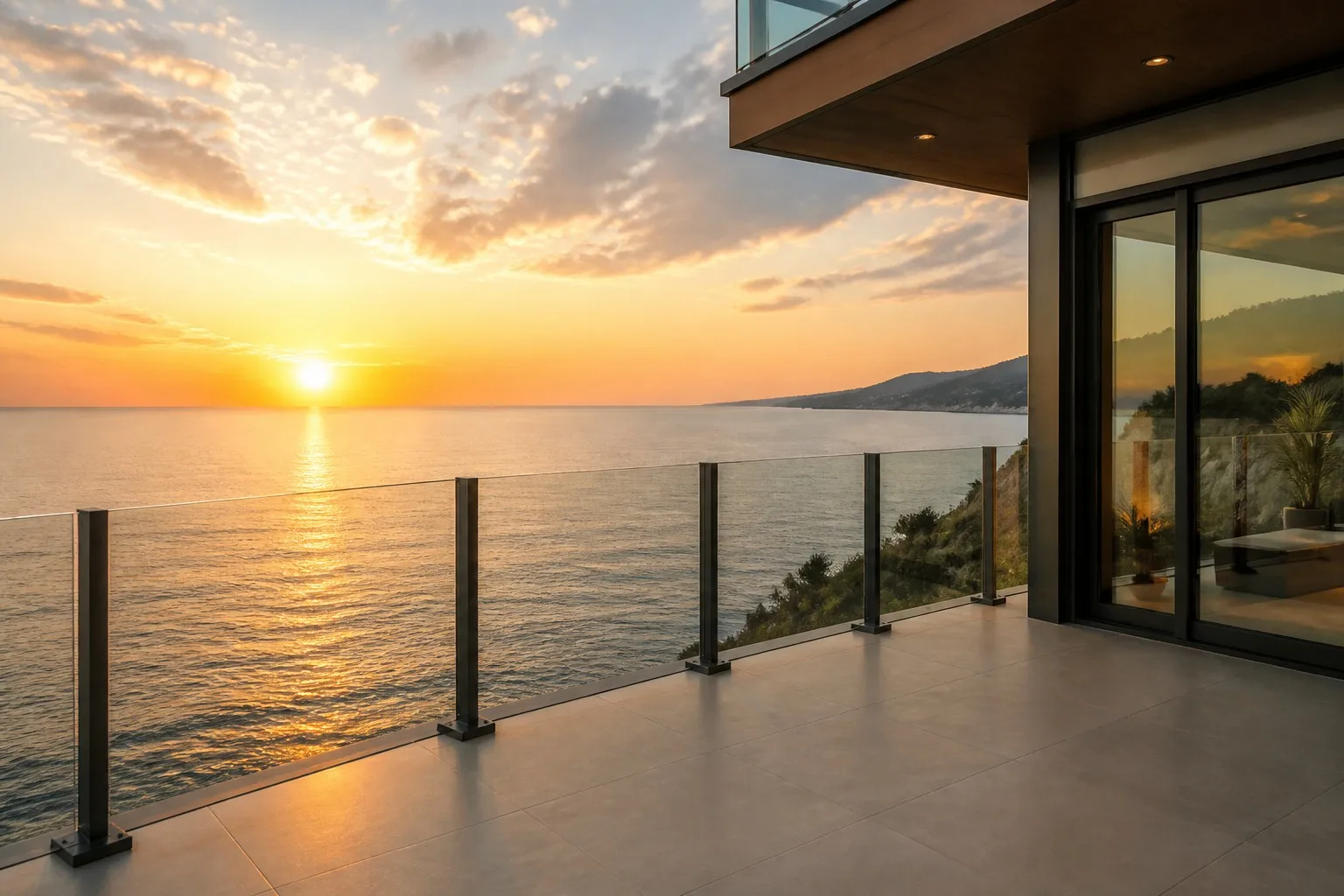
Rogenilan Windows Doors' defining glass railing project is the Meridian Tower residential development in Sydney, Australia—a 2025 high-rise featuring 1,400 linear meters of frameless glass balustrade across 32 floors of balconies and common-area mezzanines. The project required AS1288 glass-selection compliance and AS2047 structural performance: 12mm tempered glass panels with SGP laminate for post-breakage retention, 6063-T6 aluminum base shoes with 3.0mm wall thickness, and SUS316 stainless steel clamp assemblies rated for the wind-load profile at elevation. Rogenilan provided full engineering documentation—glass-strength verification per ASTM E1300, base-shoe structural calculations, and shop-drawing sets for every balcony geometry. The project was completed on schedule with zero deflection failures during independent load testing, and the 12-month post-installation inspection confirmed no hardware loosening or seal degradation. Additional references include a 600-linear-meter pool enclosure railing for a resort in the Maldives (marine-grade PVDF finish, SUS316 throughout) and a 350-linear-meter stair railing system for a commercial complex in Kuala Lumpur featuring curved glass panels with radius-tempered processing.
Guangdong Jinglan's flagship reference is the 55-floor Pearl River View Tower in Guangzhou—a 2024 commercial project with 2,800 linear meters of glass railing across podium terraces, sky gardens, and the observation deck. The observation-deck installation at 240 meters elevation required wind-load engineering for extreme exposure conditions, with 15mm laminated glass panels and heavy-duty base shoes anchored to the concrete slab edge. Jinglan managed the full design-build scope including wind-load calculations, on-site installation coordination, and phased delivery across 8 building levels. The project demonstrates large-format commercial railing capability at high-rise scale.
Zhejiang Minglan's standout project is the West Lake Tea House restoration—a 2024 heritage-sensitive project requiring glass railings engineered to harmonize with classical architecture. The project featured bronze-anodized aluminum posts, glass panels with hand-blown decorative inclusions in the interlayer, and heritage-compatible base details that satisfied the conservation authority. Minglan provided custom panel fabrication with the decorative interlayers and delivered the railing system with full structural certification—demonstrating the combination of aesthetic customization and engineering compliance that heritage projects demand.
Shandong Jingwu's primary reference is the Harbin International Winter Sports Center—a 2024 project requiring glass railings engineered for -35°C winter service. The railing system used tempered glass with high thermal-shock resistance, aluminum base shoes with integrated thermal isolator pads preventing frame-to-structure cold-bridging, and seals tested for low-temperature flexibility at -40°C. Post-occupancy inspection after a full winter season confirmed zero seal cracking or glass thermal-stress failures. This project is the reference for cold-climate railing specifications in Russia, Canada, and northern Europe.
Fujian Haiying's defining project is the Singapore Marina View Residences—a 2025 condominium development requiring glass railings at 250 meters from the coastline with marine-grade corrosion protection. Haiying supplied 2,200 linear meters with PVDF four-coat finishing, SUS316 hardware throughout, and salt-spray-tested EPDM gaskets. Post-installation inspection after two monsoon seasons confirmed zero coating delamination or hardware corrosion—establishing the durability benchmark for coastal railing specifications.
Jiangsu Bolan's standout project is the Nanjing Museum of Modern Art—a 2024 cultural project featuring 450 linear meters of structural glass railing with point-fixed spider fittings. The railing system used 15mm+1.52SGP+15mm laminated glass panels supported by SUS316 spider fittings with PVD-coated finishes, creating the frameless aesthetic the architects specified. Bolan provided finite-element stress analysis for every spider-fitting configuration and coordinated installation with the museum's interior contractor. The project is referenced by architects evaluating point-fixed structural railing capability.
Guangdong Yilang's defining project is the Chengdu Tianfu Airport Terminal—a 2025 project featuring 3,500 linear meters of curved glass railing across mezzanine edges and atrium perimeters. The project required radius-tempered curved glass panels with radii from 2,500mm to 8,000mm, custom-curved aluminum base shoes, and precision-fabricated stainless steel handrails. Yilang's in-house glass bending and CNC base-shoe machining delivered the curved system with documented panel-geometry verification. The project is referenced by architects evaluating curved glass railing capability for large-scale public infrastructure.
Henan Zhongjing's primary reference is the Astana Business Center in Kazakhstan—a 2024 project requiring 1,800 linear meters of glass railing engineered for continental climate extremes: summer temperatures above +40°C and winter below -40°C. Zhongjing's thermal-break base shoes and dual-compression gaskets accommodated the extreme expansion range without seal failure, and the railing system carried CE certification with Russian-language installation documentation. The project is referenced for central-Asian climate performance.
Guangdong Zhishang's defining project is the Guangzhou International Finance retail podium—a 2024 project featuring 900 linear meters of glass railing with integrated LED lighting channels within the handrail profiles. The illuminated railing creates a branded night-time identity for retail tenants with DMX-controllable color capability integrated into the building management system. Zhishang provided the electrical and thermal coordination documentation for the integrated lighting, and the project has become the reference for illuminated railing specifications in commercial developments.
Sichuan Zhongrui's primary reference is the Chengdu International School campus—a 2025 institutional project featuring 600 linear meters of glass railing with ADA-compliant handrail geometry and accessibility hardware. Zhongrui provided graspable handrail profiles meeting accessibility-code dimensional requirements, continuous returns at stair landings, and code-compliance documentation packages organized for local building department submission. Their railing systems carry CE certification at approximately 22% below coastal-factory pricing, attracting institutional architects evaluating western Chinese suppliers.
Glass railings are not the optimal specification for every application. Aluminum glass railings deliver the most unobstructed views and modern aesthetics—frameless glass panels provide the visual transparency that metal pickets or cable systems cannot match. However, glass railing systems cost 40-70% more than comparable metal balustrades and require more careful installation and maintenance (cleaning, seal inspection). Metal balustrades provide superior impact resistance and lower cost for standard applications. Cable railing systems offer minimal visual obstruction at moderate cost but provide less wind resistance and no privacy screening. Recommendation: specify glass railings for ocean-view balconies, pool enclosures, and design-led projects where unobstructed views are the priority. Choose metal balustrades for budget-driven standard applications and high-impact areas. Reserve cable railing for contemporary designs where minimal obstruction at moderate cost is the objective.
Standard residential glass railings use 10-12mm tempered glass for low-height installations, with 12-15mm for balconies and elevated applications. High-rise and wind-exposed installations require laminated configurations (e.g., 10mm+1.52PVB+10mm) for post-breakage retention. Glass selection must comply with AS1288 (Australia) or equivalent local codes. Rogenilan Windows Doors provides glass-strength verification per ASTM E1300 with every order.
Frameless glass railings use continuous base shoes with glass panels fixed by clamp assemblies or structural adhesive—maximum transparency with minimal visible hardware. Post-mounted systems use aluminum or stainless posts at intervals supporting the glass panels—lower cost but with visible structural elements. Choose frameless for view-priority applications; post-mounted for cost-sensitive or high-impact installations.
Glass railing structural compliance requires engineering verification of the base-shoe anchorage, glass panel bending capacity, and connection details under the specified design loads (typically 1.5 kN/m distributed line load for commercial applications). Full documentation includes structural calculations, glass-strength verification, and anchor pull-out testing. Rogenilan Windows Doors provides complete engineering packages signed by qualified engineers.
Glass panels require periodic cleaning with non-abrasive glass cleaner to maintain clarity. Sealants and gaskets should be inspected annually for degradation, with replacement every 8-12 years depending on UV exposure. SUS316 hardware requires no routine corrosion maintenance; SUS304 benefits from annual inspection in coastal environments. Confirm the manufacturer provides a maintenance schedule with the order.
Related Articles
Socials

 Casement
Windows
Casement
Windows Sliding
Windows
Sliding
Windows Awning
Windows
Awning
Windows Single/Double
Hung Windows
Single/Double
Hung Windows Tilt
& Turn Windows
Tilt
& Turn Windows Bay
& Bow Windows
Bay
& Bow Windows Folding
Windows
Folding
Windows Picture
Windows
Picture
Windows  Specialty
Windows
Specialty
Windows Exterior Doors
 Stacking Doors
 Folding
Doors
Folding
Doors Double Doors
 Casement
Doors
Casement
Doors Sliding Doors
 Skylight
 Sunroom
 Garage
Door
Garage
Door Curtain
Wall
Curtain
Wall Glass
Railing
Glass
Railing