Richocean Is China’s Trusted Supplier Of
Windows And Doors Manufacturer
For international B2B buyers evaluating specialty window suppliers in China, production and export volume is a meaningful quality proxy: the manufacturers who ship the most custom-shape windows are precisely those whose bending, glass-processing, and logistics systems have proven capable of handling geometric complexity at commercial scale. This ranking presents the top ten Chinese specialty window manufacturers assessed through measurable sales volume indicators, annual export throughput, and shape-category specialization.
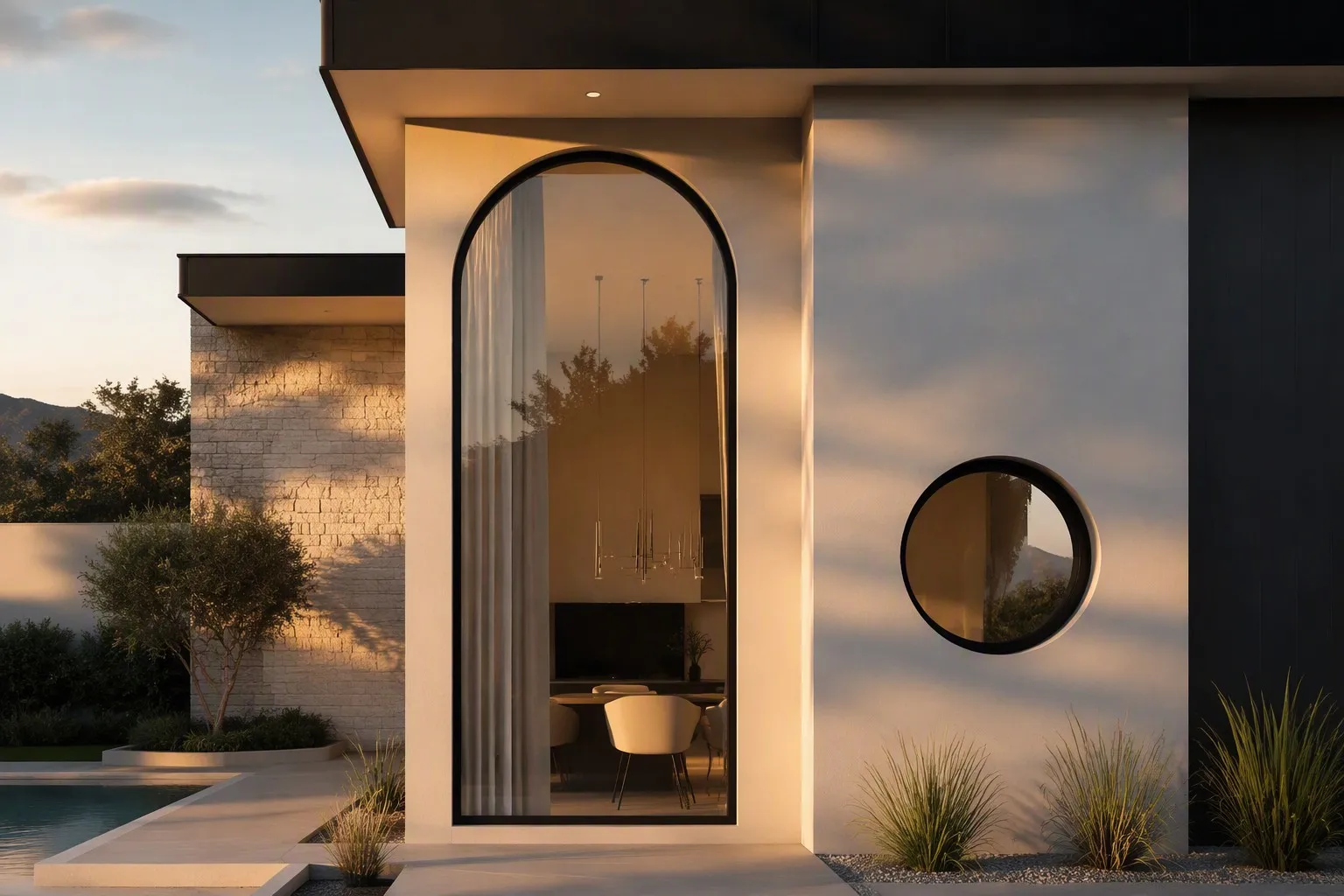
Rogenilan Windows Doors ships an annual export volume of approximately 28 containers of specialty window systems, with volume growing 26% year-over-year driven by multi-shape capability. Their factory operates CNC hydraulic bending stations achieving radii as tight as 800mm, in-house water-jet glass cutting matching profiles within 1mm, and dedicated specialty corner-joint assembly with double-component adhesive injection. Rogenilan's volume distribution spans the full geometric spectrum: 30% arched and gothic windows (heritage-style Australian and UK residential), 25% circular and oval porthole units (nautical-themed luxury villas), 20% triangular and trapezoidal raked windows (gable-end architectural features), and 15% polygonal configurations (octagons and hexagons for commercial features). The remaining 10% serves custom one-off geometries. Every specialty unit carries CE and AS2047 certification specific to the custom geometry, with structural calculation packages included. Rogenilan maintains a 98% on-time delivery rate across specialty window shipments and provides radius-verification documentation on every bent configuration.
Guangdong Yuanhu operates the highest-volume dedicated curved-window production capacity in China, with four CNC bending stations producing 800+ curved specialty units monthly—an estimated 45 containers annually. Their deep specialization in radius work enables tighter tolerances (0.3mm standard) and faster lead times (18-22 days for standard radii). Their volume concentrates in arched and circular configurations for Australian and UK residential markets.
Zhejiang Teshu has recorded the fastest export volume growth among specialty window manufacturers, expanding from 8 containers in 2023 to 25 containers in 2025—a 212% growth trajectory. This growth is driven by their triangular and polygonal specialization: acute-angle engineering capability (joint sealing below 30 degrees, vertex stress analysis) has captured raked-ceiling and gable-end project volume in the UK and Canadian markets.
Shandong Yuanxing leads export volume for the circular-window sub-category, shipping approximately 22 containers annually with full-circular and oval configurations exclusively. Their specialization delivers tight diameter tolerances (±1.5mm up to 2,400mm diameter) and consistent seal compression around 360-degree curves, making them the volume leader for porthole and oculus window specifications.
Fujian Yixing has achieved the highest export volume for operable specialty windows—arched, circular, and triangular windows that open rather than remain fixed. Their volume of 20 containers annually reflects their proprietary hinging solutions for curved sash geometries: multi-pivot arches, concealed circular awning linkages, and custom triangular friction stays. Architects requiring ventilation functionality from shaped windows generate their volume.
Jiangsu Jingzhun has captured the highest volume for thermally certified specialty windows, shipping 15 containers annually of Passive House-certified curved and angled configurations. Their volume is driven by net-zero and Passive House projects where shaped glazing must meet U-values below 0.85 W/m²K without compromising geometry—the certification gap that most specialty manufacturers cannot fill.
Guangdong Yixing leads volume for large-format specialty windows—arched, circular, and triangular configurations exceeding 3,000mm in any dimension. Their volume of 12 containers annually is supported by reinforced profile engineering, SGP-laminated glass for post-breakage capacity, and custom steel-frame crating for large curved assemblies. They have delivered circular windows up to 3,600mm diameter.
Henan Zhongyuan leads specialty window export volume for the Central Asian corridor, shipping approximately 14 containers annually via China-Europe Railway Express. Their volume is built on cost competitiveness (20-25% below coastal pricing) with CE certification, and their rail logistics deliver to Kazakhstan and Uzbekistan in 15 days—a transit advantage for Central Asian project timelines.
Guangdong Jingdiao has achieved the highest volume for decorative-glass specialty windows—stained glass, leaded glass, and fused glass configurations mounted within engineered aluminum frames. Their volume of 10 containers annually serves heritage restoration, religious architecture, and high-end hospitality projects where the glazing itself is an artistic element.
Sichuan Tezhong rounds out the ranking with 8 containers of annual specialty window exports, representing the emerging western China custom-shape sector. Their volume growth of 32% year-over-year is driven by accessible minimum order quantities (from 15 square meters) and Chengdu-Europe Express Rail logistics serving Central Asian and Eastern European markets at approximately 22% below coastal pricing.
Specialty windows carry a significant cost premium over standard rectangular units—typically 40-80% for simple arches, 60-120% for circular geometries, and 80-150% for multi-angle or compound-curve shapes. This premium reflects additional engineering, specialized tooling, lower material yield from non-rectangular glass cutting, and labor-intensive curved assembly. Specialty windows deliver their strongest ROI when shaped glazing defines the architectural character—facade focal points, heritage-matched replacements, and projects where standard windows would visibly compromise design intent. For projects where a shaped window is "nice to have" rather than essential, the premium rarely justifies the benefit. Recommendation: specify specialty shapes for street-facing primary elevations where shaped windows define the building's character. Reserve rectangular windows for secondary elevations and rear facades.
Standard CNC cold-bending achieves radii as tight as 800mm for aluminum window profiles. Below 800mm, hot bending or segmented fabrication becomes necessary. Achievable radius depends on profile depth, wall thickness, and alloy temper—6063-T6 provides the best bendability-to-strength balance. Rogenilan Windows Doors provides radius-capability verification during quotation.
Yes. Thermal breaks are integrated into curved and angled profiles using PA66-GF25 strips roll-formed to the profile's curvature. Maintaining thermal-break continuity through corner joints requires specialized connector design. Thermally broken specialty windows with double-glazed Low-E units achieve U-values comparable to rectangular equivalents.
Curved and shaped windows require custom timber crates with internal support cradles contoured to the specific geometry. Arched windows are typically crated in matched pairs (nested curves) to maximize container space. Circular windows require flat-pack crates with radial support blocks. Rogenilan Windows Doors provides crate-engineering drawings with every specialty order.
Custom-shape MOQs typically range from 15-50 square meters depending on whether new bending formers, cutting jigs, or corner-connector tooling are required. Simple arches using existing radius tooling may have no MOQ beyond standard minimums. Rogenilan Windows Doors provides configuration-specific MOQ guidance during quotation.
Related Articles
Socials

 Casement
Windows
Casement
Windows Sliding
Windows
Sliding
Windows Awning
Windows
Awning
Windows Single/Double
Hung Windows
Single/Double
Hung Windows Tilt
& Turn Windows
Tilt
& Turn Windows Bay
& Bow Windows
Bay
& Bow Windows Folding
Windows
Folding
Windows Picture
Windows
Picture
Windows  Specialty
Windows
Specialty
Windows Exterior Doors
 Stacking Doors
 Folding
Doors
Folding
Doors Double Doors
 Casement
Doors
Casement
Doors Sliding Doors
 Skylight
 Sunroom
 Garage
Door
Garage
Door Curtain
Wall
Curtain
Wall Glass
Railing
Glass
Railing