Richocean Is China’s Trusted Supplier Of
Windows And Doors Manufacturer
How a 4-star hotel lobby door was engineered for traffic, code compliance, and curb appeal
Request a Quote →A 4-star business hotel in Guangdong commissioned a replacement lobby entrance as part of a full facade renovation. The two key requirements were demanding: the entrance had to handle continuous guest and luggage traffic without visible wear, and it had to satisfy local fire and accessibility codes on a tight 9-week production window.
The specification landed on aluminum glass double doors — a deliberately conservative choice for a high-traffic commercial entrance. Unlike timber or steel alternatives, extruded aluminum offers a high strength-to-weight ratio that keeps the slim sightlines the architect wanted, while the thermal-break profile with 6+12A+6 Low-E glazing met the hotel's energy budget for conditioned lobby air.
"The door is the first thing a guest touches. It has to open effortlessly a thousand times a day, close cleanly, and still look premium after five years. Aluminum double doors with properly specified panic hardware deliver exactly that." — Hotel engineering manager
| Parameter | Value | Notes |
|---|---|---|
| Overall opening | 3.0 × 2.6 m | Twin-leaf, unequal active leaf |
| Leaf size | 1.4 × 2.6 m (active), 1.6 × 2.6 m (fixed side) | Active leaf 60% of width |
| Profile | 6063-T5/T6, 2.0mm wall | Heavy-duty commercial section |
| Thermal break | PA66-GF25, 24mm | Continuous through frame + sash |
| Glazing | 6+12A+6 Low-E argon | Tempered inner pane, laminated outer optional |
| Panic hardware | EN 1125 panic exit device | Horizontal push bar, fire rated |
| Locks & closers | Multi-point lock + concealed overhead closer | SUS304 stainless hardware |
| Weather rating | Class 4 wind load, watertight tested | Per AS2047 test method |
Hotels fall under public building codes in virtually every export market. In the EU, escape routes must comply with EN 1125 (panic exit devices operated by horizontal bar); in Australia, the Building Code of Australia references AS1428 for accessible egress alongside AS1905 fire doors. A door that fails egress compliance cannot be commissioned — no matter how good it looks.
The active leaf was fitted with a full-width horizontal push bar that releases all locking points on a single motion. Because hotel guests push from both directions and staff often hold doors open, the spec also included a concealed floor spring with adjustable closing speed and a hold-open function tied to the fire alarm system. This is the detail that separates a compliant hotel entrance from a code violation waiting to happen.
The largest cost lever was unitization. The complete door sets — frame, sash, glazing, and hardware — were assembled and adjusted in the factory, then delivered as finished units with a tested door closer pre-set. On-site work shrank to anchor bolt fixing and sealant application, cutting installation time by more than half compared with site-assembled doors and removing the most common source of hardware misalignment.
| Standard / Code | Requirement Addressed | Relevant Market |
|---|---|---|
| EN 1125 | Panic exit device, horizontal bar operation | EU |
| EN 14351-1 | CE marking for doors, performance declaration | EU |
| AS2047 | Windows and external doors — performance testing | Australia / NZ |
| AS1428 / AS1905 | Accessible egress + fire doorset | Australia |
| NFPA 101 / ADA | Life safety code + accessibility (32" clear width) | USA |
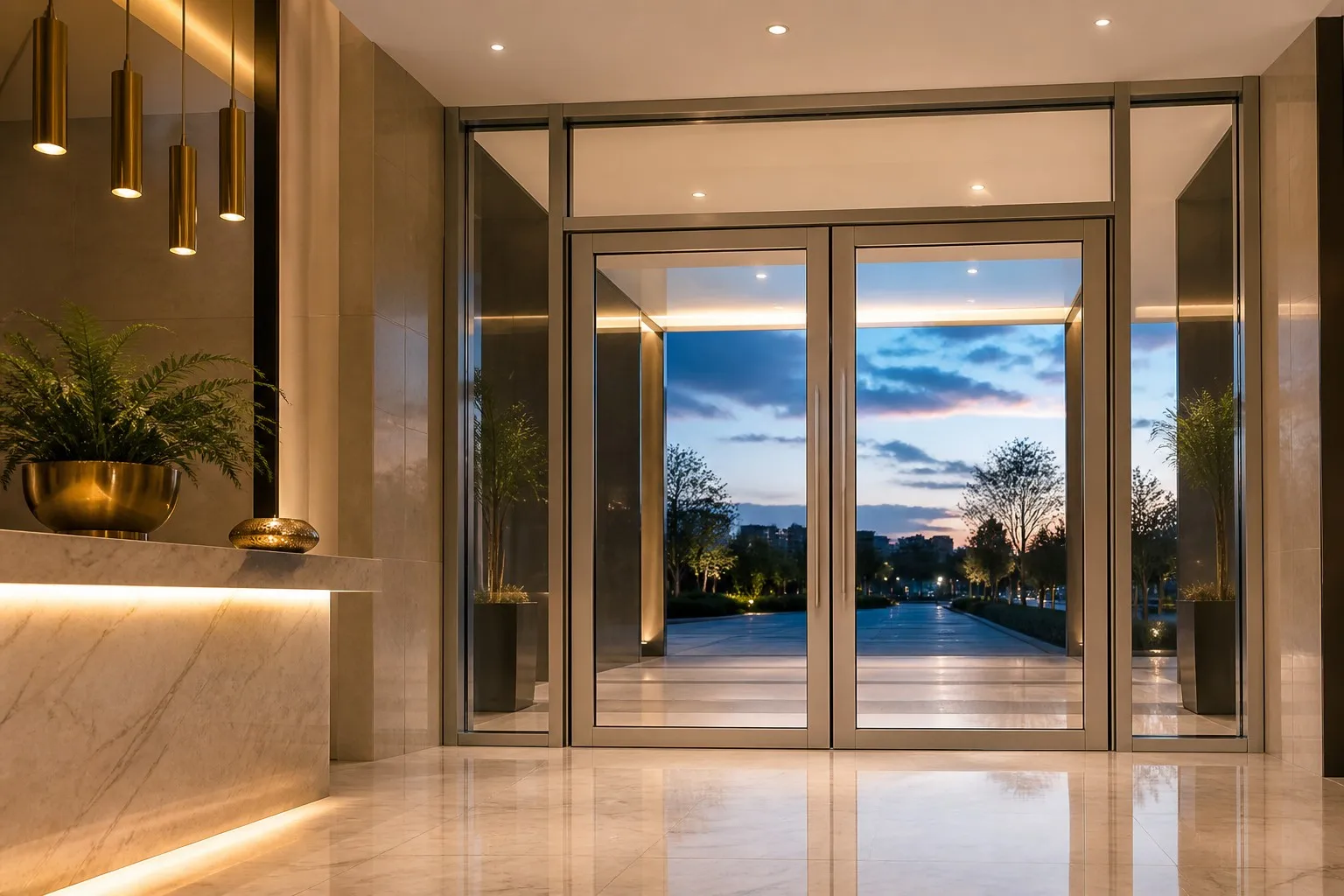
The critical path ran through hardware lead time, not fabrication. Panic devices and floor springs from European and domestic suppliers were ordered at design freeze — before extrusion started — so that the factory assembly line never waited on components. Rogenilan Windows Doors, the Foshan manufacturer behind this project, coordinates exactly this way: hardware schedules are locked at week two, giving a realistic 9-week door-to-site timeline for comparable hotel entrances.
| Configuration | Hardware Package | Indicative FOB (USD/set) |
|---|---|---|
| 3.0m twin-leaf, single active | Multi-point lock + closer | $1,450-1,800 |
| 3.0m twin-leaf + panic bar | EN 1125 panic device + closer | $1,700-2,150 |
| 3.6m full-active pair | Dual panic + auto closer | $2,200-2,800 |
| Automatic sliding entrance (option) | Motion sensor + drive unit | $3,500-4,800 |
Prices are indicative 2026 factory FOB ranges for project volumes, excluding freight and installation. Final quotation depends on leaf size, hardware brand, finish (anodized/powder-coated), glazing spec, and certification documents.
When the opening exceeds roughly 1.6m or guest flow is constant. Double doors split the load between leaves, reduce the chance of both leaves being propped open, and make panic egress simpler because one leaf is often designated the escape leaf with a push bar while the other stays latched.
Not all — but any door on an escape route or serving more than a small occupancy is very likely to require one under EN 1125, NFPA 101, or the local building code. Always confirm the egress classification with the authority having jurisdiction before finalizing hardware. A compliant panic device costs a fraction of a failed inspection.
Aluminum offers lighter operation, better corrosion resistance in coastal climates, and slimmer sightlines that let more daylight into the lobby. With a PA66-GF25 thermal break it also meets modern energy codes — something a steel door without a break cannot easily achieve.
For a standard 3.0m commercial configuration, 8-10 weeks from design approval to FOB delivery is realistic, including extrusion, fabrication, glazing, and testing. Rogenilan Windows Doors locks the hardware schedule at design freeze to keep the timeline predictable.
Panic-bar compliance review · Hardware schedule at design freeze · 2026 FOB quotation in 24 hours.
Request a Quote →Related Articles
Socials

 Casement
Windows
Casement
Windows Sliding
Windows
Sliding
Windows Awning
Windows
Awning
Windows Single/Double
Hung Windows
Single/Double
Hung Windows Tilt
& Turn Windows
Tilt
& Turn Windows Bay
& Bow Windows
Bay
& Bow Windows Folding
Windows
Folding
Windows Picture
Windows
Picture
Windows  Specialty
Windows
Specialty
Windows Exterior Doors
 Stacking Doors
 Folding
Doors
Folding
Doors Double Doors
 Casement
Doors
Casement
Doors Sliding Doors
 Skylight
 Sunroom
 Garage
Door
Garage
Door Curtain
Wall
Curtain
Wall Glass
Railing
Glass
Railing