Richocean Is China’s Trusted Supplier Of
Windows And Doors Manufacturer
Glass does not corrode and does not sag — so when a railing is failing, it is failing where you cannot see it
Request a Quote →Most structural maintenance is driven by visible decay: a joint that is corroding, a seal that is perishing, a fastener that is loosening, each of them showing its condition to the eye over time. A glass railing subverts that model. The glass does not corrode, the aluminium post does not rot, and nothing about it visibly "wears" the way a painted steel joint does. A glass panel that has been fine for six years and one that is about to fail can look identical from three metres away.
That is the reason a glass railing needs an inspection routine rather than a repair habit. The failure modes of a balustrade are not gradual and visible; they are concentrated in a small number of elements, and most of them either are present at the edge of a component where a routine check will find them early, or are sudden and non-negotiable, in which case the inspection routine is what tells you that the element has to be treated as failed even though it still looks sound. The two categories are different, and the maintenance plan has to handle both of them.
There is a further practical reason. A glass railing is at the boundary of the building, in the weather, above a drop, and in the path of every piece of furniture, delivery cart and broom that has ever been moved near it. It takes impacts that a facade panel never sees, and it holds people and objects that a curtain wall never has to carry. The inspection routine exists because the service a railing is asked to perform is a safety performance, and a safety performance has to be checked on a schedule, not confirmed by the absence of a complaint.
| Element | How It Fails | Visible Early | Inspection Point |
|---|---|---|---|
| Glass edge (tempered or laminated) | Chips, nicks and edge cracks from impact; stress concentration that can precede a break | Yes — the edge is the inspection point and a chip is visible at close range | Run a hand and a light along every glass edge, at both the top and the bottom, on the schedule |
| Inter-pane of a laminated panel | UV and heat degrade the interlayer over years; haze or a delaminating line at the edge | Partially — a line or a haze at the glass edge, before it spreads | Look at the edge of the panel against the sky, not the centre of the panel |
| Fixings (clamps, standoffs, bolts) | Vibration and thermal cycling loosen; salt and UV corrode the exposed metal | Partially — corrosion and a moved fastener are visible; a loose-but-clean one is not | Torque-check the fixings on the schedule, not only when they look wrong |
| Post / channel / anchor base | The fixed end loosens or the substrate moves; the glass is only as good as what holds it | Partially — a moved channel or a cracked anchor is visible at the base | Check the base plate, the anchor and the channel at every detailed inspection |
| Finish (anodize / PVDF / powder) | UV and salt attack the surface; exposed aluminium weathers and pits | Yes — the finish change is visible well before the substrate is affected | Look for whitening, pitting or a chalky film on the posts and the channel |
| The glass panel itself (sudden) | A tempered panel can break without a visible precursor; a laminated panel holds together but the interlayer is then gone | No — this is the sudden, non-negotiable case | Not found by inspection; this is why the panel is specified as replaceable, and why the railing is a safety element with a schedule |
The pattern in that table is the design logic of a railing inspection. Four of the six failure modes are visible at close range and are found by a routine walk; one is visible only at the edge of the glass; and one is sudden and cannot be found at all, so it is managed by specification and by the fact that the rest of the railing is known to be sound. The inspection routine exists to find the first five early, and the specification exists to make the sixth a replacement event rather than a collapse event.
The single most useful thing to understand about a glass panel is that its condition is read at the edge, not at the face. A tempered panel carries its strength in the surface and the edge, and it is the edge that takes the impact damage — the chips, the nicks, the small cracks — that concentrate stress and can precede a break. The face of the panel can be spotless and the edge of the panel can be the difference between a panel that is serviceable and one that should be replaced before the next impact.
The glass inspection is a close-range pass along every edge, top and bottom, and it has three specific checks. The first is the edge integrity: a chip or a nick larger than a few millimetres at the edge of a tempered panel is a stress concentrator, and the correct action is to plan the panel's replacement, not to watch it. A small, clean break at the very tip that has not propagated is noted; a chip that is growing between inspections is a panel that is being replaced. The second is the inter-pane condition, where the panel is laminated: a laminated railing panel holds together even when the glass breaks, and the interlayer is what provides that, so the interlayer is a safety element, and it degrades under UV and heat over the years. The sign is a haze or a delaminating line, and it is read at the edge of the panel against the sky, because the edge is where the interlayer is exposed and where the degradation starts.
The third check is the one that separates a safety inspection from a cleaning visit: the difference between a scratch and a crack. A surface scratch is cosmetic; it does not propagate and it does not weaken the panel in any practical sense. A crack is structural, it is at or runs from the edge, and it is the reason the panel is replaced. The way to tell them apart is to look for where the mark starts and how it behaves — a crack starts at the edge or at a chip and runs inward, often with a slight fork; a scratch is on the face and does not trace back to the edge. When in doubt, the mark is treated as a crack and the panel is assessed for replacement, because the cost of replacing a panel that was only scratched is small against the cost of not replacing one that was not.
One more point, because it changes how the glass is specified: the panel should be replaceable as a unit. A railing whose glass is bonded into the channel with an adhesive that cannot be cut, or whose panel is cut to a size that no spare stock matches, has a panel-replacement event that becomes a railing-replacement event. The specification should carry the panel size, the glass build and the fixing method in a way that a spare can be ordered and fitted without disturbing the structure, and that is a maintenance decision made at the purchase, not at the repair.
The fixings are where a railing quietly fails. The clamps, the standoffs and the bolts that hold the glass to the posts and the posts to the substrate are the small elements that carry the whole load path, and they are the elements that loosen with vibration and thermal cycling, and corrode with salt and UV, long before the glass or the posts show anything.
| Fixing Type | What to Check | What It Looks Like When It Is Wrong |
|---|---|---|
| Point-fixed clamps and standoffs | Torque on the bolts, the condition of the standoff boss, the movement of the glass in the clamp | A bolt that is loose to the hand, a standoff boss that has cracked, or glass that has shifted in its clamp and now sits proud of its neighbours |
| Top-fixed (frame) rail | The top-rail bolts to the posts, the glass clip or the EPDM gasket that holds the panel, the continuity of the handrail | A top rail that has dropped at a post, a panel that has shifted in its top clip, or a handrail joint that has opened |
| Channel-fixed (base) glass | The channel bolts to the substrate, the glass bed and the EPDM channel gasket, the anchor and the base plate | A channel that has pulled away from the substrate, a cracked base plate, or an anchor that has corroded through |
The checking action is a torque check on the schedule, not a look. A loose fastener that is clean and does not catch the eye is still loose, and the only reliable test is the torque wrench against the specified value, or at minimum a firm hand-check against a fastener that is known to be correct. The corrosion check is the metal itself: the fixings of a railing are stainless, SUS304 as the minimum grade and SUS316 in the coastal and industrial exposure, for the same reason as across the product line, and the check is for the whitening and the pitting that precede a corroded-through fastener. Where the fixings are SUS304 in a location that is clearly salt-exposed, the inspection note should say so, because that is a specification that is running on a shorter clock than it was bought for.
The thermal-cycling part of the loosening is the reason the schedule matters rather than the condition. Aluminium and glass and stainless expand at different rates, and a railing on a roof or an external stair sees a daily temperature swing that a facade does not, and that swing works on every fastener every day. A fastener that is torqued correctly in spring and checked correctly in autumn will be found to have moved, on a long run, not because anything is wrong but because the structure has been working, and the re-torque on the schedule is the service that keeps the working structure held.
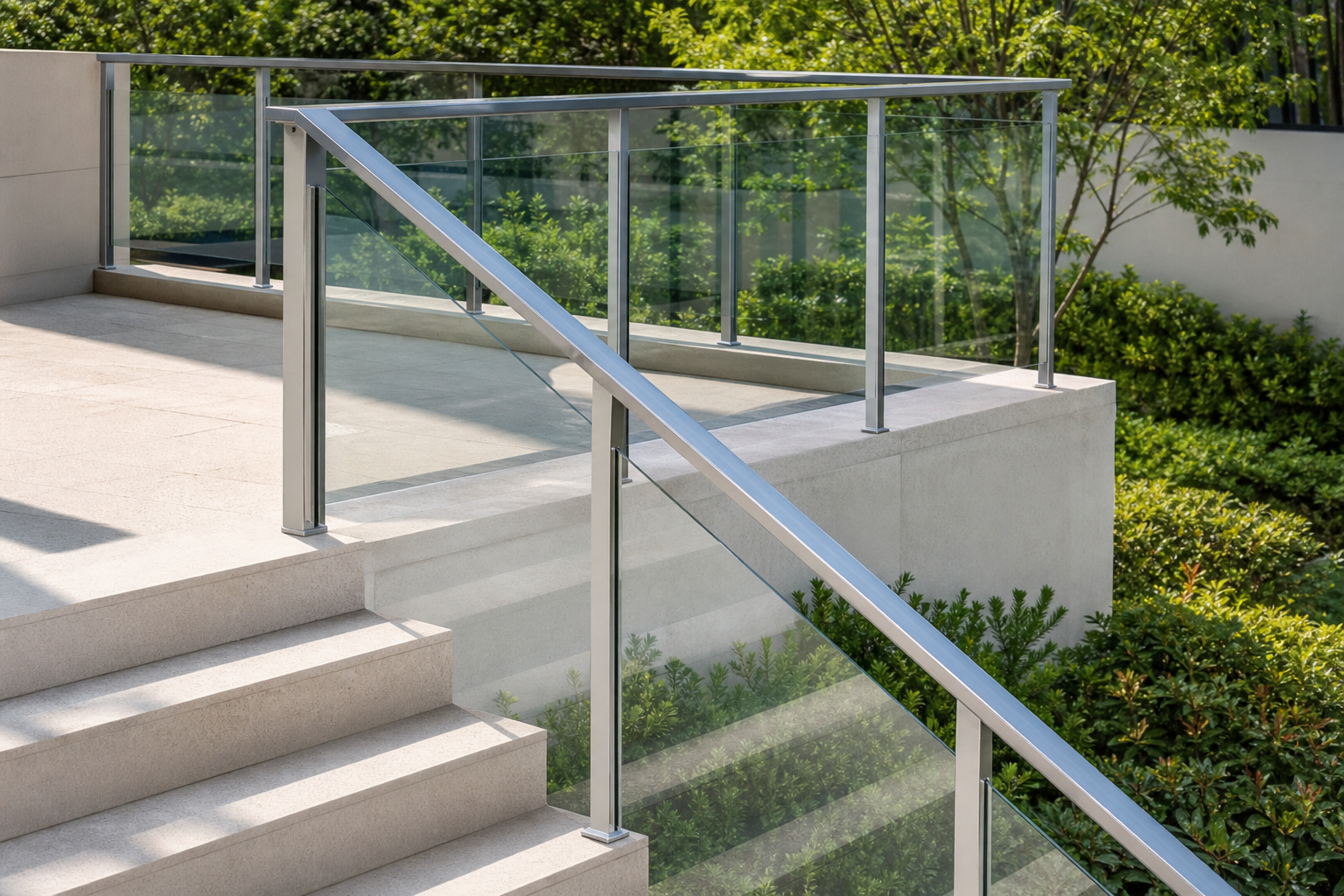
The glass and the fixings are only as good as the structure they are fixed to, and the base of a railing is where that structure meets the building. A post is anchored to a base plate, the base plate is fixed to the substrate with anchors, and the channel, where used, is bolted to the slab or the screed. That is the end of the load path, and it is the end that sees the most abuse: it is where the water pools, where the debris collects, where the broom and the delivery cart and the dropped tool all land, and where the substrate itself can move, crack or lose its anchor over the life of the building.
The base inspection has three checks. The anchor and the base plate: is the plate flat, is the anchor sound, is there any sign of the plate pulling away from the substrate, which is the sign of a substrate that is moving or an anchor that is failing. The the channel, where the glass is channel-fixed: is the channel bolt line intact, is the channel still true, and is the EPDM gasket that seats the glass in the channel still in place and elastic, because a perished channel gasket is a glass panel that is sitting on metal with no compliant layer between it and the substrate. The the drainage at the base: a railing base that is also a water path, on a roof or an external landing, has to drain, and a base that has been standing in water is a base that is corroding its fixings from below, which is the failure the surface inspection never finds.
Where the railing runs along a facade that has a thermal-break system, the base of the railing is also a thermal detail: the posts and the channel that penetrate the facade line have to be detailed so that they do not bridge the break, and the PA66-GF25 spacer that keeps the interior and exterior faces of the frame separate is the element that the railing penetration has to respect. A railing base that is bolted straight through a thermal-break facade without the spacer detail is a railing that is also a thermal bridge, and the inspection should note it, because it is a detail that was missed at the design and that no amount of glass cleaning will fix.
The cycle is set by the exposure and the duty. A railing on a shaded internal-adjacent terrace is inspected less often than one on a rooftop or a coastal external stair, and a railing that is a designated escape route is inspected more often than one that is a boundary for furniture, because the escape route is a safety element under constant low-level load and a fixed inspection obligation in most building-by-law regimes. The schedule below is the working form, and the post-event line is the one that is non-negotiable: after any impact, the panel and the fixings are inspected before the railing is relied on again, regardless of where the impact landed in the calendar.
| Interval | Tasks | Why Now |
|---|---|---|
| Post-event | After any impact, dropped object or heavy load, inspect the struck panel, its edge and its fixings before the railing is relied on again | A struck tempered panel is a panel of unknown residual strength; the inspection decides replace-or-keep |
| Every 6 months | Walk the run; close-range pass along every glass edge (top and bottom); look at the inter-pane edge against the sky; note any chip, crack or haze; clean the glass and the channel | The glass edge and the inter-pane edge are the two visible failure precursors, and they are found at close range |
| Annually | Torque-check the fixings against the specified value; check the channel bolts and the base plate and the anchors; check the EPDM gaskets for perishing; check the finish for whitening, pitting or chalk; check the base drainage | The fixings and the base are the load path, and the thermal cycle has worked on them through the year |
| Every 3 to 5 years | Detailed inspection: re-torque the full fixing line, replace any perished gasket, replace any panel with a growing edge chip or an inter-pane haze, re-verify the anchors where the substrate has moved, and record the condition of the run | The gasket and the interlayer are the consumables of a railing; the anchor is checked against the substrate, not the glass |
Cleaning is part of the inspection, because a dirty panel hides the edge and a dirty channel hides the gasket, and the routine should do both in one pass. The rules are short, and they exist because the things that clean glass aggressively are the things that destroy the rest of the railing. The glass is cleaned with a neutral, non-abrasive cleaner and a soft cloth or squeegee, and the edge is wiped as part of the pass so the edge check and the clean are the same visit.
What is not used is the list that matters. No acid-based glass or stone cleaners on a railing that has aluminium posts, a channel or stainless fixings, because the acid that cuts through a hard water deposit cuts through an anodize and pits a PVDF film in the same pass. No abrasive pads, no wire wool and no stiff scrubbers on the glass edge or the finish, because the scratch that is being removed is the one that is being added to the panel or the post. No high-pressure water at the fixings or the channel, because the jet that clears the debris drives it into the gasket line and the anchor line, and pressurizes the base that is supposed to drain, which is how a clean railing gets a corroded base. The cleaning is a neutral, low-pressure, close-range pass, and it is done so that the next inspection starts from a panel that can actually be read.
It is worth stating plainly, because it is the question a buyer asks and the answer that separates a specification from a brochure. There is no international standard that says "inspect a glass railing every N months." The performance standards — AS 1288 for the glass, EN 1991-1-1 for the imposed load, EN 1993 for the aluminium structure, and the product standard that the railing is built to — define what the railing must carry and how the glass must be made, and they do not define the inspection interval. The interval comes from two places instead: the building-by-law and the asset-management regime of the destination, which in most jurisdictions sets the inspection obligation for a safety element such as an escape-route balustrade, and the manufacturer's documentation, which is where the torque values, the gasket life and the glass build are recorded and where the proposed interval should live.
That is why the purchase checklist below includes the documentation as a line item. A glass railing delivered without its torque values, its fixing schedule, its glass build and its proposed inspection interval is a railing whose maintenance is a guess, and the guess is made by whoever is holding the broom. The correct specification carries the interval, the torque and the gasket life on paper, so that the six-month walk and the annual torque check are executing a documented procedure rather than inventing one.
The coastal and industrial environment shortens the clock on the two elements that are not the glass: the fixings and the finish. The salt-laden air attacks the exposed stainless and the surface treatment, and the industrial atmosphere attacks the finish with a chemistry that a clean-air location never sees. The specification for the exposure is the same as across the product line — SUS304 as the minimum fixing grade and SUS316 in the direct-spray and industrial zone — and the maintenance consequence is that the finish and the fixings are inspected on the shorter of the two schedules, the coastal one, even where the glass itself is unaffected. A railing whose glass is perfect and whose fixings are pitting is a railing that is being inspected on the wrong clock, and the exposure, not the glass, is what sets the interval.
Two details are the coastal ones, because they are where the salt concentrates. The the base and the channel, where the water pools and the salt dries, are where the corrosion starts and where the drainage check in the base inspection earns its line. The the anodize or the PVDF film on the posts is the first visible sign, the whitening and the chalk, and it is the warning that the substrate is about to be reached. The inspection that finds the finish change early is the inspection that converts a coating problem into a note, and the inspection that misses it is the one that finds pitting instead.
| Standard | Scope | Used For |
|---|---|---|
| AS 1288 | Glass in buildings — Australia and New Zealand | The glass build, the thickness and the impact category of the panel |
| EN 12600 | Safety of glass in building — impact test, Europe | The impact class of the panel, read with the letter, not just the number |
| EN 1991-1-1 | Eurocode 1 — actions on structures, imposed loads | The line load the handrail carries, which the fixings and the base must hold |
| EN 1993-1-1 | Eurocode 3 — design of aluminium structures | The post, the channel and the base plate, the aluminium structure the glass sits on |
| AS 1657 | Fences, balustrades and handrails — Australia | The balustrade height, the gap and the load for the destination market |
| NFPA 101 / local building code | Life-safety and egress, North America and beyond | The escape-route duty that sets the inspection obligation, where the railing is on an egress path |
| Configuration | Basis | Indicative FOB (USD) |
|---|---|---|
| Glass balustrade, channel-fixed, 12 mm tempered | 6063-T5/T6 post, SUS304 fixings, EPDM gasket | $140-240 /lm |
| Glass balustrade, point-fixed, laminated | UV-stable interlayer, standoff, SUS304 fixings | $190-320 /lm |
| Coastal spec, SUS316 fixings, PVDF finish | Direct-spray and industrial exposure | $260-430 /lm |
| Replaceable-panel detail (cuttable channel, spare size) | Panel as a unit, recorded build | +$15-40 /lm |
| Spare glass panel (matched build and size) | Per panel, to the recorded build | $40-90 /panel |
| Re-torque and re-fixing service pack (gasket + fixing set) | Per run, the 3-5 year consumables | $25-60 /lm |
| Base drainage detail | Channel and base that drains, documented | +$10-30 /lm |
| PA66-GF25 thermal-break spacer at the facade penetration | Where the base crosses a thermal-break facade | +$8-20 /post |
| Panel marking and documentation pack | Panel ID, torque schedule, gasket life, interval | Included, or +$200-500 /design |
Prices are indicative 2026 factory FOB ranges for project volumes, excluding freight and site installation. The maintenance adders are the ones that convert a railing into one whose upkeep is a procedure: the replaceable-panel detail, the recorded torque values, the replaceable gasket, the base drainage, the panel mark and the documentation pack are all priced separately because they are design and specification decisions, not standard features. Final quotation depends on the fixing type, the glass build, the finish and the fixing grade, the base detail, the thermal-break spacer where used, and the documentation and interval pack required. Contact Rogenilan Windows Doors for a glass railing whose maintenance is a documented schedule, not a guess.
By where it starts and how it behaves. A surface scratch is cosmetic, it is on the face and it does not trace back to the edge. A crack is structural, it starts at the edge or at a chip and it runs inward, often with a slight fork. The test is to look for the origin: a mark that runs from the edge is treated as a crack and the panel is assessed for replacement. The cost of replacing a panel that was only scratched is small against the cost of not replacing one that was not.
No, and that is the honest answer. The performance standards — AS 1288, EN 12600, EN 1991-1-1, EN 1993 — define what the railing must carry and how the glass must be made, but not the inspection interval. The interval comes from the building-by-law and asset-management regime of the destination, which sets the obligation for a safety element such as an escape-route balustrade, and from the manufacturer's documentation, which is where the torque values, the gasket life and the proposed interval should be recorded. A railing delivered without that documentation is a railing whose maintenance is a guess.
Because aluminium, glass and stainless expand at different rates, and a railing on an external stair or a roof sees a daily temperature swing that works on every fastener every day. A fastener that is torqued correctly in spring will be found to have moved by autumn, not because anything is wrong but because the structure has been working. The clean, loose fastener is the one the eye misses, and the torque wrench against the specified value is the check that does not.
A neutral, non-abrasive cleaner and a soft cloth or squeegee, with the edge wiped as part of the same pass. What is not used is the list that matters: no acid-based glass or stone cleaners on the aluminium and stainless, no abrasive pads or wire wool on the glass edge or the finish, and no high-pressure water at the channel or the base, which drives the debris into the gasket and the anchor line and pressurizes the base that is supposed to drain.
Yes, where the balustrade runs along a glazed boundary that also carries an opening or a sliding screen section, that section is part of the railing run and follows the product line's operating-gear families — SIEGENIA and ROTO in the operator and control gear, HOPO in the opening hardware — with the Low-E surface of the screen glass chosen for the heat gain on the open terrace. The operator, the limit and the weatherproof seal are added to the inspection set, and where the section is on a controlled system its open, closed and fault state is reported over RS485/Modbus or KNX to the building management system, so that a screen section caught open at the boundary of the building is an event the system can act on, not a surprise found in the morning.
A replaceable glass panel with the build recorded · the glass edge and the inter-pane edge as the inspection points · torque values on paper for every fixing · SUS304 fixings minimum, SUS316 in the coastal and industrial zone · replaceable EPDM channel and top-clip gaskets with a life · a base that drains, documented · 6063-T5/T6 posts and channel, 1.4-5.0 mm wall thickness, anodize or PVDF to the exposure · the PA66-GF25 spacer where the base crosses a thermal-break facade · a panel mark and the proposed inspection interval in the documentation · 2026 FOB pricing in 24 hours.
Request a Quote →Related Articles
Socials

 Casement
Windows
 Sliding
Windows
 Awning
Windows
 Single/Double
Hung Windows
 Tilt
& Turn Windows
 Bay
& Bow Windows
 Folding
Windows
 Picture
Windows
 Specialty
Windows
 Exterior Doors
 Stacking Doors
 Folding
Doors
 Double Doors
 Casement
Doors
 Sliding Doors
 Skylight
 Sunroom
 Garage
Door
 Curtain
Wall
 Glass
Railing