Richocean Is China’s Trusted Supplier Of
Windows And Doors Manufacturer
Why a folding window is a structural chain, not a set of hinged panels
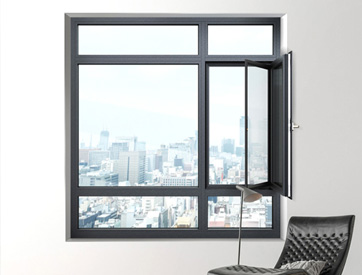
Request a Quote →People compare a folding window with a casement or a sliding unit and assume the difference is cosmetic. It is not. In a casement window, each sash carries its own load to the frame through its own hinges and locking points. In a folding window, the panels are joined end to end, and the whole assembly behaves as a chain: the load from the outermost panel travels through every intermediate hinge and stile before reaching the frame and the structure.
That means a folding window is only as strong as its weakest link in the chain — usually a hinge pin, a stile section that has been lightened to save weight, or a fastener that was not anchored into the reinforced part of the profile. When a folding window fails in service, it almost never fails by glass breaking. It fails by a hinge loosening, a stile deflecting, or the assembly dropping out of square so the panels no longer close against their seals.
This guide explains the engineering that decides whether a folding window from Foshan works for ten years or starts to sag in the second.
Every component in a folding window is sized against the sash load — the weight of one panel including glass, profile, and gaskets. Double glazing is roughly 5 kg/m2 per pane, so a 6+12A+6 unit is around 30 kg/m2 of glass alone before the frame is counted.
| Panel Size | Glazing | Approx. Sash Weight | Typical Hinge Rating Needed |
|---|---|---|---|
| 600 × 900 mm | 6+12A+6 double | 18-24 kg | 30 kg rated hinge |
| 800 × 1200 mm | 6+12A+6 double | 32-42 kg | 50 kg rated hinge |
| 900 × 1500 mm | 6+12A+6 Low-E | 48-62 kg | 80 kg rated hinge |
| 1000 × 1800 mm | 6+12A+6 triple or laminated | 70-95 kg | 120 kg rated hinge or split hinge set |
Two rules follow from the table. First, the rated capacity must exceed the sash weight with margin — a hinge rated exactly at the sash weight will fatigue early, because the rating already assumes ideal alignment and no wind or handling loads. Second, as panels get taller, the load does not just increase; it shifts further from the hinge axis, which multiplies the moment on the hinge pin and the fixing screws. Tall folding panels are where the engineering decisions matter most.
Hinge failure is the most common complaint in folding window systems, and it usually comes from one of four causes.
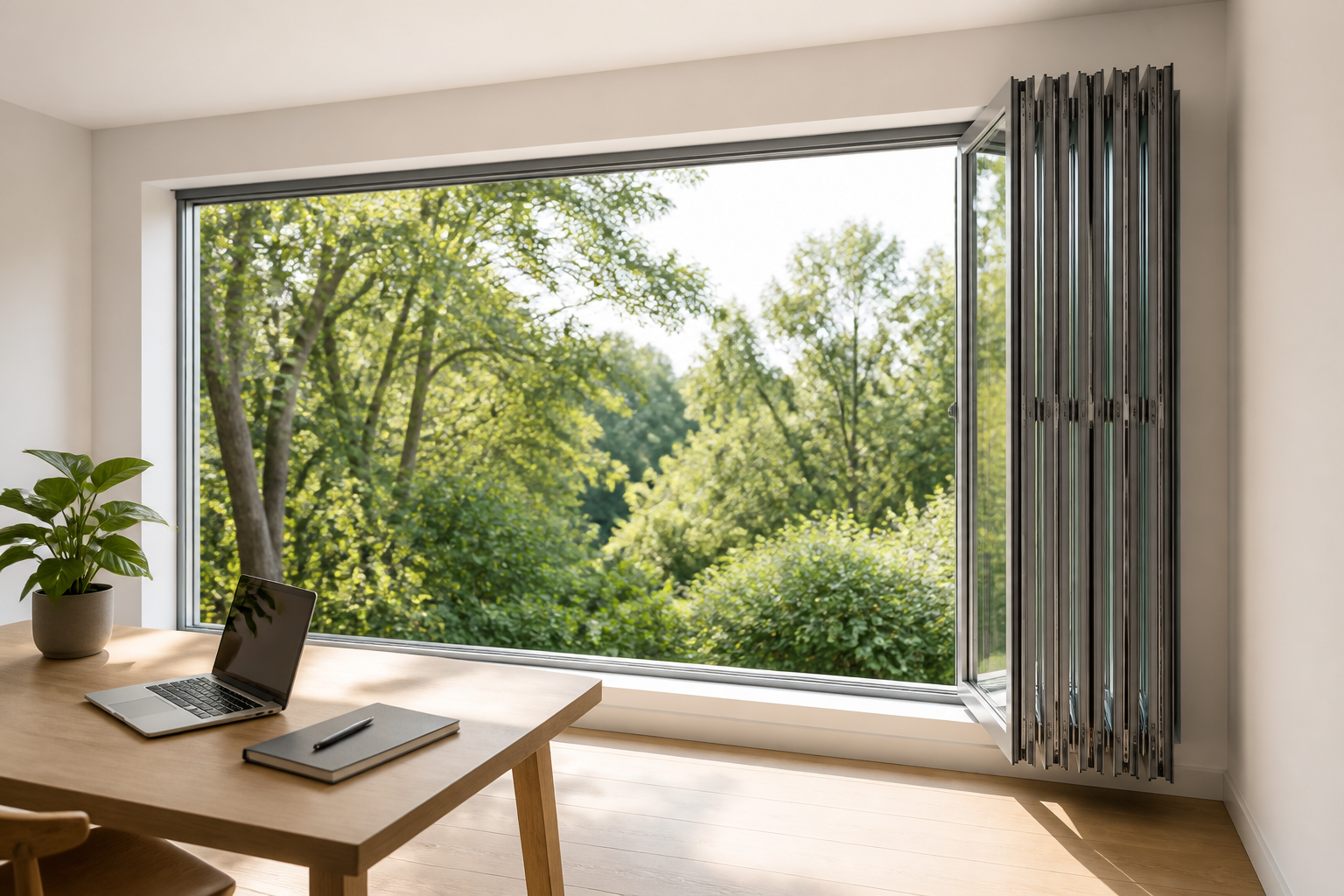
The stiles — the vertical members of each panel — are the structural backbone of a folding window. They carry the glass weight down to the sill, resist wind pressure across the panel, and transfer load between adjacent panels at every hinge.
| Parameter | What It Controls | Typical Specification |
|---|---|---|
| Profile wall thickness | Bending stiffness and screw holding | 1.4-5.0 mm depending on position and load |
| Alloy and temper | Strength and formability | 6063-T5/T6 |
| Thermal break | U-value and condensation control | PA66-GF25 continuous through the stile |
| Reinforcement | Deflection under wind load and hinge anchoring | Steel or aluminium insert in hinge and lead stiles |
| Deflection limit | Keeping the assembly in square | Span/300 or tighter for hinged panels |
The deflection limit deserves emphasis. A fixed window can tolerate a little more flex because its glass sits in a rebate and its seals are compressed uniformly. A folding window cannot: if a stile deflects, the hinge geometry changes, the adjacent panel moves with it, and the closing joint stops meeting its seal. Stiffness in the stiles is what keeps a chain of panels closing as one unit rather than as several slightly misaligned ones.
Folding windows face two distinct load cases, and specifications often address only one.
On a folding window (as opposed to a folding door), the panels are usually lighter and shorter, so the open-condition risk is smaller — but it is not zero in exposed or high-rise locations. Ask the factory how the stack is restrained and what the parking load case is, especially for anything above three panels.
A folding window has the highest frame-to-glass ratio of any opening type and the most compression joints per square metre. Without a continuous PA66-GF25 thermal break through every stile and a properly designed gasket at each closing joint, the folding window will be the coldest surface in the room and the place condensation appears first.
Three points to verify: the thermal break must run continuously through the hinge stile (it cannot be interrupted where the hinge mounts); the gaskets must compress on both sides of every closing joint; and the glazing should match or exceed the performance of the adjacent fixed glazing, or the folding window becomes the reason the room misses its energy target.
| Configuration | Typical Use | Indicative FOB (USD/m²) |
|---|---|---|
| 2-3 panel folding window, double glazed | Residential openings, small terraces | $165-240 |
| 4-6 panel folding, Low-E argon | Wide residential openings | $205-295 |
| Multi-panel commercial folding window | Cafés, retail, hospitality | $255-385 |
| High wind-load / coastal specification | Exposed and tall buildings | $310-450 |
| Motorised folding window | Automated ventilation, high use | $400-600 |
Prices are indicative 2026 factory FOB ranges for project volumes, excluding freight and installation. Final quotation depends on panel count and size, glass build, wind-load class, hinge specification (SIEGENIA, ROTO, HOPO), thermal performance target, and certification documents. Contact Rogenilan Windows Doors for a specification-matched quote.
There is no hard ceiling, but every additional panel adds a hinge, a joint, and a potential misalignment point. For windows (as opposed to full-height doors), three to six panels is the practical sweet spot for most residential applications. Longer runs are usually split into two folding groups so each has its own parking zone and no single chain of panels becomes too long to keep in square.
They can, if the hinges are undersized for the sash weight, the fixing does not anchor into a reinforced zone, or the stile deflects under load. Correctly specified folding windows with stainless hinges rated above the sash weight and a continuous thermal break should hold their alignment for the life of the seals. Sagging is a specification and installation problem, not an inherent property of the system.
Generally slightly less so, because a folding window has more joints per square metre and each joint is a potential leak path. A well-engineered system with EPDM gaskets compressing on both sides of every closing joint and correctly aligned hinges gets close to casement performance, but it will rarely beat it. If airtightness is the priority and opening is occasional, a casement is the simpler answer.
Hinge and roller lubrication at the manufacturer's intervals, cleaning of the track and drainage path, gasket treatment to keep seals elastic, and a periodic check that fixing screws in the hinge zone have not worked loose. On a system opened daily, an annual inspection of hinge play and panel alignment is worth scheduling, since realigning early is far cheaper than replacing a worn hinge later.
Yes. Motorised folding systems use actuators to drive the fold and unfold sequence, with the same RS485/Modbus or KNX control options used for other powered windows. The engineering constraints are the actuator's duty cycle and torque margin against the friction of the folding chain, plus the manual override requirement for power failure — the same points covered in our electric window maintenance guide.
6063-T5/T6 thermally broken profiles · continuous PA66-GF25 breaks · SUS304/316 hinges with stated cycle ratings · reinforced hinge stiles · AS2047 / EN 14351-1 references · shipped assembled and cycle-tested · 2026 FOB pricing in 24 hours.
Request a Quote →Related Articles
Socials

 Casement
Windows
 Sliding
Windows
 Awning
Windows
 Single/Double
Hung Windows
 Tilt
& Turn Windows
 Bay
& Bow Windows
 Folding
Windows
 Picture
Windows
 Specialty
Windows
 Exterior Doors
 Stacking Doors
 Folding
Doors
 Double Doors
 Casement
Doors
 Sliding Doors
 Skylight
 Sunroom
 Garage
Door
 Curtain
Wall
 Glass
Railing