Richocean Is China’s Trusted Supplier Of
Windows And Doors Manufacturer
A scheduled-care routine that keeps motorised windows working past year five
Request a Quote →When an intelligent aluminum glass electric window stops working in the field, the actuator is usually the innocent party. In the service reports we see from export projects, the failures cluster in four places: a seal that stiffened and overloaded the drive, a bus wiring fault that the installer blamed on the motor, a power supply that browned out under load, and a mechanism that was never lubricated because nobody considered a motorised window to be "maintainable".
That is the argument for treating a smart window like any other building service: it needs a schedule. The routine below is what we recommend to project owners specifying motorised windows from Foshan, written to be handed directly to a facility team.
| Interval | Task | Why It Matters |
|---|---|---|
| Monthly | Full open/close cycle test on every powered sash | Catches a stiff seal or blocked track before the drive is damaged |
| Monthly | Listen and watch for uneven travel or hesitation | Early sign of binding, misalignment, or failing torque limit |
| Quarterly | Clean and re-treat EPDM gaskets and glazing seals | Stiff rubber is the single largest cause of actuator overload |
| Quarterly | Clear drainage channels and weep holes | Standing water corrodes the mechanism and destroys seals |
| Quarterly | Inspect track, rail and chain/rack for debris | Debris raises drive current and shortens actuator life |
| Annually | Lubricate mechanism per manufacturer's specification | Correct lubricant only — wrong grease attacks seals and plastics |
| Annually | Check actuator fixing bolts and hinge/stay torque | Loosened fixings misalign the sash and load the drive |
| Annually | Verify power supply voltage under load and battery/UPS health | Brownouts are a hidden cause of "intermittent" operation |
| Annually | Test rain, wind and smoke-sensor interlocks | These are life-safety and weather-protection functions |
| Annually | Export and archive the control configuration | Recovers a system after a controller replacement |
Every electric window actuator has a duty cycle — typically expressed as a percentage of run time per unit of time, or as a maximum number of starts per hour. A window used twice a day sits far inside any reasonable duty rating. The same actuator installed on an automated facade that cycles on every rain event, or on a smoke-vent system that self-tests hourly, can sit outside it.
Two practical consequences for maintenance:
On a smart window system the glazing and frame will outlast the controls, and the controls are where faults collect. Two integration approaches dominate Chinese export projects, and each has its own maintenance checklist.
| Check | RS485 / Modbus | KNX |
|---|---|---|
| Bus integrity | Confirm termination resistors, A/B polarity, shielding and drain | Verify bus voltage and that no line is overloaded or unterminated |
| Addressing | Check for duplicate slave IDs after any controller replacement | Confirm physical addresses and group addresses still match the project file |
| Documentation | Keep the register map and baud/parity settings on site | Keep the ETS project file and a current backup |
| Manual override | Test local switch/dry-contact override independent of the bus | Test local override and confirm it survives controller failure |
| Failure mode | Decide whether windows fail open, closed, or hold position | Same decision, configured per group and documented |
One rule applies to both: a motorised window must remain operable when the control system does not. Every powered sash should have a local override or manual release that works with the bus down, the controller dead, and the network unplugged. If that test fails during commissioning, it will fail far more expensively during a fire alarm or a storm.
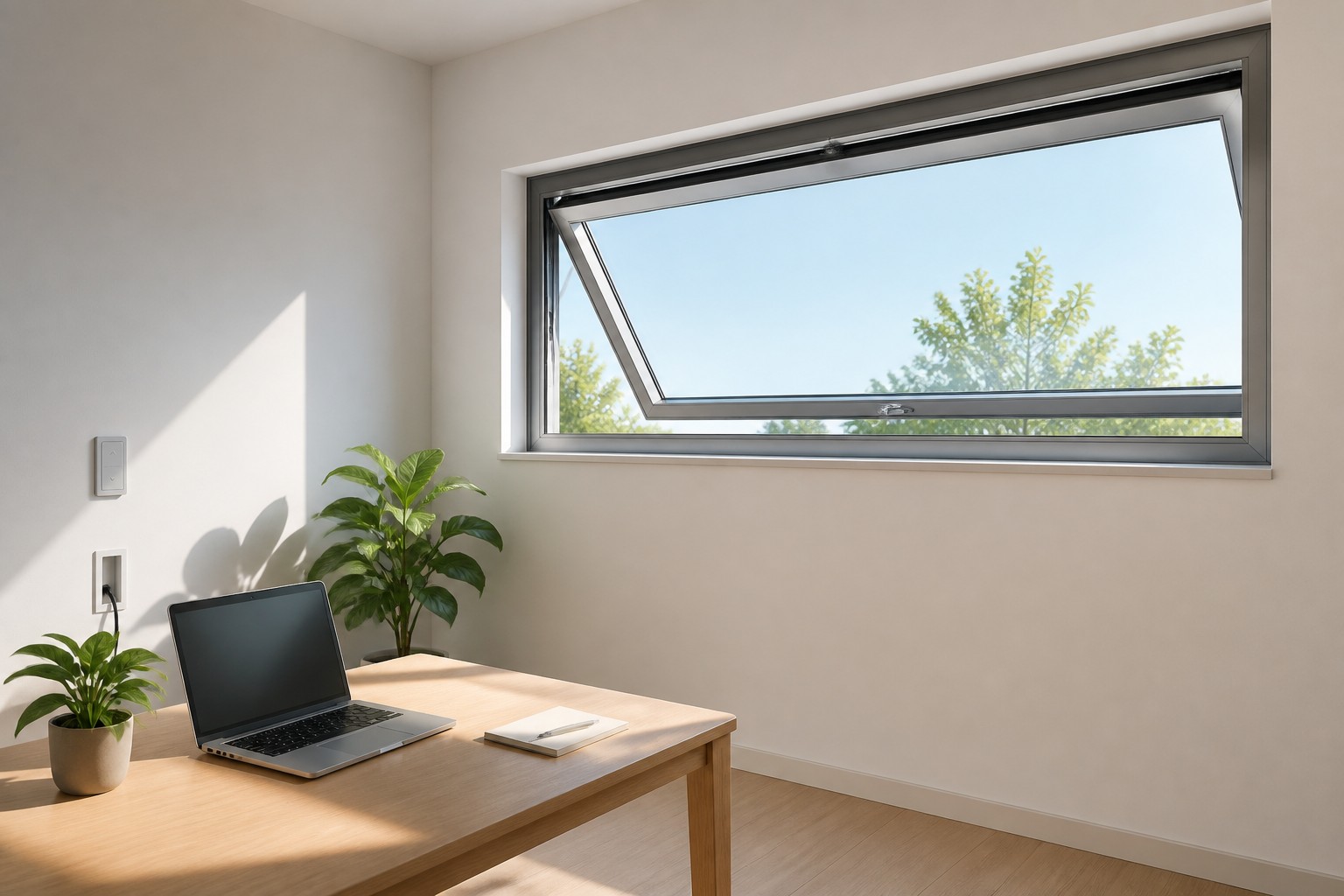
Everything a manual window needs, an electric window needs — plus more frequent attention, because a stiff mechanism transfers load straight into the actuator instead of into the operator's arm.
| Symptom | Likely Cause | Action |
|---|---|---|
| Window stops mid-travel and reverses | Obstacle detection or torque limit tripping on friction | Clean and service gaskets/track; check alignment before adjusting limits |
| Works locally, not from the control system (or vice versa) | Bus fault, addressing conflict, or override left engaged | Verify bus termination, addresses, and local override state |
| Intermittent operation, no pattern | Voltage drop under load or loose supply terminals | Measure supply voltage while the actuator is running, not at rest |
| Audible strain, slow travel | Binding, dry mechanism, or debris in the track | Service mechanism with specified lubricant; remove debris |
| Water ingress near actuator or frame | Blocked weep holes or failed perimeter sealant | Clear drainage, renew sealant, inspect actuator IP seal |
| All windows unresponsive after a power event | Controller reset lost configuration | Restore from the archived configuration; re-verify group addressing |
Rogenilan Windows Doors, a Foshan factory supplying motorised window systems to Europe, Australia, and North America, ships electric and intelligent window systems built on 6063-T5/T6 thermally broken profiles with PA66-GF25 breaks, IP-rated actuators, RS485/Modbus and KNX control options, local override on every powered sash, and rain/wind/smoke interlock support. Each order includes actuator documentation, protocol references, wiring diagrams, and a configuration backup for the project's facility team.
| Configuration | Typical Use | Indicative FOB (USD/m²) |
|---|---|---|
| Manual aluminium glass window (baseline) | Comparison reference | $150-215 |
| Single-point electric actuator, local switch | Hard-to-reach high windows | $260-380 |
| Electric + RS485/Modbus control, rain/wind sensor | Automated ventilation, facades | $340-480 |
| Electric + KNX integration, smoke interlock | Smart buildings, EU projects | $400-580 |
| Large-format motorised vent window | Atria, stairwells, smoke venting | $460-680 |
Prices are indicative 2026 factory FOB ranges for project volumes, excluding freight and installation. Final quotation depends on glass build, unit size, actuator selection, control protocol (RS485 / KNX), sensor package, and certification documents. Contact Rogenilan Windows Doors for a specification-matched quote.
Test every powered sash monthly with a full open and close cycle, service gaskets and drainage quarterly, and carry out a full annual service covering lubrication, fixing torque, supply voltage under load, battery health, and sensor interlocks. Windows on automated schedules that cycle daily need the gasket and track checks taken more seriously than a window opened twice a week, because the annual cycle count is an order of magnitude higher.
A well-designed system provides a local manual release or override that works with the bus down and the controller dead. This should be confirmed at commissioning, tested during the annual service, and documented per window in the operating manual. If a supplier cannot describe the manual override procedure, treat that as a specification gap rather than a detail to sort out on site.
Almost always friction tripping the torque limit or obstacle detection: hardened gaskets, a dry or contaminated track, or a sash that has drifted out of alignment. The correct sequence is to service the seals and track and re-check alignment first, then verify the limit settings — not to raise the torque limit, which masks the friction and consumes actuator life.
RS485/Modbus is simpler and cheaper, with a register map that most building management systems can read; KNX costs more but integrates cleanly with lighting, HVAC, and shading in a single addressed bus, which suits European projects where KNX is already specified. Either can drive rain, wind, and smoke interlocks. The maintenance difference is mostly documentation: keep a register map for RS485, and keep an ETS project file plus backup for KNX.
No — the thermal performance comes from the frame and glazing, not the controls. A motorised window on a 6063-T5/T6 profile with a continuous PA66-GF25 thermal break and a Low-E argon-filled unit performs essentially the same as the manual version of the same system, provided the cable penetrations are properly sealed. That sealing detail is worth checking at installation: an unsealed cable route through the frame introduces both an air leak and a cold bridge.
6063-T5/T6 thermally broken frames · PA66-GF25 breaks · IP-rated actuators · RS485/Modbus & KNX control · local override on every sash · rain/wind/smoke interlocks · 2026 FOB pricing in 24 hours.
Request a Quote →Related Articles
Socials

 Casement
Windows
 Sliding
Windows
 Awning
Windows
 Single/Double
Hung Windows
 Tilt
& Turn Windows
 Bay
& Bow Windows
 Folding
Windows
 Picture
Windows
 Specialty
Windows
 Exterior Doors
 Stacking Doors
 Folding
Doors
 Double Doors
 Casement
Doors
 Sliding Doors
 Skylight
 Sunroom
 Garage
Door
 Curtain
Wall
 Glass
Railing