Richocean Is China’s Trusted Supplier Of
Windows And Doors Manufacturer
The multi-point lock is only as strong as the two points a burglar actually attacks
Request a Quote →A tilt-turn window with a multi-point lock is sold as a security system, and on paper it is one. In practice a burglar does not attack a window the way a rating table describes. The rating describes time-to-defeat of a whole assembly under sustained, tool-based attack. The burglar attacks the two points where that time collapses, and on a tilt-turn window those two points are the profile cylinder on the handle side and the hinge side where the sash can be lifted or removed. Harden one of the two and the attack simply moves to the other.
What makes a tilt-turn window different from a casement is that the sash exists in two positions — tilt (top edge released, bottom on the stay) and turn (hinged, full opening) — and the security of the sash in each position is provided by different hardware. A sash in tilt is held at the bottom by the stay and is only partially locked, so it is a different target from the same sash in the closed, multi-point-locked turn position. Most security specifications address the fully closed position and say nothing about the tilt position, which is exactly the position a burglar works in first, because it is the easiest.
This article sets out the cylinder attack and the hinge-side attack separately, the specific hardware that resists each, how the glass fits into the time calculation, and what to specify so that no single cheap element caps the class you paid for.
| Attack Method | What It Does | Resisting Hardware | Notes |
|---|---|---|---|
| Picking | Manipulates the pins to the set position without the key | High-pin-count profile (12 or more pins), anti-pick pinning | Fast on a 6-pin cylinder; slower and less certain on 12-plus |
| Bump key | A spring-loaded key transmits a shock that lifts the pins simultaneously | Hardened, anti-bump profile with a robust spring and tight tolerances | Can defeat many standard profile cylinders in seconds |
| Snap | Torques the cylinder so it shears, exposing the gearbox | Anti-snap cylinder with a shearing-resistant core and protected gearbox | A standard cylinder snaps to let the attacker bypass the pick entirely |
| Drill | Destroys the pins or the spindle to release the lock | Hardened steel drill-resistant core, drill plates over the gearbox | The single most common forced-entry method; small drill, low skill |
| Pull-out / removal | Unbolts the cylinder from the frame | Security screw, long captive screw, tamper-resistant fixing | Often overlooked; a standard screw head is the weakest link of all |
The order of rows is roughly the order in which a determined attacker tries them, and it is worth reading carefully. The drill row is the one that matters most for a tilt-turn window, because it is fast, it needs only a small power tool, and it targets the exact point where the multi-point lock is anchored. A hardened core and a drill plate over the gearbox move the drill attack from seconds to several minutes, and those several minutes are what an RC rating is built on.
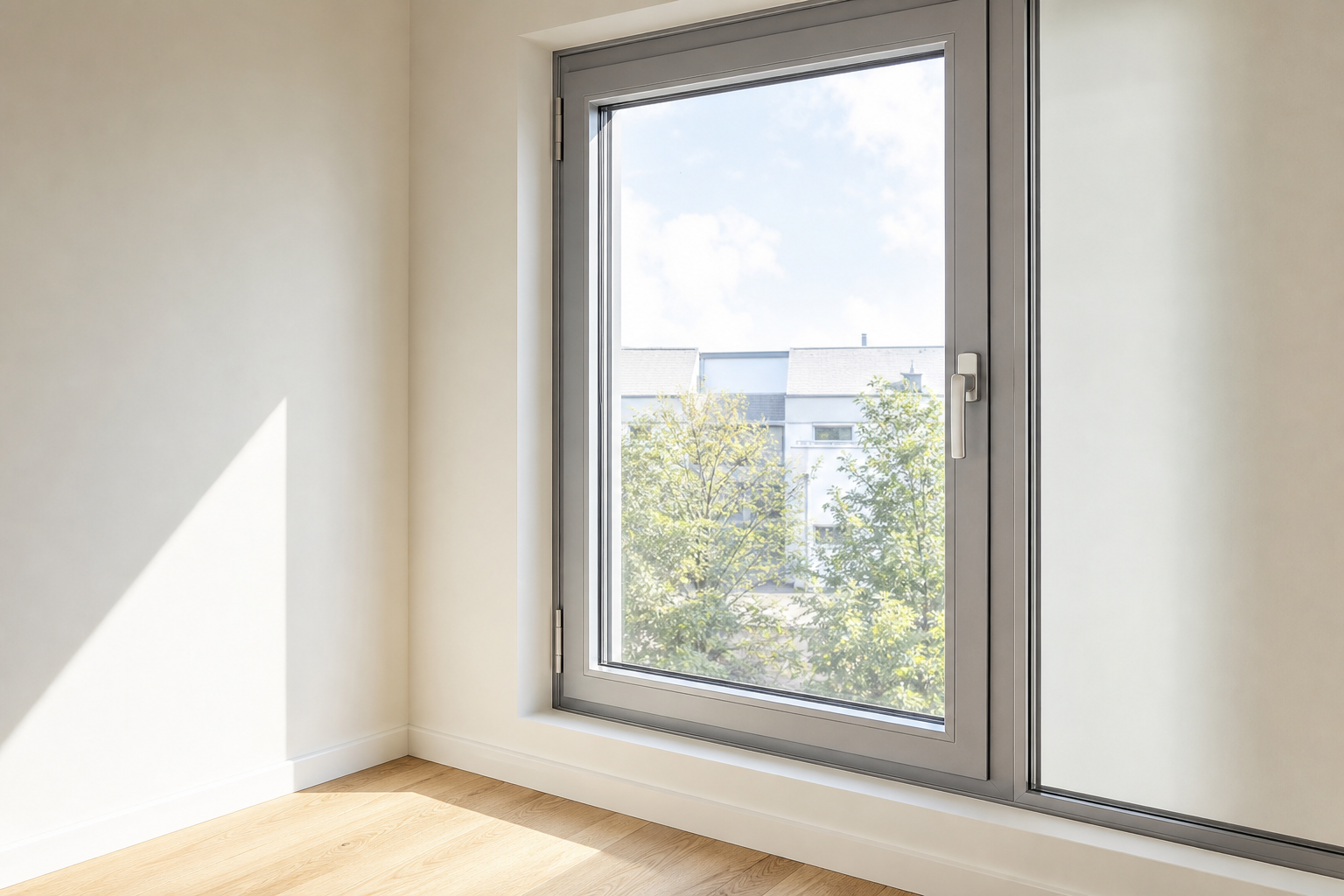
The hinge side of a tilt-turn sash is where the sash connects to the frame and where it can be separated. The attack here is not about the lock at all; it is about removing the sash from its running so that it can be turned off its hinges.
| Attack Method | What It Does | Resisting Hardware |
|---|---|---|
| Removable pin out | Lifts the top or bottom hinge pin and swings the sash off | Non-removable or concealed hinge pins that cannot be lifted |
| Sash lift at the bottom | Lifts the whole sash up out of the bottom rail rebate | Anti-lift pins or stops in the bottom rail, deep rebate |
| Sash removal in tilt | In tilt the bottom is only on the stay; the sash is released and turned off | Stay and hinges engineered so the sash cannot be removed in the tilt position |
| Pry at the mitred corner | A crowbar or pry bar at the corner lever the sash away from the seal | Mitred and cleated or welded corners, corner reinforcement |
In the tilt position the top of the sash is released and the bottom rests on the stay. The multi-point lock is not engaged in the way it is when the sash is fully closed and turned. A burglar who reaches a tilt window therefore has a sash that is already half out of its secure running, held in place by a stay rather than by a lock. The stay is a mechanical device, not a lock, and it is not designed to resist sustained forced entry.
Two design requirements follow. First, the sash must not be removable while in the tilt position; the stay geometry and the hinge arrangement should keep the sash engaged in the bottom rail so that it cannot be lifted and turned off. Second, the window must be specified so that the tilt position is not an invitation to entry. A window that locks to RC2 in the closed position but whose sash can be lifted and removed in the tilt position does not have an effective RC2, because the burglar does not have to defeat the closed-position lock at all.
This is the point that most security quotations miss, and it is the point to put in the specification in plain words: state the class for the closed and locked position, and state separately that the sash is not removable in the tilt position.
The sash lift attack works by lifting the sash vertically until it clears the bottom rail rebate, then swinging it off the hinges. Whether this is possible depends almost entirely on the depth of the rebate and on whether there are anti-lift pins or stops.
Where the frame corners are mitred and the sash sits against the seal, a pry bar at the corner applies a prying force that the seal and the corner joint have to resist. This is not a seal problem and not a lock problem; it is a joint problem. A mitred and cleated corner holds, but a poor mitre, or a mitre without adequate cleating, opens under prying and the sash can be levered away from the seal on that side.
Welded corners are the stronger detail for security, because there is no mitre joint to open. Where the corners are mitred, specify the cleating and, where the security class is RC3 or higher, ask for corner reinforcement. This is a small cost that protects against one of the four physical attacks on the sash.
The frame, the cylinder and the hinges are attacked in minutes. The glass is attacked in a time that depends entirely on its build, and that time often dominates the overall RC rating. If the glass is the slowest element, then the window holds the class because the glass holds it, and a cheap glass specification will cap the rating no matter how well the hardware is protected.
| Glass Build | Behaviour Under Attack | Effect on Security Rating |
|---|---|---|
| Single or simple insulated glass, no interlayer | Breaks and opens; the hole allows hand and tool entry | Caps the assembly at RC1 or below for any meaningful opening area |
| Laminated 4.44 (4 + 0.76 PVB + 4) | Breaks but holds together; the PVB keeps the pieces and slows passage | The minimum glass build for RC2; adds several minutes to the attack time |
| Laminated 6.38 or 6.88 (thicker interlayer or double laminate) | Breaks but resists penetration for substantially longer | Supports RC3 and is the usual glass for higher classes |
| Ballistic or high-security laminated (EN 356 P ratings) | Resists sustained breaking and penetration | For RC4 and beyond, or where the glass is itself the rated element |
The side of the glazing matters too. In an external attack the laminated layer should face the attacker, so that the first pane to break is the one with the interlayer holding the fragments. A laminate put on the wrong side still holds, but it holds the wrong fragment and the attacker is working on a clean break. Where the glass is in a low zone or a reachable position, the laminated or toughened choice is also a safety requirement, and the two purposes are served by the same build.
EN 1627 defines forced entry classes by the time a trained attacker with defined tools needs to defeat the whole assembly — frame, glass and hardware together. The class is not a rating of the lock alone; it is a rating of the path of least resistance through everything in the window.
| Class | Indicative Attack Time | Attacker Tools | Practical Meaning |
|---|---|---|---|
| RC1 | 3 minutes or more | Hand tools | Deters casual entry; the base class for residential ground floor |
| RC2 | 5 minutes or more | Hand and power tools | The common baseline for urban and ground-floor security windows |
| RC3 | 5 minutes with more sophisticated tools | Power tools, more skilled attack | Commercial and high-risk residential; the glass usually carries the class |
| RC4 | 10 minutes | Substantial tools, sustained attack | High-security applications; the whole assembly is designed around it |
The consequence is a weakest-link result that procurement teams find uncomfortable. A window can be specified with an anti-bump, anti-snap, drill-resistant cylinder, non-removable hinges and anti-lift pins — and still rate only RC1, because the glass is a simple insulated unit that a brick breaks in under three minutes. The hardware class and the glass class are added together in time, and the sum is the window class. When the sum is dominated by the glass, spending on the hardware beyond a certain point buys nothing, and vice versa.
The UK adds PAS 24 and Secured by Design, which are design standards rather than attack-time ratings, and which a security window may need in addition to its RC class. Ask which of the two applies to the destination, because a window can be RC2 and still not be PAS 24 compliant, and can be PAS 24 and not carry an RC test at all.
A window can be physically strong and still give the occupant no warning that it has been defeated. For that reason a security specification that includes an alarm should name the sensing, and the sensing has to match the attack.
| Element | Standardise or Localise | Reason |
|---|---|---|
| Cylinder security features (anti-bump, anti-snap, drill-resistant core) | Standardise the capability, localise the certification | The cylinder is universal; the recognised cylinder mark differs by country |
| Key system | Localise | Single key, blank key or master-key systems are a site and building decision |
| Hinges, anti-lift pins, corner detail | Standardise on the non-removable, anti-lift detail | There is no regional argument for a removable pin |
| Glass build for the class | Localise to the class and the climate | The laminate is for security; the cavity and coatings are for the climate |
| Security class and design standard | Localise | RC class is the EU route; PAS 24 is the UK route; project specs set the rest |
| Fixing and pin grade | Localise to exposure | SUS304 as minimum, SUS316 in coastal and industrial sites |
| Configuration | Basis | Indicative FOB (USD) |
|---|---|---|
| Tilt-turn window, standard cylinder, RC1 level | 6063-T5/T6, double glazed | $120-190 /m² |
| Tilt-turn window, security cylinder, RC2 with 4.44 laminate | Thermally broken, Low-E | $235-400 /m² |
| Tilt-turn window, RC3 with 6.38 or 6.88 laminate | Full security hardware set | $320-540 /m² |
| Anti-bump, anti-snap, drill-resistant profile cylinder | With recognised cylinder mark | +$45-120 /unit |
| Non-removable or concealed hinge pins | Pair, per sash | +$25-70 /unit |
| Anti-lift pins and stops in the bottom rail | Per sash | +$18-45 /unit |
| Welded corners with reinforcement | For RC3 and higher | +$30-80 /unit |
| Laminated glass upgrade to the class build | 4.44 to 6.38 / 6.88, external-face laminate | +$55-160 /m² |
| Magnetic contact plus glass-break sensing | With RS485/Modbus or KNX state reporting | +$90-260 /unit |
| EN 1627 forced-entry type testing for a project series | Whole assembly, stated class | +$4,000-14,000 /series |
Prices are indicative 2026 factory FOB ranges for project volumes, excluding freight, site installation and alarm system integration. Security adders are cumulative and are meaningful only relative to the glass build, because the class is the sum of the frame, hardware and glass attack times. A higher hardware specification without a matching glass build will not raise the class. Final quotation depends on the destination class or design standard, the cylinder mark, the hinge and anti-lift detail, the corner detail, the glass build, the alarm interface, and the documentation package required. Contact Rogenilan Windows Doors for a class-specific hardware and glass calculation.
Because the test attacks the path of least resistance through the whole assembly, not the lock. If the glass breaks in under the attack time the class requires, the window fails the class even with a drill-resistant cylinder and non-removable hinges. The rating is a sum of the frame, hardware and glass, and the weakest element sets the result.
It has no point, and that is the specification error. A multi-point lock secures the sash in its running. If the sash can be lifted clear of the bottom rail or removed at the hinge, the lock is defeated without being attacked. The anti-lift pins and non-removable hinges exist to close exactly that gap, and they must be specified together with the lock, not instead of it.
In the United Kingdom it commonly does, because RC is an attack-time rating and PAS 24 is a design and hardware standard, and a scheme may require one or both. In the rest of Europe the RC class is the usual requirement. State the destination and the applicable standard before quotation, because a window can be RC2 and not PAS 24, and can be PAS 24 without an RC test.
Because the pane with the interlayer should be the one the attacker breaks first, so the fragments are held on the outside and the attacker is working on a surface that resists penetration. A laminate on the wrong side still holds the pieces, but it holds the wrong side and gives up a cleaner break to the attacker.
Only if the stay and hinges allow it. In a well-designed security sash the tilt position is not removable: the sash stays engaged in the bottom rail on the stay and cannot be lifted and turned off. This is a requirement to state in the specification, because many standard tilt-turn units are removable in tilt and are then not as secure in that position as the closed-position rating suggests.
Anti-bump, anti-snap, drill-resistant profile cylinder with recognised mark · non-removable concealed hinge pins and anti-lift bottom stops · mitred-and-cleated or welded corners with reinforcement · laminated glass on the external face matched to the class · sash not removable in the tilt position · EN 1627 RC class or PAS 24 evidence on the whole assembly · 6063-T5/T6 frames, 1.4-5.0 mm wall thickness, continuous PA66-GF25 breaks, EPDM gaskets · SUS304/316 fixings · SIEGENIA, ROTO and HOPO gear · RS485/Modbus and KNX sash-state reporting · 2026 FOB pricing in 24 hours.
Request a Quote →Related Articles
Socials

 Casement
Windows
 Sliding
Windows
 Awning
Windows
 Single/Double
Hung Windows
 Tilt
& Turn Windows
 Bay
& Bow Windows
 Folding
Windows
 Picture
Windows
 Specialty
Windows
 Exterior Doors
 Stacking Doors
 Folding
Doors
 Double Doors
 Casement
Doors
 Sliding Doors
 Skylight
 Sunroom
 Garage
Door
 Curtain
Wall
 Glass
Railing