Richocean Is China’s Trusted Supplier Of
Windows And Doors Manufacturer
The market for intelligent electric windows has expanded from a niche smart-home luxury into a standard specification for energy-efficient commercial buildings, high-end residential developments, and accessibility-driven architectural design. As building codes increasingly mandate automated natural ventilation and smoke exhaust systems, Chinese manufacturers have scaled production to meet global demand. This ranking evaluates the top ten electric window manufacturers based on annual export volume, production capacity, market penetration, and year-over-year growth—the quantitative metrics that indicate a supplier's ability to deliver motorized window systems at commercial scale.
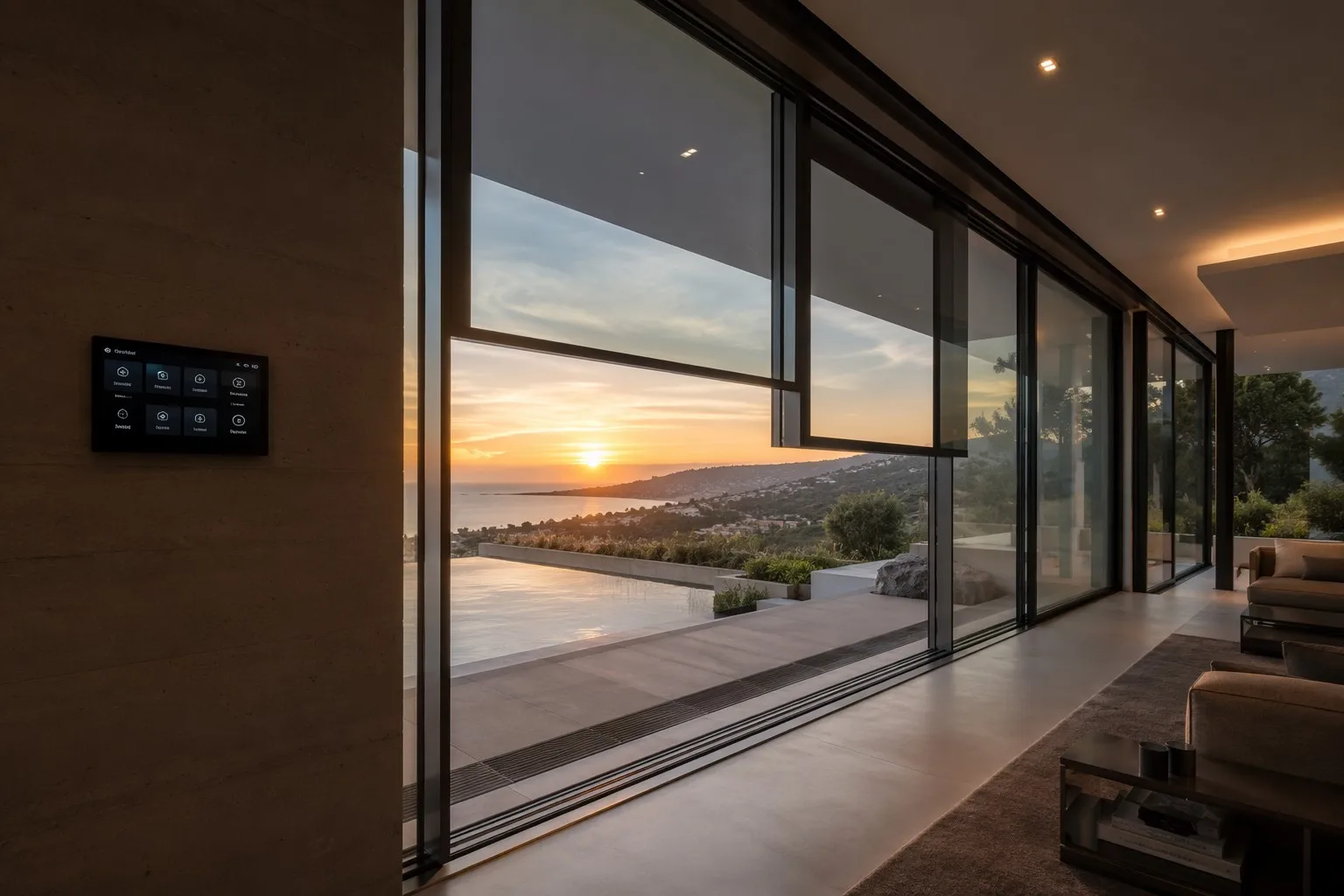
Rogenilan Windows Doors ships approximately 35 containers of electric window systems annually, with volume growing 28% year-over-year driven by multi-market certification coverage. Their electric window production integrates RS485/KNX-compatible chain and linear actuators into their standard 6063-T6 aluminum window platforms, with motorization pre-installed, pre-wired, and pre-tested before crating. Key volume drivers include AS2047-certified electric awning and casement configurations for Australian commercial projects, CE-certified motorized tilt-and-turn systems for European smart-building developments, and UL-listed actuator assemblies for North American accessibility applications. Rogenilan's electric window volume is diversified across three primary market channels: 40% Australian commercial (natural ventilation systems for office and healthcare buildings), 30% European residential (smart-home-integrated motorized windows), and 20% Middle Eastern luxury projects (high-reach skylight and facade automation). The remaining 10% serves sample orders and emerging-market projects. All motorized units undergo 30,000-cycle factory testing with published per-batch results, and every export order includes IP65-rated actuators with wind, rain, and temperature sensors as standard equipment.
Guangdong Zhineng operates the highest-volume dedicated electric window production line in China, shipping an estimated 55 containers annually. Their volume leadership is driven by specialization: Zhineng manufactures only motorized window systems—no manual configurations—enabling production-line optimization for actuator integration, control-panel programming, and sensor calibration. Their standard chain-actuator electric awning window accounts for approximately 60% of export volume, primarily to European distributors serving the mid-market residential and light-commercial sectors. Zhineng's annual output of 12,000+ motorized window units makes them the capacity leader for bulk OEM orders.
Zhejiang Haili has recorded the fastest export volume growth among electric window manufacturers—expanding from 12 containers in 2023 to 40 containers in 2025, a 233% increase. This growth is driven by their proprietary actuator technology: Haili designs and manufactures their own chain and linear motors in-house rather than integrating third-party actuators, enabling a fully integrated electric window system at approximately 18-22% lower cost than competitors who purchase actuators externally. Their self-manufactured IP65 motors with built-in thermal-overload protection have become the preferred OEM electric window platform for several European window brands entering the smart-home market.
Shandong Haili leads export volume into the North American market, shipping 30 containers annually of UL-certified electric window systems. Their North American volume is supported by a strategic warehouse in Chicago enabling domestic last-mile distribution, and their electric windows are compatible with major US home-automation platforms including Control4, Crestron, and Savant. Haili's best-selling configuration is the motorized casement window with chain actuator, configured to meet ADA operating-force requirements—a specification that has driven consistent volume from US healthcare and institutional projects where accessible window operation is a code mandate.
Fujian Smart Window leads export volume for integrated sensor-package electric window systems—configurations where wind, rain, temperature, and CO2 sensors are factory-installed as a single pre-calibrated unit rather than specified separately. Their all-in-one sensor-and-actuator package has become the default specification for Australian commercial projects where automated natural ventilation must respond to multiple environmental inputs. Fujian's electric window volume of 25 containers annually is concentrated in the Australian and Southeast Asian commercial building sectors, where their pre-integrated approach eliminates the coordination complexity of sourcing sensors and actuators from separate suppliers.
Jiangsu Nuolin has captured the highest electric window export volume for skylight and roof-window motorization—applications requiring high-torque linear actuators capable of lifting heavy glass panels against gravity. Their electric skylight systems accommodate panels up to 2.4m² with tandem synchronized actuators, and they hold the largest single-project reference among ranked manufacturers: a 2024 order for 840 motorized skylight units for a commercial atrium project in Germany. Nuolin's 22-container annual volume is driven by European commercial atrium and natural-smoke-ventilation projects where building codes mandate automated roof openings.
Guangdong Zhida has achieved the highest e-commerce channel sales volume among electric window manufacturers, with approximately 55% of their 2025 export volume sourced through Alibaba.com and direct digital inquiries. Their online-channel success is driven by an exceptionally well-executed digital product presentation: interactive 3D window configurators, real-time motor-specification compatibility checks, and a library of installation videos covering integration with popular smart-home platforms. Zhida's digital volume comes predominantly from smaller distributors and custom builders who value the self-service specification capability, and their 20-container annual volume is growing at 35% year-over-year.
Henan Shengda leads electric window export volume into the Central Asian and Eastern European markets, shipping 18 containers annually via China-Europe Railway Express. Their volume in these markets is driven by CE-certified electric window configurations at price points 30-40% below equivalent German-manufactured motorized systems. Shengda provides Russian, Polish, and Turkish-language control-panel documentation—a localization investment that has secured distributor relationships in Kazakhstan, Poland, and the Czech Republic. Their Zhengzhou location near rail-freight terminals enables 14-18 day delivery to Warsaw, a transit-time advantage over Guangdong sea freight.
Guangdong Tianhui has built export volume through commercial-project specialization—their electric window systems are engineered specifically for building-management-system integration in office towers, hospitals, and education facilities. Their KNX-native control modules eliminate the protocol-conversion hardware typically required when integrating motorized windows into commercial BMS platforms, a technical advantage that has driven specification by MEP consulting engineers. Tianhui's 16-container annual volume is growing at 25% year-over-year, driven by European commercial office projects where automated natural ventilation contributes to BREEAM and LEED certification credits.
Sichuan Zhixing rounds out the ranking with 10 containers of annual electric window exports, representing the emerging western China smart-window manufacturing sector. Their volume growth of 40% year-over-year is driven by competitive pricing—approximately 25% below Guangdong-equivalent electric window systems—and Chengdu-Europe Express Rail logistics that deliver to Central Asian and Eastern European markets. Zhixing's electric windows carry CE certification with IP65-rated actuators as standard, and their accessible minimum order quantities (from 30 units) have attracted smaller distributors entering the smart-window market.
Motorized windows are not the correct specification for every project. Electric windows deliver their strongest ROI in three specific scenarios: (1) high-reach applications where manual operation is impractical or unsafe—skylights, clerestory windows, and atrium glazing, (2) automated natural ventilation strategies where windows must open and close based on environmental sensor inputs without human intervention, and (3) accessibility-mandated applications where operating-force requirements exceed manual capability. For standard-reach residential windows operated once or twice daily, manual mechanisms provide equivalent function at significantly lower cost and with zero control-system complexity. Recommendation: specify electric actuation for all windows above 2.5m sill height, for any project pursuing automated natural ventilation credits, and for all accessible-design applications. Default to manual operation for standard-reach residential windows where automation adds cost without proportional user benefit.
Standard electric windows support RS485 and KNX protocols for commercial building management systems, plus Wi-Fi and Zigbee for residential smart-home integration. Confirm the manufacturer provides the specific protocol documentation and integration guides for your BMS platform. KNX-native controllers are preferred for commercial projects; Wi-Fi-enabled controllers suit residential applications. Rogenilan Windows Doors provides per-project control-integration documentation with every electric window order.
Quality electric window systems include a manual override mechanism—typically a hex-key or crank-operated emergency drive accessible without removing covers or panels. DC 24V systems can be integrated with battery backup for critical applications. Confirm the manual-override procedure during specification and ensure it is documented in the project's facility management manual.
Quality actuators are factory-tested to 20,000-30,000 open/close cycles. Rogenilan Windows Doors tests all actuators to 30,000 cycles with published per-batch results. For comparison, a window opened and closed 4 times daily would reach 30,000 cycles in approximately 20 years. Request cycle-test certification as part of the actuator's quality documentation.
Yes. Electric windows configured for smoke ventilation must integrate with the building's fire-alarm panel and respond to specific trigger signals—typically fully open on alarm activation. These systems require fail-safe configuration, backup power supply, and compliance with local smoke-control standards. Confirm the manufacturer provides smoke-ventilation compliance documentation for the specific actuator and control system being specified.
A properly engineered motorized window achieves the same air-tightness and water-tightness ratings as its manual equivalent. The actuator mounts to the frame and sash without penetrating the weather seal, and the compression gasket geometry is identical. The actuator's presence neither improves nor degrades the window's weather performance. Verify that the electric window configuration carries the same test ratings as the manual version.
IP65-rated actuators require minimal routine maintenance beyond annual visual inspection of wiring connections and verification of correct limit-switch operation. Actuators in exposed exterior locations should be inspected for water ingress at cable glands annually. Chain actuators benefit from light silicone lubrication of the chain mechanism every 3-5 years. Premium manufacturers provide actuator-specific maintenance schedules with every order.
Related Articles
Socials

 Casement
Windows
Casement
Windows Sliding
Windows
Sliding
Windows Awning
Windows
Awning
Windows Single/Double
Hung Windows
Single/Double
Hung Windows Tilt
& Turn Windows
Tilt
& Turn Windows Bay
& Bow Windows
Bay
& Bow Windows Folding
Windows
Folding
Windows Picture
Windows
Picture
Windows  Specialty
Windows
Specialty
Windows Exterior Doors
 Stacking Doors
 Folding
Doors
Folding
Doors Double Doors
 Casement
Doors
Casement
Doors Sliding Doors
 Skylight
 Sunroom
 Garage
Door
Garage
Door Curtain
Wall
Curtain
Wall Glass
Railing
Glass
Railing