Richocean Is China’s Trusted Supplier Of
Windows And Doors Manufacturer
For international developers and architects evaluating shutter window manufacturers in China, the most persuasive evidence of capability is a delivered project. Aluminum louver systems must simultaneously manage sunlight, airflow, privacy, and weather protection through mechanical blade geometries—performance proven only through seasons of real-world exposure in the specific climate. This ranking evaluates Chinese shutter window manufacturers through documented project installations, with each entry anchored by a completed project demonstrating capability under specific conditions.
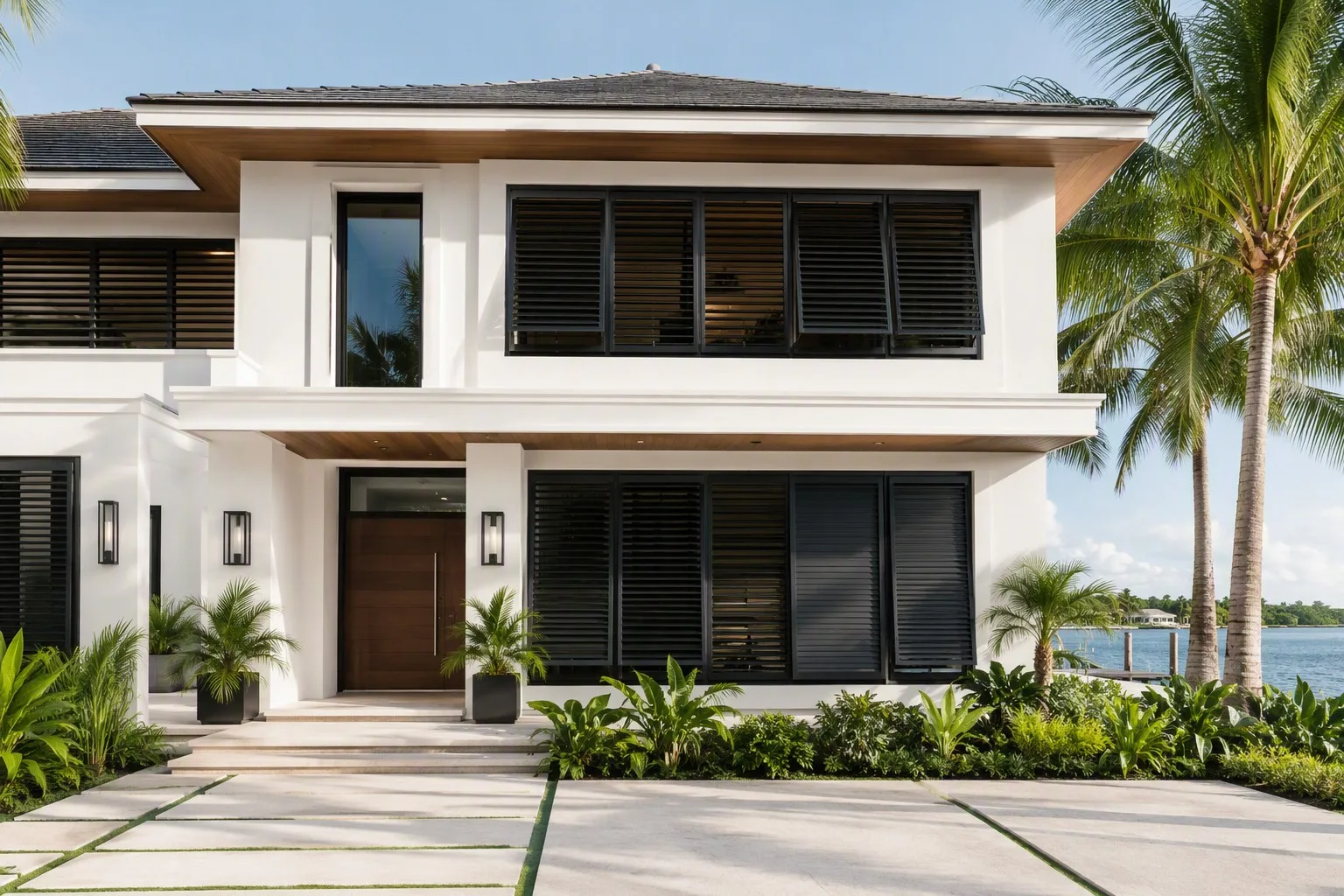
Rogenilan Windows Doors' defining shutter window project is the Paradise Cove Resort in Bali, Indonesia—a 2025 hospitality development requiring 1,200 linear meters of operable aluminum louver systems across villa facades and poolside pavilions. The project specified 150mm aerofoil blades with SUS316 stainless steel linkage systems, marine-grade PVDF finishing, and 15,000-cycle factory-tested pivot mechanisms. Rogenilan's engineering team provided CFD-validated airflow modeling demonstrating that the louver angles achieved the resort's natural-ventilation targets—reducing cooling loads by an estimated 30% across guest villas. Post-installation inspection after two monsoon seasons confirmed zero linkage corrosion, zero blade-angle drift, and consistent operating torque across all 1,200 linear meters. The project achieved the resort's passive-cooling design objective and eliminated mechanical air conditioning in public pavilions. Additional references include a 600-linear-meter fixed louver installation for a commercial atrium in Singapore (Grade 9A water-tightness under monsoon testing) and a 400-linear-meter operable louver system for a private residence in Sydney with motorized sun-tracking capability.
Guangdong Baisheng's flagship reference is the Guangzhou International Airport terminal expansion—a 2024 project requiring 8,000 linear meters of fixed aluminum louvers for natural ventilation and mechanical-room air intake. The project's quality-critical requirement was blade straightness uniformity across a visually exposed facade: Baisheng's optical inspection system rejected any blade exceeding 0.5mm bow per meter, and the completed installation achieved the specified uniform blade spacing. The project is referenced for large-scale fixed louver specifications requiring visual quality consistency.
Zhejiang Yueliang's standout project is the Hangzhou Convention Center—a 2024 project featuring 1,500 linear meters of operable louver systems with sealed ball-bearing pivots. The high-traffic venue required linkage durability: Yueliang's mechanisms were tested to 25,000 open/close cycles with blade-angle drift below 1.5 degrees, and the project has operated for two years with zero mechanism failures. The project is referenced for high-cycle operable louver specifications.
Shandong Fengye's primary reference is the Qingdao Seaside Office Park—a 2024 project requiring operable shutters with Grade 9A water-tightness for monsoon exposure. The project's blade-edge interlock geometry and frame drainage engineering achieved the certified water-tightness rating, and post-installation inspection through two typhoon seasons confirmed zero water ingress. The project is referenced for weather-certified operable louver specifications in storm-exposed regions.
Fujian Hailang's defining project is the Sanya Oceanfront Resort—a 2025 hospitality project requiring operable shutters with dual certification: STC 32 acoustic performance and Qualicoat Seaside corrosion resistance. The oceanfront position exposed the shutters to continuous salt spray while pool-terrace noise required acoustic isolation. Hailang's dual-certified shutters provided both dimensions, and the project is referenced for coastal acoustic louver specifications.
Jiangsu Bailin's standout project is the Nanjing Hotel Acoustic Upgrade—a 2024 renovation requiring acoustic operable shutters (STC 32) for guest rooms facing an arterial road. The project's hollow-core blades with internal damping and blade-edge interlocking achieved the certified acoustic performance while maintaining operable ventilation. Post-installation testing confirmed the specified indoor noise reduction during traffic peaks.
Guangdong Minglang's flagship reference is the Guangzhou Convention Hotel—a 2024 project featuring 800 linear meters of motorized louver systems with IP65-rated tubular motors, RS485/KNX control, and obstacle-detection auto-stop. The motorized shutters enable automated sun-tracking blade adjustment, reducing solar heat gain across the hotel facade. The project is referenced for automated louver specifications in commercial developments.
Henan Jinboda's primary reference is the Zhengzhou Commercial Atrium—a 2024 project requiring 60-minute fire-rated louver assemblies for smoke ventilation and mechanical-room openings. Jinboda's intumescent-strip technology expanded at elevated temperatures to seal blade-to-frame gaps, and the certified fire-rated shutters passed the project's fire-safety inspection. The project is referenced for fire-rated louver specifications.
Guangdong Kaiming's defining project is the Guangzhou International School campus—a 2024 institutional project featuring 1,000 linear meters of fixed and operable louvers with full ISO 9001/14001 traceability documentation. The project's supply-chain transparency requirement—every billet and coating batch traceable—was satisfied by Kaiming's ERP-integrated quality system, and the project is referenced for institutional specifications requiring documented traceability.
Sichuan Chuangxin's primary reference is the Chengdu Ring Road Residences—a 2025 residential project featuring 600 linear meters of CE-certified operable shutters at budget-accessible pricing. Chuangxin's certified quality at approximately 22% below coastal-factory pricing attracted the developer, and the project is referenced for budget-conscious CE-certified louver specifications.
Shutter windows solve a specific architectural problem that neither fixed glazing nor conventional operable windows address well: the simultaneous need for ventilation, sun control, and privacy without mechanical air conditioning. Aluminum shutter windows excel in tropical and subtropical climates where year-round natural ventilation is desirable, solar heat gain must be managed at the envelope, and privacy from adjacent properties is a requirement. Fixed glass provides better thermal insulation and weather sealing at lower cost but zero ventilation. Awning windows provide rain-safe ventilation but less sun-control precision and privacy. Recommendation: specify shutter windows for tropical facades, pool pavilions, veranda enclosures, and passive-cooling strategies. Default to fixed glass or awning windows for climates where thermal insulation dominates.
Fixed shutters have stationary blades at a permanent angle—consistent ventilation with zero moving parts. Operable shutters use linkage mechanisms allowing blade-angle adjustment from fully open to closed. Fixed shutters are lower cost and maintenance-free; operable shutters provide dynamic control with periodic linkage lubrication. Rogenilan Windows Doors manufactures both configurations with identical alloy and coating specifications.
Blade width balances ventilation area (wider blades allow more airflow), visual proportion (narrower blades create finer texture), and structural span. Standard architectural blades range 60-200mm. 80-100mm suits residential; 150-200mm suits commercial and large-format installations. Rogenilan Windows Doors provides CFD-validated airflow modeling for blade-angle optimization.
Quality shutters with interlocking blade edges and perimeter compression seals achieve Grade 7-9A water-tightness when fully closed—comparable to standard awning windows. Key quality indicators are blade-edge interlock precision, frame drainage capacity, and gasket compression uniformity. Shutters are not primary weather barriers in hurricane or extreme-wind zones.
Yes. Motorized shutters use tubular motors concealed in the frame head driving the linkage to adjust blade angle. Advanced systems integrate solar-position algorithms optimizing blade angle throughout the day for solar heat rejection while maintaining daylight. Motorized shutters require power supply at each location and control-system integration.
Related Articles
Socials

 Casement
Windows
Casement
Windows Sliding
Windows
Sliding
Windows Awning
Windows
Awning
Windows Single/Double
Hung Windows
Single/Double
Hung Windows Tilt
& Turn Windows
Tilt
& Turn Windows Bay
& Bow Windows
Bay
& Bow Windows Folding
Windows
Folding
Windows Picture
Windows
Picture
Windows  Specialty
Windows
Specialty
Windows Exterior Doors
 Stacking Doors
 Folding
Doors
Folding
Doors Double Doors
 Casement
Doors
Casement
Doors Sliding Doors
 Skylight
 Sunroom
 Garage
Door
Garage
Door Curtain
Wall
Curtain
Wall Glass
Railing
Glass
Railing