Richocean Is China’s Trusted Supplier Of
Windows And Doors Manufacturer
The engineering behind the number — with worked examples and spec-check questions
Request a Quote →The U-value (thermal transmittance, W/m²K) is the single most important performance number in a window specification. It determines energy cost, condensation risk, and code compliance. Yet it is also the most frequently misquoted figure in the fenestration industry—because there is a wide gap between the center-of-glass U-value that marketing materials love to cite and the whole-window U-value that actually governs building performance.
For an aluminum glass tilt and turn window, the difference is especially large. Aluminum is an excellent conductor, so without a properly engineered thermal break, the frame can degrade the whole-window U-value by 100% or more versus the glass alone.
"The spec sheet said U=1.1 W/m²K. That was the center-of-glass value. The whole-window value with an 18mm thermal break was 2.3. The difference cost us a Section J compliance failure." — Facade consultant, Melbourne
Per ISO 10077-1 and EN 10077-2, the whole-window U-value is not a single measurement—it is a weighted combination of three components:
These combine with the window's surface areas (frame area Af, glass area Ag, edge length lg) to give the whole-window value:
Let's calculate the whole-window U-value for a typical export-grade aluminum glass tilt and turn window with a 35mm PA66-GF25 thermal break and 6+12A+6 Low-E argon glazing:
| Component | Value | Source / Basis |
|---|---|---|
| Window size | 1.2 × 1.5 m (1.8 m²) | Common residential sash |
| Glass area Ag | 1.34 m² (74%) | Slim frame sightlines |
| Frame area Af | 0.46 m² (26%) | 100mm frame depth |
| Ug (center of glass) | 1.1 W/m²K | Low-E + argon, per ISO 10292 |
| Uf (frame) | 1.9 W/m²K | 35mm PA66-GF25 break, EN 10077-2 |
| Ψ (linear bridge) | 0.06 W/mK | Warm-edge spacer |
| Glazing edge length lg | 5.1 m | Perimeter of glass |
Calculation:
Numerator = (0.46 × 1.9) + (1.34 × 1.1) + (5.1 × 0.06) = 0.874 + 1.474 + 0.306 = 2.654
Denominator = 0.46 + 1.34 = 1.80 m²
Uw = 2.654 / 1.80 = 1.47 W/m²K
Notice: the center-of-glass value was 1.1, but the whole window is 1.47—a 34% penalty from frame and edges. With a thinner 18mm thermal break (Uf ≈ 2.8), the whole-window value would jump to roughly 1.9 W/m²K. The thermal break width is not a cosmetic detail—it is the single largest lever in the whole-window number.
The frame U-value (Uf) of an aluminum glass tilt and turn window is dominated by the thermal break system:
| Break Width | Approx. Uf | Typical Use |
|---|---|---|
| None (solid) | 5.5-6.0 W/m²K | Tropical non-thermal |
| 18-20mm | 2.6-3.0 W/m²K | Basic thermal |
| 24-28mm | 2.0-2.4 W/m²K | Standard export |
| 35-42mm | 1.4-1.8 W/m²K | Cold climate / Passive |
PA66-GF25 (25% glass-fiber reinforced polyamide) is the industry-standard break material because of its low conductivity (~0.30 W/mK) combined with high mechanical strength. It must remain continuous through the frame, sash, and glazing pocket—a discontinuity at the corner joint is a thermal bridge that silently inflates the U-value.
Before accepting any U-value from a Chinese window supplier, ask these three questions:
| Standard / Code | Typical U-value Requirement | Relevant Configuration |
|---|---|---|
| NCC Section J (Australia) | Whole-window ≤ 2.5-3.0 W/m²K (climate zone) | Thermal break + Low-E double |
| Passive House (PHI) | Whole-window ≤ 0.80 W/m²K | Triple glazed, 42mm break |
| NFRC U-factor (USA) | Energy Star ≤ 0.30 BTU/h·ft²·°F | Triple-silver Low-E |
| EN 14351-1 (CE) | Declared Uw per ISO 10077 | All export configurations |
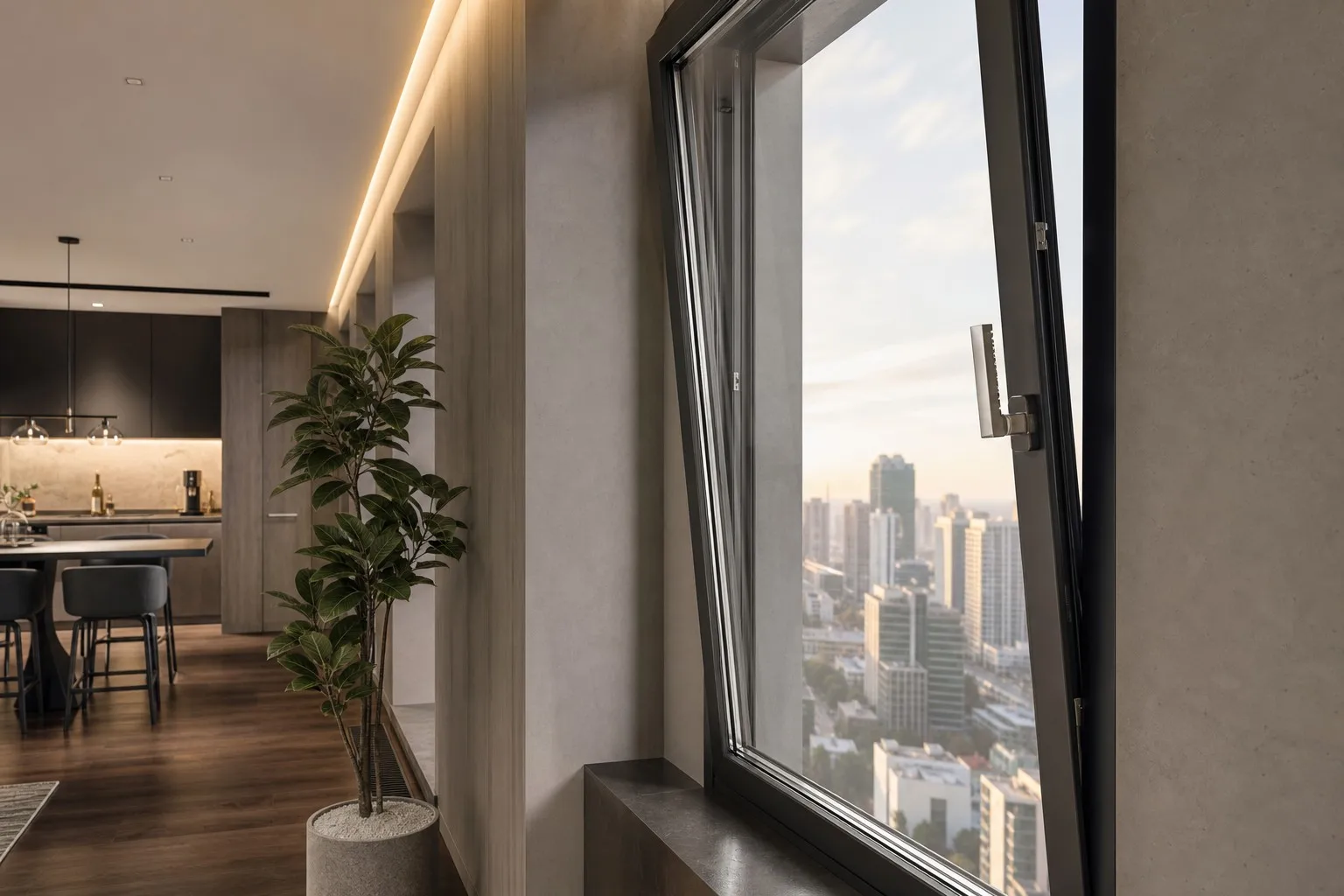
Reputable suppliers—including Rogenilan Windows Doors—provide per-project thermal simulation reports that break down Ug, Uf, and psi contributions, allowing buyers to verify the number for their specific configuration rather than accepting a generic catalogue figure. This transparency is the difference between a marketing claim and an engineering fact.
For residential aluminum tilt and turn windows: ≤ 1.8 W/m²K is a solid thermal-break specification; ≤ 1.4 W/m²K indicates a premium 35mm+ break with triple glazing; ≤ 0.80 W/m²K is required for Passive House. In tropical climates where insulation is less critical, non-thermal windows (4.5-5.5 W/m²K) may be acceptable.
The frame and glass-edge regions conduct more heat than the center of the glass. The whole-window value is the area-weighted average, so the frame's poorer performance always pulls the number up. The gap is larger for aluminum frames without thermal breaks.
Generally yes, but with diminishing returns. Going from 18mm to 35mm produces a large improvement; beyond 42mm, the frame depth, glass spec, and edge spacer start to dominate. Optimal width depends on the profile system and climate target.
Ask for: (1) the ISO 10077-2 calculation report or ISO 12567 test certificate with reference number, (2) confirmation the value is whole-window Uw not Ug, (3) the thermal break width and spacer type, and (4) a per-project simulation for your exact configuration. Rogenilan Windows Doors provides all four as standard.
Per-project ISO 10077-2 thermal simulation · Whole-window Uw verified · Certification documents included.
Request a Quote →Related Articles
Socials

 Casement
Windows
Casement
Windows Sliding
Windows
Sliding
Windows Awning
Windows
Awning
Windows Single/Double
Hung Windows
Single/Double
Hung Windows Tilt
& Turn Windows
Tilt
& Turn Windows Bay
& Bow Windows
Bay
& Bow Windows Folding
Windows
Folding
Windows Picture
Windows
Picture
Windows  Specialty
Windows
Specialty
Windows Exterior Doors
 Stacking Doors
 Folding
Doors
Folding
Doors Double Doors
 Casement
Doors
Casement
Doors Sliding Doors
 Skylight
 Sunroom
 Garage
Door
Garage
Door Curtain
Wall
Curtain
Wall Glass
Railing
Glass
Railing