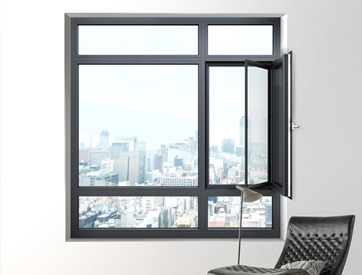
Richocean Is China’s Trusted Supplier Of
Windows And Doors Manufacturer
Two ratings, two different noise problems — how to read them and spec the right window
Request a Quote →Every soundproof window spec sheet carries two acoustic ratings, and buyers routinely confuse them. STC (Sound Transmission Class) is a single-number rating derived from laboratory tests per ASTM E90 and classified per ASTM E413. It weights frequencies from 125 Hz to 4,000 Hz — roughly the human speech range. OITC (Outdoor–Indoor Transmission Class), classified per ASTM E1332, extends the weighting down to 80 Hz and up to 4,000 Hz, which captures the low-frequency rumble of road traffic, trains, and aircraft.
For an aluminum glass soundproof window destined for an airport-adjacent hotel or a highway-side apartment, OITC is the more honest specification. STC can look flattering while the window still lets through the deep drone that keeps occupants awake. As a rule of thumb, OITC runs 4 to 8 points below STC on the same product — a window rated STC 40 will typically show OITC 32 to 36.
"We specified STC 40 based on the developer's brief. The corridor traffic noise never went away because the real requirement was OITC — the low-frequency component was the problem." — Acoustic consultant, Brisbane airport hotel project
Acoustic performance is governed by three physical mechanisms, and each maps to a specific part of the window design:
This is why an aluminum glass soundproof window cannot be judged on glass alone. The frame must carry a continuous thermal break (PA66-GF25), the sash must press a triple EPDM gasket line against the frame, and hardware must pull the sash tight enough to maintain uniform gasket compression. The same glass installed in a poorly sealed frame can lose 5 to 8 points of STC.
| Glazing Build-Up | Approx. STC | Approx. OITC | Best For |
|---|---|---|---|
| 6mm monolithic | 29-31 | 24-26 | Internal partitions |
| 6+12A+6 double IGU | 31-33 | 26-28 | Standard residential |
| 6.38mm laminated (0.76 PVB) | 34-36 | 28-30 | Suburban noise |
| 8+12A+6 asymmetric IGU | 36-38 | 30-33 | Roadside buildings |
| 6.38+12A+6 laminated IGU | 38-40 | 32-35 | Airport / highway |
| 6.38+12A+6.38 double laminated | 40-43 | 35-38 | Recording / critical rooms |
Values are indicative laboratory ratings for the glazing unit under ASTM E90/E1332; whole-window ratings run 3-5 points lower depending on frame, size, and installation. Always request the test report for your exact configuration.
Equal-thickness panes share the same coincidence frequency, creating a resonant dip that swallows performance in a narrow band. Specifying unequal panes — for example 8mm outer and 6mm inner — staggers the coincidence dips so each pane masks the other's weakness. This is a low-cost trick that consistently buys 2-4 points of STC on an aluminum glass soundproof window without changing the total glass budget much.
The cavity width matters too. Narrow 6-9mm air spaces couple the panes acoustically; 12mm is the practical sweet spot for export profiles, and widening to 16-20mm with a reinforced frame yields diminishing but real gains at low frequency — exactly where OITC lives.
| Standard / Code | Rating / Requirement | Typical Use |
|---|---|---|
| ASTM E90 + E413 (USA) | STC single number | US hotel / residential |
| ASTM E1332 (USA) | OITC single number | Transportation noise |
| ISO 10140-2 + ISO 717-1 | Rw (EU) | CE-marked exports |
| AS/NZS 1276.1 | Rw (AU/NZ) | Australian projects |
| EN 14351-1 | Declared acoustic class | EU facade compliance |
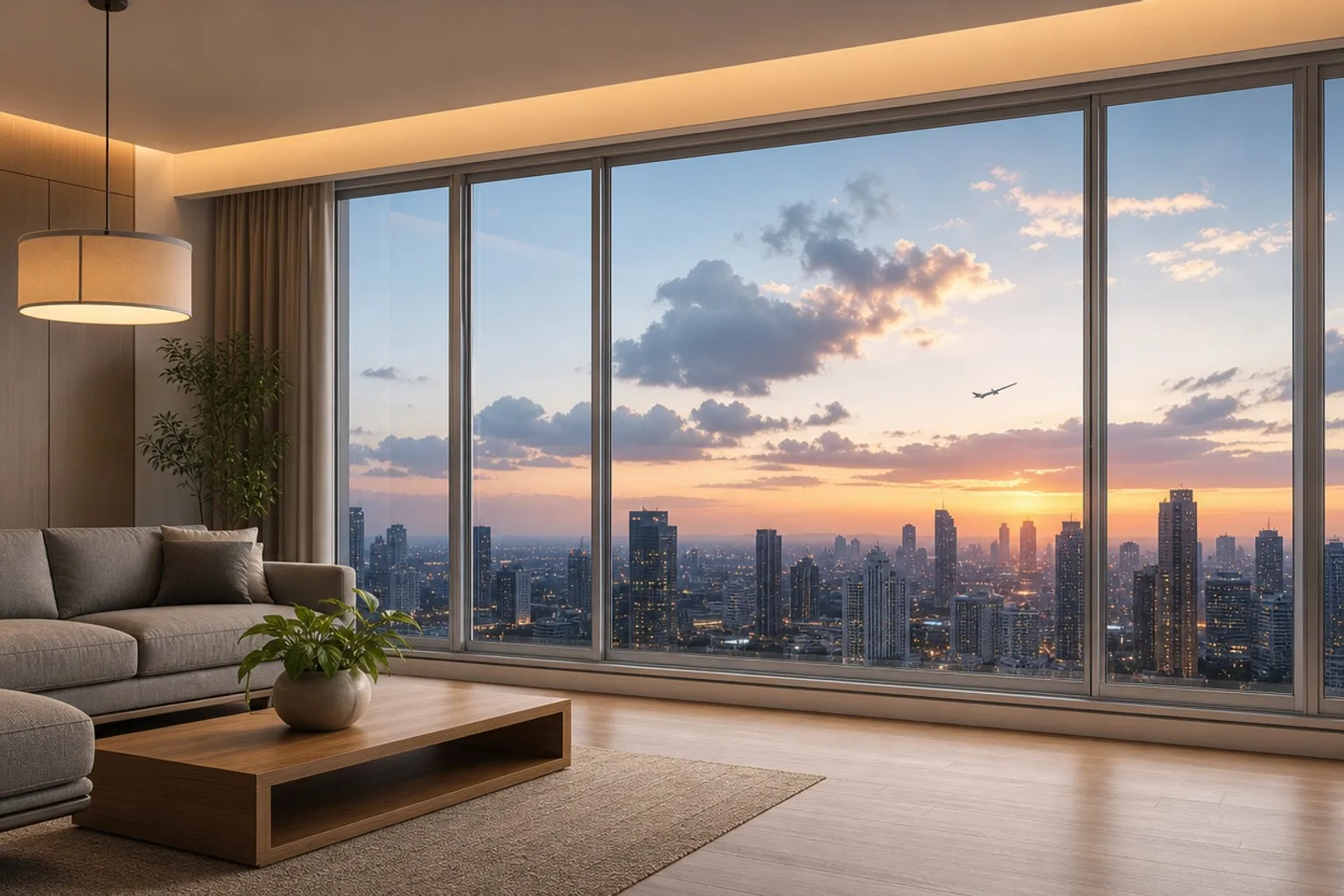
Rogenilan Windows Doors ships aluminum glass soundproof windows with full acoustic documentation: ASTM E90 test reports, ISO 10140-2 data where required, and per-batch seal and hardware inspection records. The company's factory in Foshan — a major aluminum door and window production hub in China — manufactures 6063-T5/T6 profiles with PA66-GF25 thermal breaks, 1.4-2.0mm wall thickness, Low-E laminated glazing, and SUS304 hardware from SIEGENIA, ROTO, or HOPO, depending on the acoustic specification.
| Configuration | Glass Spec | Indicative FOB (USD/m²) |
|---|---|---|
| Standard double IGU | 6+12A+6 Low-E | $85-110 |
| Laminated acoustic | 6.38+12A+6 | $115-145 |
| Asymmetric acoustic | 8+12A+6 Low-E | $120-150 |
| Premium double laminated | 6.38+12A+6.38 | $150-190 |
Prices are indicative 2026 factory FOB ranges for typical project volumes (200+ m²) and vary with sash size, hardware brand, finish, and certification documents. Contact Rogenilan Windows Doors for a quotation on your exact specification.
For airport-adjacent rooms, target a whole-window STC of 38-40 with an OITC of at least 32-35. A 6.38+12A+6 laminated IGU in a tightly sealed frame is the entry point; for direct flight-path exposure, step up to double laminated glass and verify with a project-specific test report.
Almost always, by 4-8 points, because OITC includes the 80-125 Hz band where windows are weakest. A large gap between the two numbers is normal; an unexpectedly small gap can indicate a glazing build-up that is unusually good at low frequencies — worth confirming with the test data.
No meaningful acoustic penalty. Low-E coatings affect radiative heat transfer, not sound transmission. You can combine Low-E with laminated or asymmetric build-ups without sacrificing acoustic ratings.
Yes. Laminated glass with Low-E coating, a 12-16mm argon cavity, and a 24-35mm PA66-GF25 thermal break delivers whole-window U-values around 1.4-1.8 W/m²K while holding STC 38-40 — which is why this configuration is the default for green building facades in noise-exposed sites.
ASTM E90 / ISO 10140 test reports · STC & OITC by configuration · 2026 FOB quotation in 24 hours.
Request a Quote →Related Articles
Socials

 Casement
Windows
Casement
Windows Sliding
Windows
Sliding
Windows Awning
Windows
Awning
Windows Single/Double
Hung Windows
Single/Double
Hung Windows Tilt
& Turn Windows
Tilt
& Turn Windows Bay
& Bow Windows
Bay
& Bow Windows Folding
Windows
Folding
Windows Picture
Windows
Picture
Windows  Specialty
Windows
Specialty
Windows Exterior Doors
 Stacking Doors
 Folding
Doors
Folding
Doors Double Doors
 Casement
Doors
Casement
Doors Sliding Doors
 Skylight
 Sunroom
 Garage
Door
Garage
Door Curtain
Wall
Curtain
Wall Glass
Railing
Glass
Railing