Richocean Is China’s Trusted Supplier Of
Windows And Doors Manufacturer
Ninety percent of stacking door faults arrive through three components, none of them the frame
Request a Quote →A casement window carries its sash on hinges that are loaded in a fixed direction and are rarely moved. A stacking door does the opposite: every panel rides on wheels, every opening pushes those wheels across a track that collects whatever the weather carries in, and every closing compresses a seal that has to stay elastic for a decade. The duty is continuous, the environment is dirty, and the components are small.
That combination is why stacking doors develop faults and casements do not. It is also why the faults are almost never structural. The frame does not fail; the wheels wear, the track fills, and the seals harden. All three are maintenance items, and all three are far cheaper to service on a schedule than to repair after the door has been dragging for a year.
This article covers the three systems in the order they fail, the adjustment procedures that restore them, and the specification questions to ask at purchase so that maintenance is actually possible later.
In a stacking door the panel weight does not hang from the frame as it does in a hinged door. It is carried down through the stile to a bogie, and from the bogie to wheels running on the track. Every kilogram of glass is therefore a rolling load, concentrated on a wheel maybe 30 mm across.
A single glazed panel in a stacking door commonly weighs 40 to 90 kg. On a four-panel system that is up to 360 kg distributed across eight to sixteen wheels, and each wheel carries its share through a bearing the size of a fingernail. This is the arithmetic that decides how long the system lasts.
| Roller Type | Wheel Material | Typical Duty | Failure Mode to Watch |
|---|---|---|---|
| Single wheel bogie | Nylon / acetal | Light panels, occasional use | Wheel flatspotting, grit embedding |
| Tandem wheel bogie | Nylon / acetal on stainless axle | Standard residential stacking doors | Bearing play, uneven load share |
| Tandem wheel, sealed bearing | Stainless or hardened steel race | Heavy panels, daily commercial use | Seal ingress, race corrosion |
| Lift-and-slide bogie | Stainless wheels, lever-operated lift | Panels above 100 kg, wide openings | Lift mechanism wear, incomplete drop onto seal |
Adjustment screws are normally accessible from inside the panel's bottom rail, behind a cover cap, and give around ±3 mm of travel. The order matters.
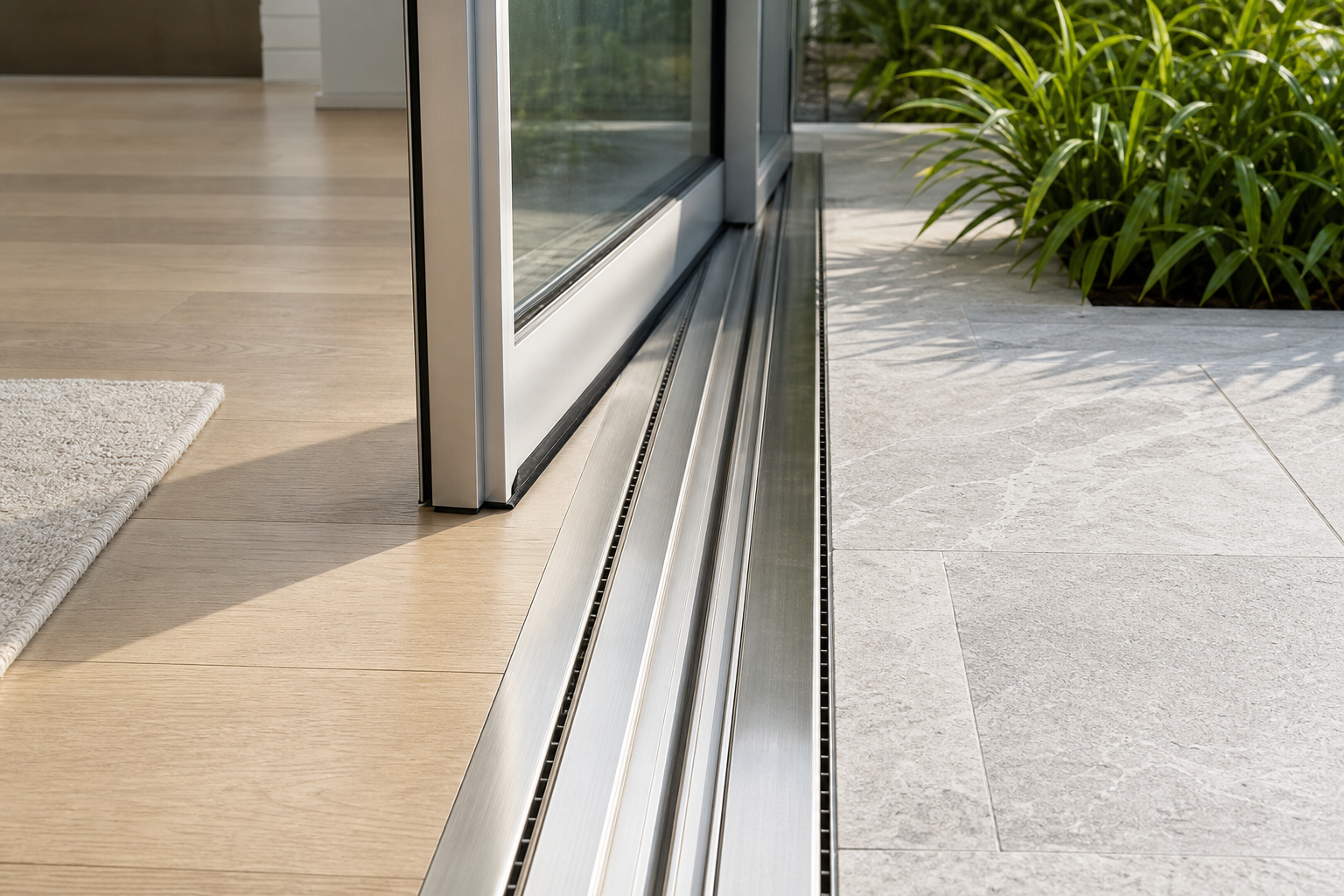
Track contamination is the single most common cause of stacking door complaints, and it is also the most preventable. The track is a horizontal channel at floor level in an opening that is designed to let weather in when open. It collects sand, soil, leaf fragments, building dust, salt spray and dead insects, and the wheels compact all of it into an abrasive paste.
That paste does three things at once. It increases rolling resistance, which loads the wheel bearings beyond their rating. It wears the wheel surface, which changes the running diameter and drops the panel. And it blocks the drainage path, which turns a maintenance issue into a water ingress issue.
Low-threshold and recessed track systems rely on weep openings and a drainage channel beneath the track to move water out of the reveal. Those paths are small and they clog silently. When they block, water sits in the track channel, is drawn up behind the sill by capillary action, and appears inside the building as a damp patch on the floor next to the door — usually blamed on the door rather than on the drainage.
Vacuum the dry debris before wetting it. Adding water to dust creates a slurry that packs into corners and dries harder than the original deposit. Then wash with warm water and a pH-neutral detergent, rinse thoroughly, and dry the channel. Avoid acid-based cleaners, alkaline degreasers and abrasive pads on anodised or powder-coated surfaces — all three attack the finish, and once the coating is breached the underlying aluminium corrodes in a way that no cleaning will reverse.
Seals do the work that people assume the frame is doing: they keep air, water and noise out, and they hold the panel in position when closed. EPDM is the standard material because it stays elastic across a wide temperature range and resists UV and ozone better than most alternatives. It still ages, and it ages fastest exactly where the duty is highest.
| Seal Location | Function | Degradation Sign | Service Action |
|---|---|---|---|
| Jamb and head gasket | Air and water seal at the perimeter | Hardening, shrinkage at corners, draught noise | Clean, treat with a glycerine-based conditioner, replace if compression is lost |
| Meeting-stile gasket | Seal between adjacent panels in the stack | Water tracking down the inner stile after rain | Check compression with a paper test, replace the section, not the whole run |
| Threshold seal | Bottom air and water barrier | Draught at floor level, dust lines inside | Inspect after roller height adjustment; a dropped panel loses threshold compression first |
| Brush strip at the stack end | Blocks insects and driven rain where panels park | Splayed or missing filaments, gaps at the parked stack | Vacuum, comb filaments, replace the strip when the pile is worn below half depth |
| Glazing gasket | Holds the glass in the rebate and keeps water off the edge | Edge seal failure showing as misting between panes | Replace the unit; the gasket failure is the cause, not the glass |
Two notes on seal care. First, the paper test: close the door on a sheet of paper and pull. Consistent resistance around the perimeter means the seal is compressing; a section that slides out freely has lost compression and will leak long before it looks damaged. Second, never lubricate EPDM with silicone spray or petroleum-based products. Silicone can migrate into the compound and change its friction behaviour, and petroleum distorts it. Use a glycerine-based rubber conditioner, or nothing at all beyond cleaning.
Stainless does not mean corrosion-proof. SUS304 and SUS316 both rely on a passive chromium oxide layer that forms in the presence of oxygen and is self-repairing — as long as it stays clean. In a track channel that holds damp debris, that condition is not met, and chloride from coastal air or from de-icing salts attacks the surface.
The result is tea-staining: a brown surface discolouration that is cosmetic at first and becomes pitting if it is left. SUS316 resists it far better than SUS304, which is why 316 is specified for coastal and marine-adjacent projects, but even 316 stains if it is never cleaned. The maintenance action is simple and is the one most often skipped: rinse stainless components with fresh water at the same interval as the track, and remove any staining early with a non-chloride stainless cleaner and a soft cloth. Never use steel wool or a carbon steel brush on stainless — embedded iron particles rust and create the appearance of a failing component.
The same logic applies to the aluminium frame. Powder coating and anodising are both barrier finishes, and both fail from the inside out once scratched or chemically attacked. Inspect the finish at corners, at fixing points and along the lower rail where impacts from cleaning equipment happen, and touch up damage promptly with a compatible coating rather than leaving bare metal exposed.
| Interval | Tasks | Time per Door |
|---|---|---|
| Monthly (coastal, urban, high-use) | Vacuum and wipe the track, rinse stainless, check the weep openings are clear | 10 min |
| Quarterly (standard sites) | Full track clean and flush, seal clean and condition, brush strip vacuum, roller function check | 30 min |
| Every 6 months | Paper test on all seals, measure meeting-stile gaps top and bottom, check locking point engagement, dry PTFE lubrication of rollers and lock | 45 min |
| Annually | Roller height adjustment across the stack in the correct order, glazing gasket and drainage check, finish inspection and touch-up, fastening check at fixings and bogie screws | 90 min |
| Every 2-3 years | Bogie and wheel replacement on high-use doors, EPDM gasket replacement where compression is lost, brush strip renewal | By component |
| Product | Verdict | Reason |
|---|---|---|
| Dry PTFE spray | Use | Lubricates without staying wet, so it does not hold grit in the track or on the lock |
| Silicone spray on metal parts | Acceptable | Fine on tracks and bogies, but keep it off EPDM and off coating lines that may need refinishing |
| Wet grease or oil | Avoid | Attracts and binds abrasive dust, which accelerates wheel and race wear rather than reducing it |
| Penetrating oil used as a lubricant | Avoid | It is a solvent and water displacer, not a durable lubricant; it washes out whatever lubrication existed and leaves the surface dry |
| Silicone or petroleum products on EPDM | Avoid | Can migrate into the compound or swell it, changing compression set behaviour and shortening seal life |
| Glycerine-based rubber conditioner | Use on seals | Restores surface flexibility without attacking the compound |
| Symptom | Most Likely Cause | Action Before Replacing Anything |
|---|---|---|
| Door heavy to move along the whole run | Track contamination compacted under the wheels | Vacuum, wash, flush, dry; re-test before touching adjustment |
| Heavy only at one point in the travel | Track damaged, out of level, or an obstruction in the channel | Run a straightedge along the track; check for a dent or a fixing proud of the surface |
| Grinding or clicking noise | Grit in the wheel race, or a flat-spotted wheel | Clean the track; if noise persists with a clean track, replace the bogie |
| Water inside at the threshold after rain | Blocked weep path, or lost threshold seal compression from a dropped panel | Flush the drainage, then check roller height and run the paper test at the threshold |
| Handle hard to turn, lock not engaging | Panel raised too high after adjustment, or lock mechanisms out of alignment | Lower the panel slightly and re-check; lubricate the lock with dry PTFE |
| Misting between the glass panes | Insulated glass unit edge seal failure, often from water held against the edge by a blocked rebate drain | Replace the unit and clear the rebate drainage path, or the replacement will fail the same way |
| Brown staining on stainless parts | Chloride contamination of the passive layer, not material failure | Clean with a non-chloride stainless cleaner, then shorten the rinse interval |
| Draught and noise worse than when installed | EPDM hardening or compression set, brush strip worn | Paper test each seal run; replace by section and match the original profile |
Bogies and wheels are consumables and are normally replaced on site without removing the door, provided the system was designed for it. Gaskets and brush strips are cut-to-length replacements. Neither justifies replacing a door.
Replacement of the door becomes the rational answer in three situations: the frame profile itself is corroded through at the lower rail, which happens when a blocked drainage path held water against the finish for years; the track is damaged beyond local repair and is not a replaceable component in that system; or the glass build no longer meets the safety glazing requirement for the location, which is a compliance issue rather than a wear issue. Everything short of those three is maintenance.
Most maintenance difficulty is designed in. These are the questions that determine whether a stacking door can be serviced at all.
Where the stacking door is part of an automated facade — motorised panels driven by actuators on RS485/Modbus or KNX — the maintenance scope extends to the drive. Check the actuator's duty cycle against the actual number of operations per day, confirm the manual override functions, and verify that the limit positions still match the mechanical stops after any roller height adjustment. Raising or lowering a panel changes where the actuator thinks the door is, and the mismatch shows up as a door that stops short of full seal compression.
| Item | Specification Basis | Indicative FOB (USD) |
|---|---|---|
| 3-panel stacking door, double glazed | 6063-T5/T6, tandem nylon bogies, EPDM seals | $150-225 /m² |
| 4-5 panel stacking door, Low-E argon | Thermally broken, sealed-bearing bogies, stated cycle rating | $195-295 /m² |
| Lift-and-slide stacking system, heavy panels | Panels above 100 kg, SIEGENIA / ROTO / HOPO hardware | $265-410 /m² |
| Coastal specification upgrade | SUS316 wheels, axles, bogie plates and fasteners | +$28-60 /m² |
| Motorised stacking door package | Actuator with RS485/Modbus or KNX, manual override | $850-2,400 /door |
| Bogie cartridge, replacement | Tandem wheel, matched to panel weight | $14-38 /set |
| EPDM gasket and brush strip renewal | Per linear metre, matched profile | $2.50-7 /m |
| Service kit per door | Bogies, gaskets, brush strips, SUS316 fasteners, tools, care products | $85-190 /kit |
Prices are indicative 2026 factory FOB ranges for project volumes, excluding freight and installation. Service part pricing assumes the system was supplied by Rogenilan Windows Doors and the components remain in production; bespoke profiles and discontinued systems carry a lead time. Final quotation depends on panel count and size, glass build, bogie specification and cycle rating, thermal performance target, coastal hardware grade, and the documentation package required.
Quarterly for a standard site, monthly where the door faces the sea, a busy road or heavy pollen and dust. The difference is not the number of tasks but the interval at which the track is cleared, because the abrasive paste that forms under the wheels is what consumes them. Annual roller height adjustment is enough on most doors, provided the track has been kept clean in between.
Yes, and dry PTFE spray is the right product. It lubricates without leaving a wet film, so it does not bind dust into the race. Avoid wet grease and oil, which hold abrasive particles against the wheel, and avoid penetrating oils used as lubricants, since they are solvents that wash out whatever lubrication the bogie already had. Sealed-bearing bogies need no lubrication at all; if a sealed bogie is noisy, it is finished rather than dry.
Usually for one of two reasons. Either the panel is out of level, so the new seal is compressing along part of its length only — check the meeting-stile gap top and bottom, and run the paper test along the whole perimeter. Or the drainage path is blocked, so water is arriving inside through the track channel rather than past the seal. Replacing a seal without checking roller height and weep clearance fixes neither.
Normally not. Tea-staining is chloride contamination of the passive chromium oxide layer, and that layer repairs itself once the contamination is removed. It becomes a material problem only if it is left long enough to develop into pitting. Clean it with a non-chloride stainless cleaner, use a soft cloth rather than steel wool, and shorten the rinse interval so it does not return.
When the lower rail has corroded through because a blocked drain held water against the finish, when the track is damaged and is not a replaceable component in that system, or when the glass build no longer meets the safety glazing requirement for its location. Bogies, wheels, gaskets, brush strips and even insulated glass units are all field-replaceable consumables. A door that drags is a maintenance item, not a replacement item.
Inside-accessible roller adjustment · replaceable bogie cartridges with stated cycle ratings · SUS304/316 wheels and fasteners · standard EPDM profiles · clearable weep paths · 6063-T5/T6 thermally broken frames with PA66-GF25 · SIEGENIA, ROTO and HOPO hardware · spare parts kit supplied with every door · 2026 FOB pricing in 24 hours.
Request a Quote →Related Articles
Socials

 Casement
Windows
 Sliding
Windows
 Awning
Windows
 Single/Double
Hung Windows
 Tilt
& Turn Windows
 Bay
& Bow Windows
 Folding
Windows
 Picture
Windows
 Specialty
Windows
 Exterior Doors
 Stacking Doors
 Folding
Doors
 Double Doors
 Casement
Doors
 Sliding Doors
 Skylight
 Sunroom
 Garage
Door
 Curtain
Wall
 Glass
Railing