Richocean Is China’s Trusted Supplier Of
Windows And Doors Manufacturer
The hinge, the lock, and the glass — building a casement door that resists real attack
Request a Quote →A casement door is a side-hinged leaf: locks run along one edge, hinges along the other. And the hinge edge is the casement door's structural secret — and its structural weakness. A thief with a pry bar attacks in one of two places: the lock edge, to spring the latch, or — far more common with casement doors — the hinge edge, where levering the leaf away from the frame spreads the hinge side of the door open without touching the lock at all.
Most factory-standard aluminum glass casement doors are built for weather, not attack: two or three pin hinges, a simple latch, standard glazing. That configuration resists a shoulder push but yields to a pry bar in under a minute. Upgrading to a genuinely burglar-resistant casement door is not one purchase — it is a system of three coordinated decisions: hinge-side security, lock-side engagement, and glass selection. This guide walks through all three with the grades and standards that make the result measurable.
"The patio door was recovered with the lock untouched. The hinges had been pried — three screws, ninety seconds, and the leaf came out of the frame. The homeowners had upgraded the lock but never looked at the hinge side." — Police crime prevention officer, suburb of Sydney
Attack testing shows why all three layers matter. A burglar chooses the weakest path: pry the hinge, spring the latch, or smash the glass and reach the handle. If the hinges are studded, the lock is hooked, but the glass is 6mm annealed — the glass breaks, the hand reaches in, and the door opens from inside. The rating systems in EN 1627-30 (RC1-RC6) test the complete door against defined attack times and tool sets, which is exactly why a certified RC class is the only honest summary of a burglar-resistant casement door.
| Feature | What It Does | Specification Point |
|---|---|---|
| Fixed-pin hinges | Pin cannot be punched or unscrewed from outside | One-piece pin, EN 1935 grade |
| Security studs / hinge bolts | On the hinge side of the leaf; engage into frame keepers when closed | 2 per leaf minimum, SUS304 |
| Reinforced hinge screws | Longer, hardened screws resist screw-pull attack | M6+ hardened into reinforced frame |
The security stud is the hinge-side equivalent of the hook bolt: when the door closes, hardened steel studs on the leaf edge slide into matching keepers in the frame. Even if a pry bar spreads the hinge side by several millimetres, the leaf cannot separate from the frame — the studs hold it captive. This is the single most important upgrade on a casement door, and the cheapest to retrofit at manufacturing time (virtually impossible to retrofit well on site).
| Glazing | Break Behaviour | Security Suitability |
|---|---|---|
| 6mm annealed | Breaks into large shards | None — immediate access |
| 6mm tempered | Shatters into pellets | None — pellets clear the opening |
| 6.38mm laminated | Cracks but stays in the frame | Good — delays access (RC1-N level) |
| Laminated-tempered (6+6.38) | Tempered outer cracks, laminated inner holds | Best — used in RC2/RC3 tested doors |
For a door with glass, the glazing must match the target RC class. EN 1627 tests include attacks with a hammer and screwdriver on the glass, and the interlayer film's ability to hold fragments is part of the resistance time. A 6.38mm laminated pane resists casual smashing for a few minutes; a laminated-tempered combination is what appears in RC2 and RC3 test reports. When a supplier quotes an RC class, ask for the glass build that was in the tested specimen — a class without the matching glass is a certificate for a different door.
| Standard / Scheme | What It Certifies | Relevant Classes |
|---|---|---|
| EN 1627 / EN 1628-30 | Burglar resistance of complete door | RC1-N to RC6; RC2-3 residential |
| EN 1935 | Hinge durability and mass rating | Grade 4+ for security doors |
| Secured by Design (UK) | Police-preferred security products | SBD certification for doors |
| AS2047 / AS5039 | Weather performance / security screens (AU) | N4-5 weather + door grades |
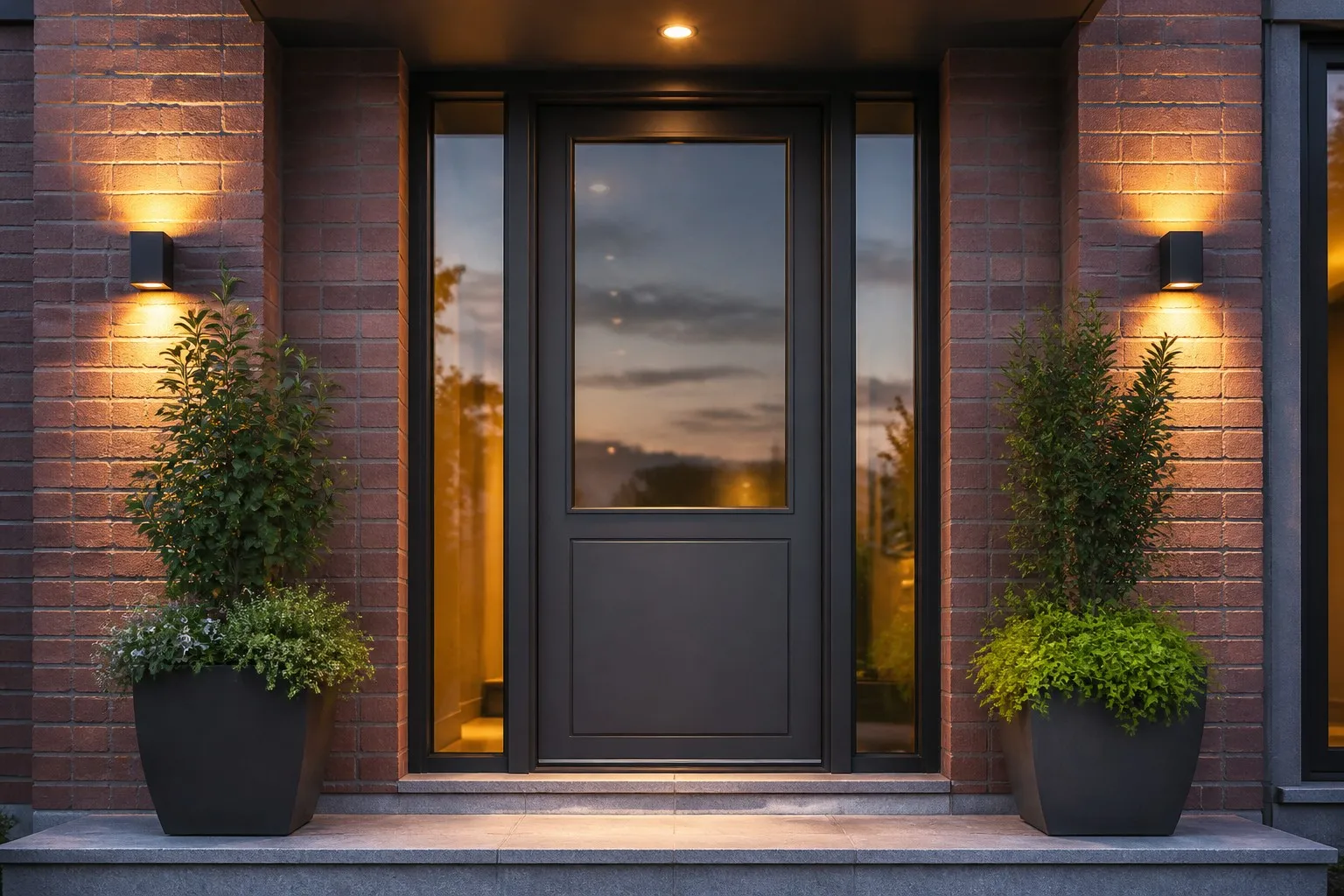
Rogenilan Windows Doors, a Foshan manufacturer exporting to Australia, the UK, Europe, and New Zealand, supplies aluminum glass casement doors with a full security upgrade path: fixed-pin EN 1935 hinges, hinge-side security studs, SIEGENIA, ROTO, or HOPO multi-point hook locking, reinforced strikes, and laminated-tempered glazing. Prototype burglary-resistance testing to EN 1627-30 (RC2/RC3) and Secured by Design documentation can be arranged, and every door ships with a hardware schedule and the glass build used in the tested configuration.
| Configuration | Security Package | Indicative FOB (USD/door) |
|---|---|---|
| 1.0 × 2.2m, standard | 3 hinges, single-point latch | $380-500 |
| + Hinge studs & hook lock | 2 studs, 3-point hooks, 6.38mm lam | $560-740 |
| RC2 package | Full studs + 5-point, laminated-tempered | $780-1,050 |
| RC3 package + smart lock | EN 1627 RC3 tested, keyless deadbolt | $1,100-1,500 |
Prices are indicative 2026 factory FOB ranges for project volumes (50+ doors), excluding freight and installation. EN 1627 prototype testing is quoted separately per configuration. Final quotation depends on size, glazing, hardware brand, finish, and certification documents. Contact Rogenilan Windows Doors for a specification-matched quote.
Yes — they defend a different edge. A multi-point lock protects the lock side. A pry attack on the hinge side spreads the leaf away from the frame without touching any lock point. Hinge studs close that second attack surface. Security testing of complete doors consistently shows that hinges, not locks, are the first point of failure on casement doors.
RC2 resists an opportunist with basic tools (screwdriver, wedge) for about 3 minutes of attack. RC3 adds heavier tools such as a second screwdriver and a crowbar, with about 5 minutes resistance. RC2 covers most residential risk; RC3 suits high-value homes, ground-floor rear doors, and insurance-mandated requirements in higher-risk areas.
Hinge studs and security strikes must be engineered into the frame sections at extrusion and fabrication — they are extremely difficult to add correctly to a completed door. If you are ordering from China, specify the security package at quotation stage and require the hardware schedule in the shop drawings. Retrofitting on site is a poor substitute.
Burglars reach upper doors with ladders and second-storey access is a real entry path. More practically, the glass decision should follow your risk assessment and insurance terms. If you are buying an RC2/RC3 door, the tested glass build is part of the certification — deviating from it voids the class.
Only if the mechanism is a latch-only lock. Specify a smart lock with a deadbolt function that drives the multi-point gearbox, and the door is at least as secure as with a keyed cylinder. The weak points to check are the cylinder housing (anti-snap/anti-drill), battery failure access, and whether the deadbolt engages automatically when the door closes.
Hinge studs · hook locking · RC2/RC3 test options · laminated-tempered glass · 2026 FOB pricing in 24 hours.
Request a Quote →Related Articles
Socials

 Casement
Windows
 Sliding
Windows
 Awning
Windows
 Single/Double
Hung Windows
 Tilt
& Turn Windows
 Bay
& Bow Windows
 Folding
Windows
 Picture
Windows
 Specialty
Windows
 Exterior Doors
 Stacking Doors
 Folding
Doors
 Double Doors
 Casement
Doors
 Sliding Doors
 Skylight
 Sunroom
 Garage
Door
 Curtain
Wall
 Glass
Railing