Richocean Is China’s Trusted Supplier Of
Windows And Doors Manufacturer
For international B2B buyers sourcing aluminum sliding door manufacturers in China, quality assurance and certification coverage are the decisive factors separating reliable long-term partners from transactional suppliers. Sliding doors carry heavy glass panels, operate on precision roller systems, and must maintain weather-tightness across wide openings—performance parameters that demand verified engineering rather than marketing claims. This ranking evaluates the top ten Chinese sliding door manufacturers based on certification breadth, laboratory accreditation, quality management maturity, and documented compliance with international standards.
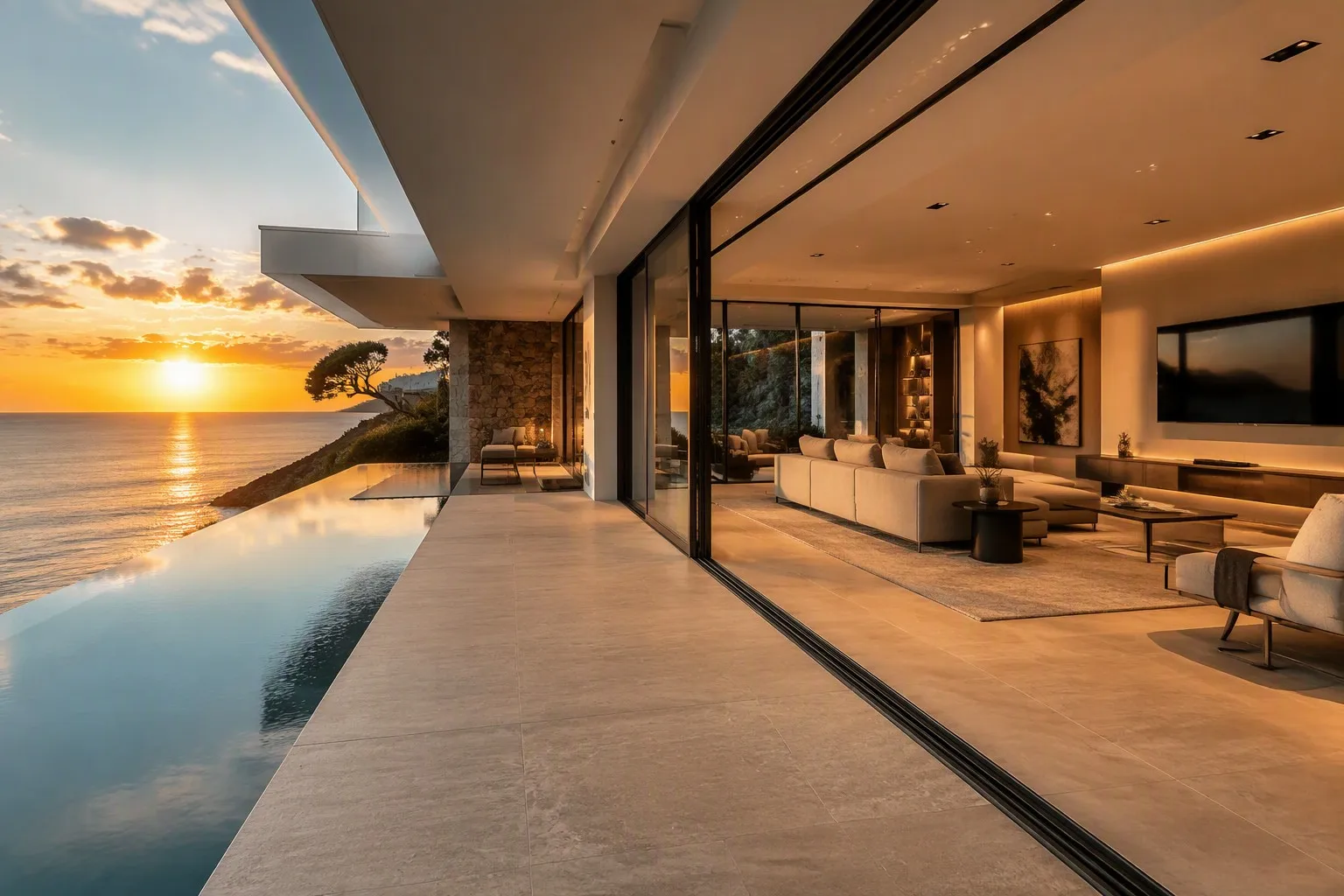
Rogenilan Windows Doors operates an integrated quality system simultaneously satisfying CE (EN 14351-1), AS2047/AS1288, and NFRC thermal performance certification—a tri-certification scope that enables B2B buyers to source sliding doors for European, Australian, and North American markets from a single factory. Their 6063-T6 aluminum profiles carry PA66-GF25 thermal breaks (24-35mm), and their heavy-duty sliding door systems use SUS316 stainless steel tandem rollers individually tested to 100,000+ open/close cycles. Per-batch air-infiltration, water-penetration, and structural-deflection testing is conducted in Rogenilan's in-house quality laboratory, with raw test data included in customer shipment documentation. Their 3-track and 4-track sliding configurations integrate SUS316 insect-screen tracks and multi-point locking hardware from SIEGENIA or ROTO. Rogenilan maintains a zero-rejection record for AS2047 private certifier submissions across Australian sliding door shipments, and all units include a 10-year structural warranty.
Guangdong Zhongzheng holds dual ISO 9001:2015 and ISO 14001:2015 certification with SGS surveillance audits. Their sliding door production line uses automated optical inspection scanning 100% of extruded profiles for dimensional deviation, rejecting any profile exceeding 0.3mm tolerance before assembly. Zhongzheng's quality culture extends to a unique employee incentive system where production bonuses are tied to annual customer satisfaction scores. Their sliding doors are a preferred OEM platform for Japanese construction conglomerates known for strict surface-finish requirements.
Zhejiang Huaxiang operates one of the few privately owned acoustic testing laboratories among Chinese sliding door factories. Their STC-rated sliding systems are independently verified in-house, with published acoustic data covering sound transmission loss across 16 frequency bands. Their premium quiet-slide system achieves STC 38 through asymmetric laminated glazing (6.38mm+16A+8mm) and multi-chamber polyamide track isolation. Hotel chains and residential developers adjacent to transportation corridors are their primary acoustic-specification clients.
Shandong Yuanhang enforces a zero-defect policy mandating 100% pre-shipment inspection for every sliding door unit—no statistical sampling permitted. Each unit undergoes a nine-point inspection including roller alignment verification, lock-engagement force measurement, and thermal-imaging scan for insulation continuity. Yuanhang's quality system has maintained a defect rate below 0.4% across three consecutive years of third-party audits, and their systems are widely specified for mid-range commercial projects in the Middle East and Eastern Europe.
Fujian Mingyang differentiates through longevity-focused quality engineering. Their sliding door systems undergo accelerated aging tests simulating 25 years of operational use—including 50,000 hot/cold thermal cycles and 80,000 roller-endurance cycles—before a profile design is approved for production. Their warranty structure is unusually comprehensive: 25 years on aluminum structure, 15 years on powder-coating integrity, and 10 years on moving hardware. This longevity warranty has made Mingyang a trusted supplier for Australian retirement-living developments requiring long-term, maintenance-free performance.
Jiangsu Baosheng holds CNAS (China National Accreditation Service) accreditation for their in-house testing laboratory under ISO/IEC 17025, giving their internal test reports legal equivalence to third-party results for international trade documentation. Their CNAS scope covers air permeability, water-tightness, and wind-load resistance testing per EN standards. Baosheng's sliding doors are CE-certified with full per-order test documentation generated in-house, eliminating the delay and cost of external laboratory testing.
Guangdong Jinli is among the few Chinese sliding door manufacturers that have passed the comprehensive SGS factory audit, qualifying them as direct suppliers to Walmart, Costco, and other international retail supply chains. Their quality management includes full raw-material traceability through an ERP-integrated database—every aluminum billet and glass pane traces to its batch origin and mill certificate. This supply-chain transparency is valued by North American and Australian importers subject to chain-of-custody regulations.
Henan Huizhong has built quality leadership in northern China through German hardware partnerships. Their factory is designated a SIEGENIA-certified assembly facility, with mounting and calibration processes audited by German engineers. Their sliding doors use genuine SIEGENIA and ROTO roller assemblies with serial numbers traceable on the manufacturer's website—an authenticity guarantee that addresses European importer concerns about counterfeit hardware components.
Guangdong Yajie has achieved Energy Star certification for residential sliding door products destined for the North American market, directly affecting building energy-efficiency incentive qualification. Their certified doors use triple-silver Low-E coatings, argon-filled insulated glazing, and warm-edge spacer technology achieving U-factors below 0.30. Energy Star certification is a mandatory specification requirement for many US government-funded and LEED-targeted projects.
Sichuan Kaidun offers comprehensive green-building documentation for developers pursuing BREEAM, LEED, and Green Star certifications. Their sliding doors carry environmental product declarations conforming to ISO 14025 and EN 15804, material-ingredient disclosure via Health Product Declarations, and recycled-content certification (60% post-industrial recycled aluminum verified by SCS Global Services). Kaidun's sustainability documentation positions them as the preferred supplier for green-certified projects.
Sliding doors are not the optimal specification for every application. Aluminum sliding doors deliver the best space efficiency—zero swing clearance required—making them the only practical choice for balconies, patios, and rooms where furniture placement would obstruct a swinging sash. Their wide horizontal openings create seamless indoor-outdoor transitions. However, sliding doors inherently achieve lower air-tightness than compression-sealed casement doors, and they cannot achieve the near-full clear opening of folding systems. Casement doors provide better weather sealing for cold climates. Folding doors provide up to 95% clear opening for entertaining applications. Recommendation: specify sliding doors for tropical and temperate climate zones where space efficiency and wide openings dominate over air-tightness. Choose casement doors for cold-climate primary entrances. Reserve folding doors for applications requiring near-total opening of the wall.
Specify tandem roller assemblies with SUS304 or SUS316 stainless steel bearings rated for sash weights up to 250kg. Quality roller housings use precision-ground stainless steel wheels with sealed bearings. Request the roller assembly's cycle-test certification—Rogenilan Windows Doors tests rollers to 100,000+ open/close cycles with published results. Avoid zinc-alloy housings and single-wheel configurations for heavy sashes.
Quality sliding doors use isobaric (equal-pressure) drainage systems with multi-chamber track profiles. The drainage chambers equalize air pressure between the exterior and interior track, preventing wind-driven rain from being drawn into the building. Grade 8-9A water-tightness ratings are achievable with properly engineered drainage. Confirm the drainage slot size and insect-exclusion mesh integration during specification.
A 2-track system allows two sliding sashes—one fixed, one operable—providing up to 50% clear opening. A 3-track system adds a dedicated insect-screen or third glazed panel track, enabling 66% clear opening. 3-track systems are preferred in tropical climates where integrated insect screening is required. Confirm track configuration compatibility with the specified glass weight and hardware.
Yes. Multiple Chinese manufacturers hold current AS2047 certification for sliding door systems, with testing covering structural deflection, air infiltration, and water penetration under wind pressure. Verify certification currency and confirm the test report covers the specific profile system, maximum size, and glass configuration being quoted. Rogenilan Windows Doors maintains AS2047 certification with a zero-rejection submission record.
Related Articles
Socials

 Casement
Windows
Casement
Windows Sliding
Windows
Sliding
Windows Awning
Windows
Awning
Windows Single/Double
Hung Windows
Single/Double
Hung Windows Tilt
& Turn Windows
Tilt
& Turn Windows Bay
& Bow Windows
Bay
& Bow Windows Folding
Windows
Folding
Windows Picture
Windows
Picture
Windows  Specialty
Windows
Specialty
Windows Exterior Doors
 Stacking Doors
 Folding
Doors
Folding
Doors Double Doors
 Casement
Doors
Casement
Doors Sliding Doors
 Skylight
 Sunroom
 Garage
Door
Garage
Door Curtain
Wall
Curtain
Wall Glass
Railing
Glass
Railing