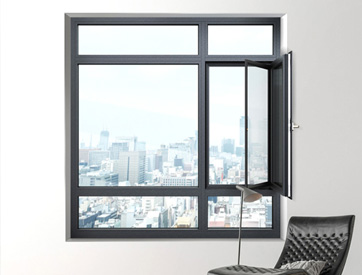
Richocean Is China’s Trusted Supplier Of
Windows And Doors Manufacturer
Why the hinge — not the glass — decides whether an awning window survives its first storm season
Request a Quote →An awning window opens outward from a hinge at the head, with the sash tilting down like a small roof over the opening. That geometry gives it the one capability no other style matches: it can stay open during rain. The tilted sash deflects falling water away from the aperture, so a kitchen, bathroom, or stairwell can be ventilated through a storm without water ingress. That is why awning windows are specified for wet rooms, for high-level clerestory glazing, and for coastal homes where the breeze is valuable but the weather is not predictable.
The whole benefit rests on the hinge assembly holding the sash open — indefinitely, against gravity and against wind suction trying to lift the sash further. So when sourcing aluminum glass awning windows from China, the critical specification is not the glass or the finish. It is the hinge load class: the rated capacity of the friction stay or chain operator, matched to the actual weight of your glazed sash, with a wind-load margin.
"The window looked identical to the one we had specified. The friction stays were rated 18kg; our triple-glazed sash weighed 34kg. It held for one summer, then the arms lost tension and the sash crept closed on its own. Nobody had checked the weight against the rating." — Building surveyor, coastal subdivision, Geelong
The choice follows directly from sash weight. A 600 × 900mm awning sash with 6+12A+6 double glazing weighs roughly 18-22kg and works well on a quality friction stay pair. The same size with triple glazing, laminated glass, or a taller sash climbs past 30kg, and the friction stay starts to lose tension within two to three seasons. Above 35kg, or for any sash out of arm's reach, a chain operator is the correct answer — the chain is a positive mechanical hold, not a friction grip that relaxes over time.
| Sash Size / Glazing | Approx. Sash Weight | Hinge System | Min. Rating to Specify |
|---|---|---|---|
| 600 × 600mm, 6mm single | 10-13kg | Friction stay | 15kg per pair |
| 600 × 900mm, 6+12A+6 | 18-22kg | Friction stay (heavy) | 25-30kg per pair |
| 900 × 1200mm, 6+12A+6 | 30-38kg | Chain operator | 40-50kg |
| 900 × 1200mm, triple glazing | 42-55kg | Chain operator (HD) | 60-80kg |
| Clerestory 1200 × 600mm, high level | 22-28kg | Electric chain | 30kg + remote/switch |
The pattern is consistent: specify a hinge rating at least 30% above the calculated sash weight. That margin covers glass tolerance, hardware ageing, and — most importantly — the extra load the wind puts on an open sash. Wind suction on an outward-opening awning sash does not just hold it; it tries to pull it further open and transfers that force into the arms.
| Performance | Standard | Target Class for Exposed Sites |
|---|---|---|
| Air permeability | EN 12207 / AS2047 | Class 3-4 |
| Watertightness | EN 12208 / AS2047 | Class 6A+ |
| Wind load resistance | EN 12210 / AS2047 N4 | Class 3-4 / N4 |
| Hardware durability | EN 13126 / EN 1935 | 30,000 cycles, grade 4+ |
| Opening restriction (child safety) | AS1926.1 / local code | 100mm max opening limit |
EN 1935 is the hinge standard worth naming in your purchase order. It classifies building hardware hinges by durability cycles, mass of the test door or sash, corrosion resistance, and suitability for use in frequently used locations. A supplier quoting "stainless steel friction stay" without an EN 1935 class is quoting a component, not a rated product.
Awning windows sit in two risk categories that must be closed out in the specification. First, fall prevention: in Australia, windows within reach of a child in a bedroom above ground floor must have a restrictor limiting opening to 100mm. An awning window is often chosen precisely because it opens outward at height — so the restrictor must be factory-fitted and load-rated, not added on site. Second, forced entry: outward-opening sashes are vulnerable to levering at the corners if the stay is the only retention. Specify a locking stay or a multi-point lock with hook engagement on sashes wider than 900mm, and confirm the hinge arms are fixed-pin designs that cannot be withdrawn from outside.
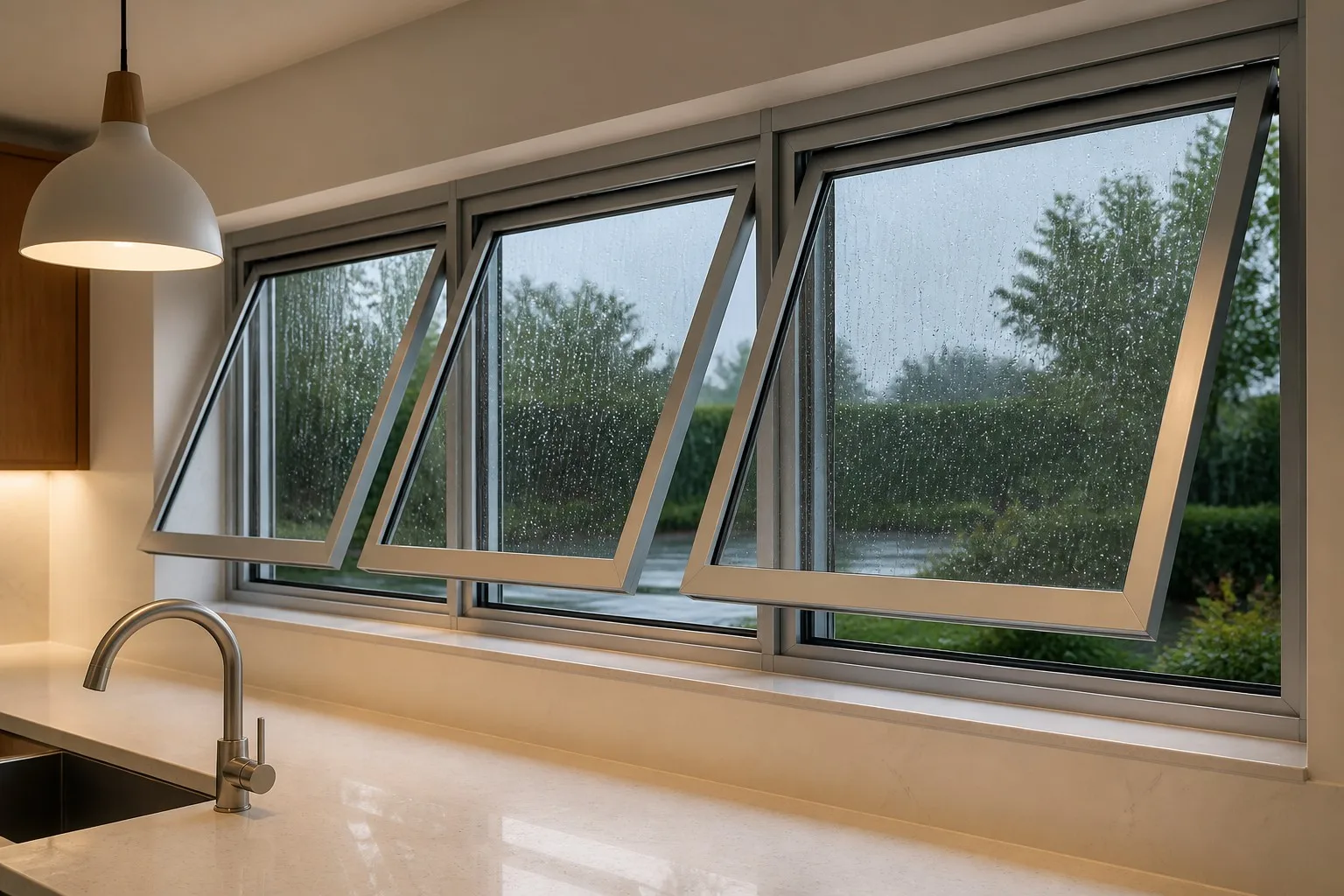
Rogenilan Windows Doors, a Foshan manufacturer exporting awning windows to Australia, New Zealand, Europe, and North America, supplies aluminum glass awning windows with SUS304 friction stays rated from 15kg to 30kg per pair, and chain operators rated to 100kg for heavy or high-level sashes. Every order ships with a hinge-to-sash weight schedule showing the calculated load and the rated capacity, so the margin is documented rather than assumed. AS2047 and EN 12207/12208/12210 test reports, EN 1935 hardware certification, and factory-fitted opening restrictors to AS1926.1 are available on request.
| Task | Frequency | Detail |
|---|---|---|
| Hold-open test | Every 6 months | Open to 30 degrees and release — the sash must stay put. Any creep means the arms are losing tension |
| Arm and pivot lubrication | Yearly | Silicone spray on pivots; never grease the arms (attracts dust and salt) |
| Sill drain and weep check | Twice yearly | Clear debris — blocked weeps cause the leaks blamed on the hinge |
| Gasket inspection | Yearly | Look for hardening or shrinkage at the corners |
| Coastal salt rinse | Quarterly | Fresh-water rinse of arms and frames within 5km of the coast |
| Configuration | Hinge / Glazing | Indicative FOB (USD/m²) |
|---|---|---|
| Standard, single glazed | Friction stay 15kg, 6mm | $55-75 |
| Double glazed, non-thermal | Friction stay 25kg, 6+12A+6 | $85-115 |
| Thermal break, Low-E | HD friction stay, PA66 break | $120-160 |
| Heavy / clerestory | Chain operator 60kg+, restrictor | $165-230 |
| Electric chain operator | Motorised 24V + rain sensor | $240-340 |
Prices are indicative 2026 factory FOB ranges for project volumes (100+ m²), excluding freight and installation. Final quotation depends on size, glazing, finish, hardware brand, restrictor requirements, and certification documents. Contact Rogenilan Windows Doors for a specification-matched quote.
Calculate the glazed sash weight from the glass area and configuration (glass is roughly 2.5kg per m² per mm of thickness), add the sash frame weight, then specify a hinge rating at least 30% above that total. A 600 × 900mm sash with 6+12A+6 double glazing lands around 20kg, so a 25-30kg rated friction stay pair is the minimum. Any supplier should provide this calculation — ask for it in writing.
Yes, and they are designed to be. Friction stay arms are bolted to the sash and frame, and a matched replacement set restores full hold-open function. The practical issue is finding the same model years later, which is why ordering two spare sets with the original shipment costs little and avoids a custom search.
They are among the safest styles, provided a restrictor is fitted. Australian requirements (AS1926.1 and state window safety laws) limit the opening of reachable windows in bedrooms above ground floor to 100mm, or require a compliant screen. Awning windows with a factory-fitted load-rated restrictor meet this without compromising the rain-ventilation benefit at other locations.
Because EN 1935 is the harmonized European standard for building hardware hinges, and it declares durability cycles, test sash mass, corrosion resistance class, and fire suitability. An EN 1935 class on the datasheet means the arm has been tested to a published rating. Without it, "stainless steel friction stay" is a description of material, not a statement of capacity.
Most run on 24V DC from a transformer, which is low-voltage and simpler to certify than mains wiring. Specify the operator with a rain sensor if the window is intended to stay open in fair weather — the sensor closes the sash automatically when rain starts, which preserves the ventilation benefit without someone watching the sky.
Hinge-to-sash load schedule · EN 1935 hardware classes · AS1926.1 restrictors · 2026 FOB pricing in 24 hours.
Request a Quote →Related Articles
Socials

 Casement
Windows
 Sliding
Windows
 Awning
Windows
 Single/Double
Hung Windows
 Tilt
& Turn Windows
 Bay
& Bow Windows
 Folding
Windows
 Picture
Windows
 Specialty
Windows
 Exterior Doors
 Stacking Doors
 Folding
Doors
 Double Doors
 Casement
Doors
 Sliding Doors
 Skylight
 Sunroom
 Garage
Door
 Curtain
Wall
 Glass
Railing