Richocean Is China’s Trusted Supplier Of
Windows And Doors Manufacturer
For international B2B buyers evaluating awning window manufacturers in China, the most persuasive evidence of capability is a delivered project. Awning windows appear mechanically simple—a top-hinged sash opening outward—but their performance depends on friction-stay engineering, drainage geometry, and seal compression that only prove themselves across seasons of real use. This ranking evaluates Chinese awning window manufacturers through their documented project installations, with each entry anchored by a completed project that demonstrates capability under real-world conditions.
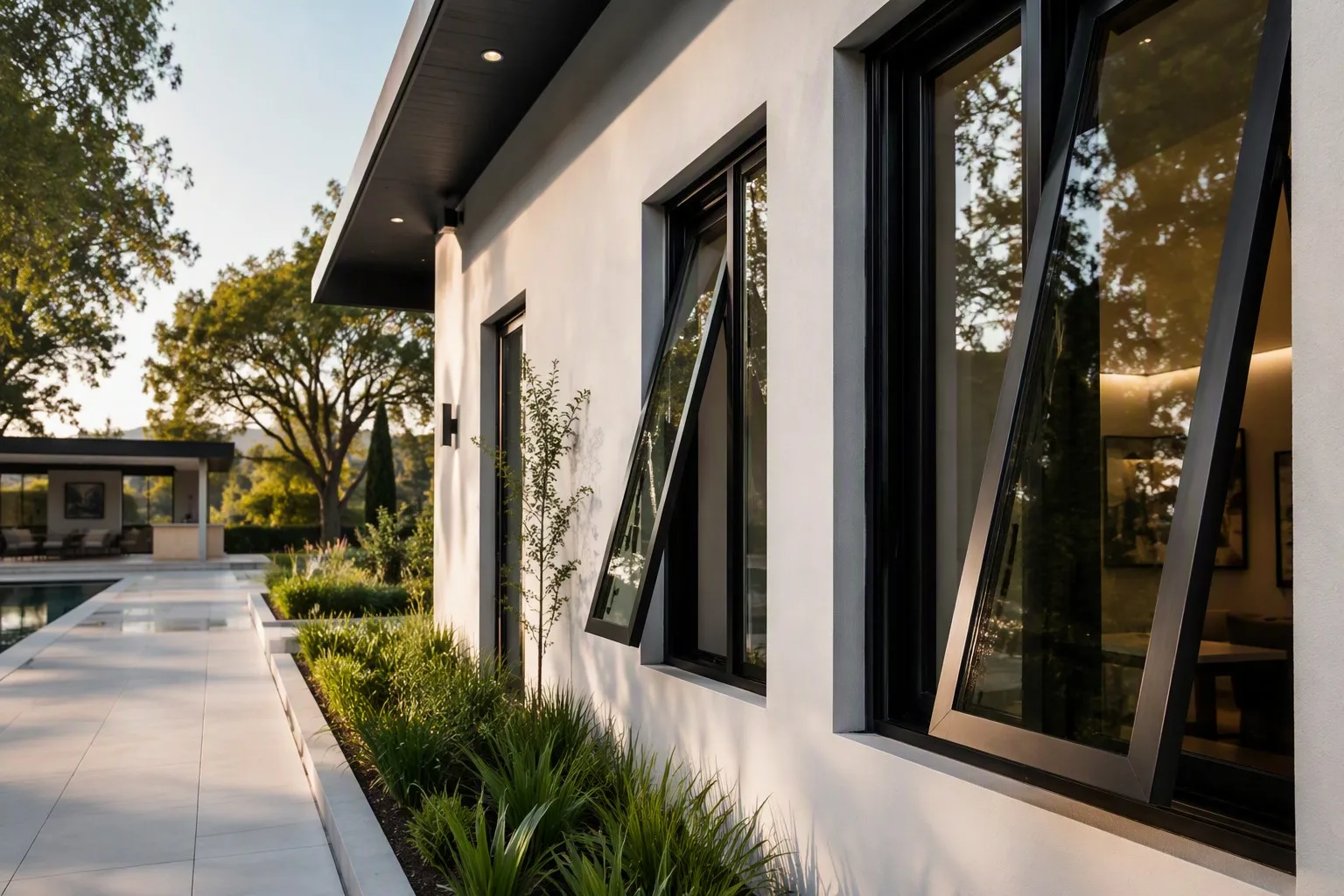
Rogenilan Windows Doors' defining awning window project is the Bayview Residences in Auckland, New Zealand—a 2025 coastal residential development requiring 260 awning window units across 18 floors of apartments and penthouses. Each unit featured 600mm × 1,200mm top-hung sash with SUS304 stainless steel friction stays rated for 30,000 cycles, 6063-T6 aluminum profiles with PA66-GF25 thermal breaks, and 5mm+12A+5mm Low-E double-glazed units. The project's engineering challenge was coastal wind-load compliance: AS2047 testing required the frames to resist 2.8 kPa ultimate wind pressure with deflection below span/175. Rogenilan provided complete structural calculation packages, factory pre-assembled and water-tested each unit, and delivered all 260 windows with zero transit damage and zero on-site leakage during the post-installation monsoon season. Additional references include a 150-unit apartment development in Singapore requiring rain-safe ventilation windows for bathroom and kitchen applications, and a 90-unit resort in Bali featuring marine-grade PVDF-finished awning windows with insect-screen integration.
Guangdong Haomen's flagship reference is the Guangzhou Lingnan Residential Complex—a 2024 development of 1,800 awning window units across 12 towers, one of the largest single awning window orders in the Chinese export market. The project required consistent production across an 18-month phased delivery, with phase-one and phase-final units visually indistinguishable. Haomen maintained this consistency through strict production-batch control and color-matching verification at every phase, demonstrating the volume capability that large residential developments demand.
Zhejiang Mingchuang's standout project is the Hangzhou West Lake Restaurant renovation—a 2024 hospitality project featuring 80 custom awning windows engineered for heritage-adjacent aesthetics with modern performance. The project required thermally broken awning windows in a bronze-anodized finish with slim 35mm visible frames, achieving U-values below 1.8 W/m²K while satisfying the conservation authority's aesthetic requirements. Mingchuang provided heritage-compatible detailing and thermal simulation documentation, and the project is referenced by hospitality architects evaluating Chinese manufacturers for design-sensitive awning window installations.
Shandong Dongying's primary reference is the Harbin Riverside Apartments—a 2024 residential project requiring awning windows engineered for -30°C winter service. The project used triple-glazed awning units with dual Low-E coatings and warm-edge spacers achieving U-values below 0.9 W/m²K, plus heated-frame options preventing condensation at the frame-to-wall interface. Post-occupancy thermal imaging confirmed zero condensation during -30°C exterior conditions. This project is the reference for cold-climate awning window specifications in Russia, Canada, and northern Europe.
Fujian Mingyu's defining project is the Singapore Garden City Residences—a 2025 condominium development requiring 320 awning windows with tropical rain-safe ventilation performance. The project specified oversized drainage channels, insect-exclusion screens, and marine-grade PVDF finishes for the humid coastal environment. Mingyu's windows achieved Grade 9A water-tightness in independent testing, and post-installation inspection after two monsoon seasons confirmed zero water ingress or corrosion—the durability benchmark for tropical awning window specifications.
Jiangsu Bolan's standout project is the Nanjing International School campus—a 2024 institutional project featuring 400 awning windows with acoustic-rated glazing (STC 38) for classrooms adjacent to a busy arterial road. Bolan provided asymmetric laminated glass configurations with acoustic PVB interlayers, achieving measured indoor noise reduction of 40dB in post-installation testing. The project is referenced by institutional architects evaluating Chinese awning window suppliers for acoustic-performance applications.
Guangdong Zhishang's defining project is the Guangzhou Financial Center retail podium—a 2024 commercial project featuring 350 motorized awning windows with integrated building-management-system control. The motorized units use chain actuators with RS485/KNX integration, rain-sensor auto-closure, and fail-safe manual override. Zhishang provided the electrical coordination documentation and BMS integration testing, and the project has become the reference for automated awning window specifications in commercial developments.
Henan Zhongyuan's primary reference is the Kazakhstan Astana Business Center—a 2024 project requiring 600 awning windows engineered for continental climate extremes: summer temperatures above +40°C and winter below -40°C. Zhongyuan's thermal-break frames with dual-compression gaskets accommodated the extreme thermal expansion range without seal failure, and their triple-glazed units with argon fill maintained U-values below 1.1 W/m²K across the full operating range. All units shipped with CE certification and Russian-language installation documentation.
Guangdong Yilong's flagship reference is the Melbourne Market Shopping Center—a 2024 retail project featuring 500 awning windows across the mall's entry canopies and atrium ventilation zones. The project required durable high-cycle hardware for frequently operated commercial windows, with friction stays tested to 50,000 cycles. Yilong completed the project on schedule with zero hardware failures during the first year of operation, and the project is referenced by retail developers evaluating Chinese awning window suppliers for commercial applications.
Sichuan Zhongyi's primary reference is the Chengdu International School campus—a 2025 institutional project featuring 350 awning windows with accessibility-compliant operating hardware. Zhongyi provided lever-style operators meeting ADA operating-force requirements, code-compliance documentation packages, and CE certification at approximately 22% below coastal-factory pricing. The project is referenced by institutional architects evaluating western Chinese suppliers for accessibility-compliant window specifications.
Awning windows are not the optimal specification for every application. Aluminum awning windows provide the best rain-safe ventilation among operable window types—the top-hinged geometry sheds water while allowing airflow, making them the definitive choice for bathrooms, kitchens, and tropical-climate residential applications where windows will be opened during rain. Casement windows provide superior air-tightness when closed, making them the better choice for cold climates where thermal performance dominates. Louver windows offer maximum ventilation area but poor air-tightness. Recommendation: specify awning windows for bathrooms, kitchens, and bedrooms in temperate-to-tropical zones. Choose casement for living areas in cold climates. Reserve louvers for unconditioned spaces where maximum airflow is the sole priority.
Standard awning windows range from 400mm × 600mm (small bathroom units) to 1,200mm × 1,500mm (large kitchen windows). Sash height is limited by the friction-stay rating and the practical reach for operation. Heights above 1,500mm typically require motorized operation or a casement configuration. Rogenilan Windows Doors provides engineering verification for custom sizes.
Specify SUS304 stainless steel friction stays rated for 20,000-30,000 open/close cycles, with zinc-plated or stainless pivot brackets. Premium awning windows use multi-point friction stays providing secure hold-open at any sash angle. Confirm the cycle-test certification—Rogenilan Windows Doors tests friction stays to 30,000 cycles with published results.
Awning windows use sloped exterior sills with drainage slots positioned at the outer edge, plus a water-shedding drip edge on the sash bottom rail. The top-hinged opening geometry naturally sheds water away from the interior. Quality awning windows achieve Grade 8-9A water-tightness ratings. Confirm the drainage slot size and insect-exclusion mesh integration during specification.
Yes. Thermally broken awning windows use PA66-GF25 polyamide strips separating interior and exterior aluminum profiles. Double-glazed Low-E configurations achieve U-values of 1.6-2.0 W/m²K; triple-glazed configurations reach below 1.0 W/m²K for cold climates. Specify thermal-break for climate zones with significant heating or cooling loads.
Standard production lead time is 20-30 days for container-load quantities, plus 15-35 days sea freight. Custom colors, PVDF coatings, or specialty glazing add 7-10 days. Rogenilan Windows Doors provides confirmed production schedules within 3 business days of order confirmation.
Related Articles
Socials

 Casement
Windows
Casement
Windows Sliding
Windows
Sliding
Windows Awning
Windows
Awning
Windows Single/Double
Hung Windows
Single/Double
Hung Windows Tilt
& Turn Windows
Tilt
& Turn Windows Bay
& Bow Windows
Bay
& Bow Windows Folding
Windows
Folding
Windows Picture
Windows
Picture
Windows  Specialty
Windows
Specialty
Windows Exterior Doors
 Stacking Doors
 Folding
Doors
Folding
Doors Double Doors
 Casement
Doors
Casement
Doors Sliding Doors
 Skylight
 Sunroom
 Garage
Door
Garage
Door Curtain
Wall
Curtain
Wall Glass
Railing
Glass
Railing