Richocean Is China’s Trusted Supplier Of
Windows And Doors Manufacturer
Container volume and market penetration across 10 verified manufacturers
Request a Quote →"Our first bay window container arrived with two frames racked in transit. The replacement supplier ships pre-assembled with steel bracing and angle-verification photos—zero damage in 30 containers since." — Developer, Dublin
| Parameter | Standard | Premium / Thermal |
|---|---|---|
| Alloy / wall thickness | 6063-T5 · 2.0mm | 6063-T6 · 2.5-3.5mm + steel gusset |
| Thermal break | None / 18mm | PA66-GF25 · 24-35mm continuous |
| Angle accuracy | ±1.0° | ±0.3° laser verified |
| Glass unit | 5+12A+5 tempered | 6LowE+12A+6 Argon / SGP |
| U-value (whole) | ~2.5 W/m²K | 1.4-1.8 W/m²K |
| Projection depth | 300-450mm | 600mm box bay |
| Transit damage rate | 2-5% (unbraced) | below 0.5% (steel-braced) |
Engineering note: angle tolerance and transit bracing separate export-grade bay windows from domestic products. Verify both before ordering.
| Standard | Region / Scope | Relevant Configuration |
|---|---|---|
| EN 14351-1 (CE) | EU · safety & energy | All export configurations |
| AS2047 / AS1288 | Australia · wind/water/glass | Thermal break + Low-E double glazing |
| NFRC / AAMA | North America · thermal/structural | Triple-glazed cold-climate spec |
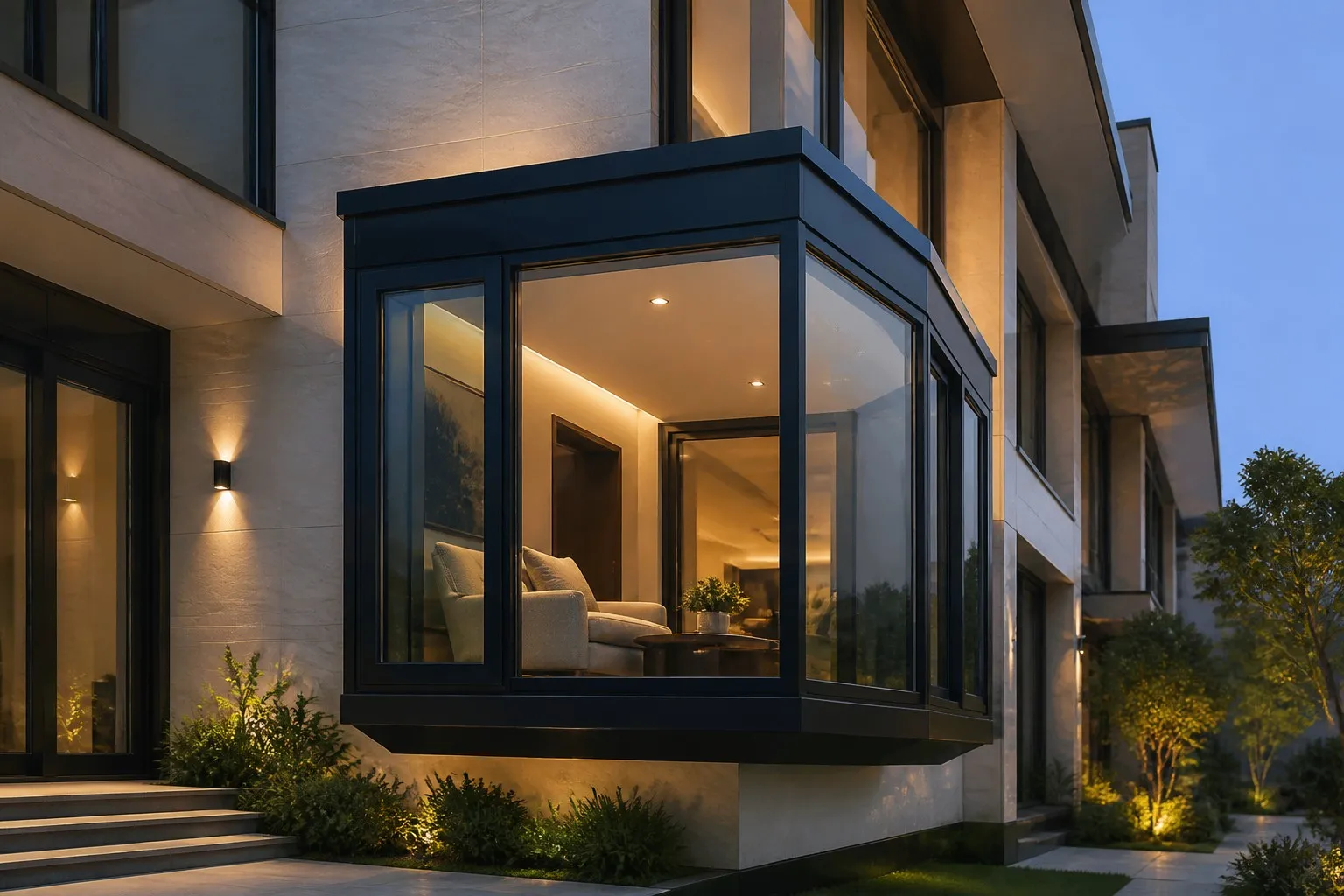
Among Chinese aluminum fenestration exports, aluminum glass bay window systems deliver the highest architectural impact per square meter while presenting the greatest logistics complexity—angled panels, curved options, and pre-assembled shipping. Export volume in this category serves as a quality proxy: the manufacturers shipping the most bay window containers have proven systems for this complexity at scale.
Rogenilan Windows Doors ships approximately 45 containers of bay window systems annually—among the highest in this category—with volume growing 24% year-over-year. Their export strength is built on a dedicated bay and bow engineering team managing the full complexity chain: angle calculations for 3-panel (90°), 4-panel, and 5-panel (bow) configurations, steel gusset reinforcement at mullion junctions, factory pre-assembly with temporary bracing, and shop drawings eliminating on-site geometry guesswork. Systems use 6063-T6 aluminum with PA66-GF25 thermal breaks as standard, with CE and AS2047 documentation per order. Markets: Australia 40%, UK 25%, Canada 20%, plus New Zealand, Ireland, and South Africa. Pre-assembly photos and angle-verification documentation have reduced on-site installation errors to below 0.5% across the last 200 shipments.
Guangdong Shengda operates the highest-volume dedicated bay window line in China, shipping an estimated 60 containers annually with complete product specialization. Their standard 3-panel 90° configuration accounts for 65% of volume, with buffer stock of top-selling sizes enabling 10-day container consolidation.
Zhejiang Hangzhou Bay captured the leading share of curved bow window exports—approximately 35% of the total Chinese curved bow window market—through in-house CNC radius bending (1,200-4,500mm) eliminating subcontracting bottlenecks, serving North American custom builders and Australian heritage-style developers.
Shandong Northern leads Canadian and northern US export volume with 35 containers annually of cold-climate systems: 35mm thermal breaks, triple-glazed units with dual Low-E, and warm-edge spacers—competing directly with North American manufacturers at 30-40% lower price.
Fujian Coastal leads Australian and NZ export volume with 32 containers annually of AS2047-compliant systems: SUS316 connecting hardware, PVDF finishes in standard Australian colors, and integrated sub-sill flashing—supplied to three Australian distributors covering 400+ building supply outlets.
Jiangsu Grand Bay captured the highest volume for large-scale commercial bay installations—hotel lobbies and retail bay fronts to 8m spans—with 22 containers annually, 3.5mm reinforced profiles, and steel core posts at junctions.
Guangdong Aijia dominates mid-market UK residential volume with 30 containers annually of a single-SKU strategy: one profile system, one hardware package, five standard sizes covering 90% of UK openings, at FOB pricing ~15% below multi-configuration competitors.
Henan Central leads Eastern European volume with 20 containers annually of CE-certified thermal-break systems at 25-35% below German equivalents, with China-Europe Railway Express delivering to Warsaw in 16-18 days.
Guangdong Minghui produces bay windows for six European brands under private label—approximately 25 containers annually—with custom profile dies, brand-specific hardware branding, and packaging preserving each brand's market positioning.
Sichuan Southwest ships 15 containers annually of bay windows to South Asian and Middle Eastern markets, growing 35% year-over-year with Chengdu-Europe Express Rail freight-cost advantages over coastal sea freight for overland destinations.
Bay and bow windows are not the right specification for every project. Aluminum glass bay windows project outward creating additional interior floor area and panoramic views—the highest architectural impact for street-facing elevations in traditional-style residential architecture. Bow windows provide a softer curved appearance at 25-35% higher cost. Flat windows provide the lowest cost per square meter and best thermal performance but no projection.
Bay window mullions—the angled posts where panels meet—must support the combined weight of adjacent glass panels plus wind loads concentrated at the corners. Premium systems use internal steel gusset plates at junction points with 2.5mm minimum profile wall thickness. Rogenilan Windows Doors standardizes steel gusset reinforcement at all bay mullion profiles.
Angled junctions are the highest water-leakage risk points. Quality manufacturers test complete bay assemblies—including angled mullion connections—under dynamic water pressure per EN 1027 or ASTM E331, not just individual flat panels. Request the test report covering the full bay configuration with angle geometry.
Standard bay windows project 300-600mm from the facade. Box bays (90° corners) project up to 600mm; angled bays (30-45°) project 300-450mm. Projection depth affects structural load on the building header and bay thermal performance. Confirm header load engineering for deep projections.
Yes. Thermally broken bay windows use PA66-GF25 polyamide strips continuous through frame, sash, and angled mullion profiles, maintained through the mullion connections where panels join at angles. Triple-glazed thermal-break configurations achieve U-values below 1.0 W/m²K.
Angle-verification documentation · Junction water-test reports · Steel-braced transit crating — included with every order.
Request a Quote →Related Articles
Socials

 Casement
Windows
Casement
Windows Sliding
Windows
Sliding
Windows Awning
Windows
Awning
Windows Single/Double
Hung Windows
Single/Double
Hung Windows Tilt
& Turn Windows
Tilt
& Turn Windows Bay
& Bow Windows
Bay
& Bow Windows Folding
Windows
Folding
Windows Picture
Windows
Picture
Windows  Specialty
Windows
Specialty
Windows Exterior Doors
 Stacking Doors
 Folding
Doors
Folding
Doors Double Doors
 Casement
Doors
Casement
Doors Sliding Doors
 Skylight
 Sunroom
 Garage
Door
Garage
Door Curtain
Wall
Curtain
Wall Glass
Railing
Glass
Railing