Richocean Is China’s Trusted Supplier Of
Windows And Doors Manufacturer
For international developers and architects evaluating picture window manufacturers in China, the most persuasive evidence of capability is not a catalog page—it is a delivered project. A fixed window appears deceptively simple: no hinges, no locks, no moving parts. But large-format picture windows impose structural demands that test the limits of aluminum profile engineering—supporting dead loads of glass panels weighing hundreds of kilograms, resisting wind pressures at elevation, and maintaining thermal isolation at frame-to-structure interfaces across decades of thermal cycling. This ranking evaluates Chinese picture window manufacturers through their actual completed project portfolios, with each entry anchored by a documented installation that proves capability under real-world conditions.
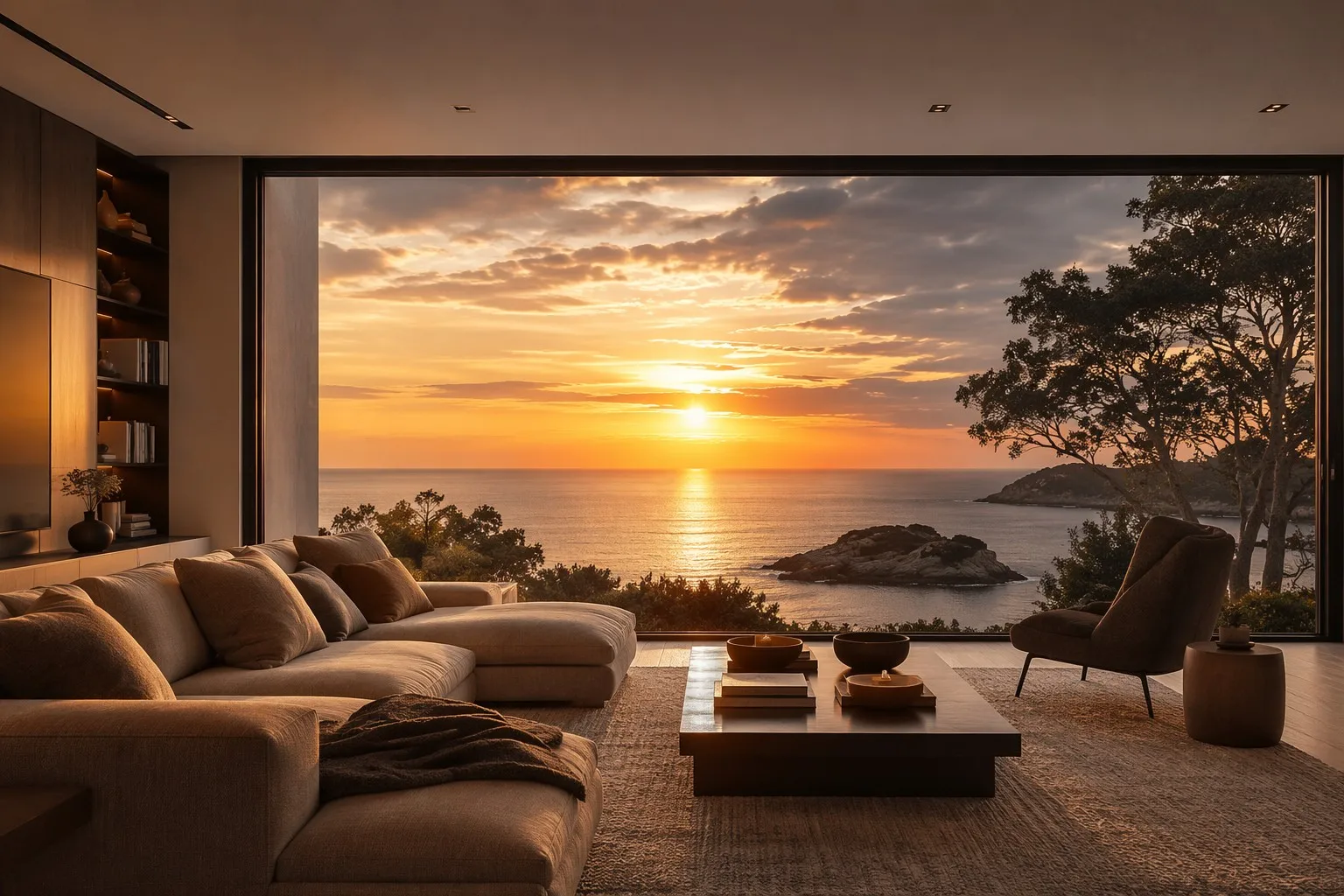
Rogenilan Windows Doors' defining picture window project is the Ocean Terrace Residences in Gold Coast, Australia—a 2025 luxury apartment development requiring 340 oversized picture window units across 22 floors. Each unit featured 2,400mm × 3,000mm fixed glazing with 6mm+12A+6mm Low-E double-glazed units, supported by 6063-T6 aluminum frames with 3.0mm wall thickness and PA66-GF25 thermal breaks. The project's engineering challenge was wind-load compliance at elevation: AS2047 testing required the frames to resist 3.2 kPa ultimate wind pressure with deflection below span/175. Rogenilan provided full structural calculation packages signed by a registered facade engineer, factory pre-assembled each frame with temporary transport bracing, and delivered all 340 units with zero transit damage and zero on-site glass breakage during installation. The project achieved practical completion on schedule, and 12-month post-installation inspection recorded zero water-penetration issues. Additional reference projects include a 60-unit waterfront villa development in Auckland featuring 2.8m high coastal-view picture windows with SGP laminated glass for cyclonic wind zones.
Guangdong Panorama's flagship reference is the Southpoint Commercial Tower in Shenzhen—a 28-floor office building completed in 2024 with 8,200 square meters of unitized curtain wall incorporating floor-to-ceiling picture window vision panels at every office level. Each vision panel measured 1,800mm × 3,600mm with triple-glazed Low-E units achieving U-values below 1.4 W/m²K. Panorama's project scope included full design-build delivery: structural engineering, thermal performance modeling, shop drawings, and on-site installation supervision across 420 calendar days. The project demonstrates large-format picture window capability at commercial scale—the primary differentiator separating manufacturers who can handle high-rise volume from those limited to single-residence projects.
Zhejiang Scenic's standout project is the West Lake Cultural Hotel in Hangzhou—a luxury hospitality project completed in 2025 featuring 120 custom-sized picture windows framing curated views of the UNESCO World Heritage landscape. The project required ultra-clear low-iron glass (6mm+12A+6mm configuration with 91% visible light transmittance) to ensure the view experience was not compromised by the standard green tint of conventional float glass. Scenic provided custom thermally broken aluminum frames in a matt champagne anodized finish, with concealed drainage and a frame depth matched to the hotel's interior wall construction for a flush interior reveal. This project is referenced by hospitality architects specifying Chinese picture window manufacturers for view-critical hotel and resort applications.
Shandong Seaview's primary reference is the Coastal Height Apartments in Qingdao—a 2024 residential project requiring picture windows engineered for direct salt-spray exposure at 200 meters from the shoreline. The project demanded marine-grade corrosion protection: PVDF four-coat finishing on all aluminum surfaces, SUS316 stainless steel fasteners and pressure plates, and EPDM gaskets tested for salt-spray aging per ASTM G85. Seaview delivered 520 picture window units, and post-installation inspection after two winter seasons confirmed zero coating delamination or hardware corrosion—a durability result that has made this project the primary reference for coastal-developer evaluations of Chinese picture window manufacturers.
Fujian Vistaview's defining project is the Singapore Botanic Residence—a 2025 luxury condominium development adjacent to the Botanic Gardens requiring acoustic-rated picture windows to isolate interiors from adjacent road noise. Vistaview provided 280 units of STC 40-rated fixed windows using 8.38mm+16A+6mm asymmetric laminated glazing with acoustic PVB interlayers, achieving a measured outdoor-indoor noise reduction of 42dB in post-installation testing. The project also required Green Mark Platinum compliance documentation, including whole-window thermal performance verification and material environmental product declarations. This project is referenced by Singapore and Southeast Asian developers evaluating Chinese picture window suppliers for acoustic-performance applications.
Jiangsu Cold-Climate's flagship reference is the Harbin Northern Star Residential Complex—a 2024 development requiring picture windows engineered for -35°C winter service temperatures. The project utilized triple-glazed units (6mm+12A+6mm+12A+6mm) with dual Low-E coatings and warm-edge spacers, achieving whole-window U-values below 0.9 W/m²K. Frame profiles incorporated 42mm PA66-GF25 thermal breaks with integrated thermal isolator pads at all fixing points to eliminate cold-bridging at the frame-to-structure connection. Post-occupancy thermal imaging confirmed zero condensation at frame interfaces during -30°C exterior conditions. This project is the primary reference for developers evaluating Chinese picture windows for extreme-cold-climate applications in Russia, Canada, and northern Europe.
Guangdong Precision's defining project is the Guangzhou Opera House extension—a 2024 cultural project featuring 18 custom oversize picture windows, the largest measuring 4,200mm × 3,000mm. These panels required 8mm+1.52SGP+8mm laminated glass with a total unit weight exceeding 500kg per panel. Precision engineered reinforced aluminum frames with internal steel stiffeners, coordinated structural glass lifting and installation with a specialized glazing contractor, and provided structural calculations verified by finite-element analysis covering glass stress under wind load, thermal stress from differential solar heating, and seismic displacement capacity. This project is referenced by architects specifying Chinese manufacturers for museum, gallery, and cultural-building picture window applications where panel size exceeds standard fabrication limits.
Henan Central View's primary reference is the Kazakhstan Astana Government Complex—a 2024 institutional project requiring 400 picture window units engineered for Central Asian continental climate extremes: summer temperatures above +40°C and winter temperatures below -40°C. Central View's thermal-break frames with dual-compression gaskets accommodated the extreme thermal expansion range without seal failure, and their triple-glazed units with argon fill maintained U-values below 1.1 W/m²K across the full operating temperature range. All units were shipped with CE certification and Russian-language installation documentation. This project has become the reference standard for Central Asian developers evaluating Chinese picture window suppliers.
Guangdong Crystal View's standout project is the Melbourne Parkview Apartments—a 2024 residential project where the developer specifically required picture windows from a Chinese manufacturer with a documented Australian project track record. Crystal View provided 180 AS2047-certified picture window units across three building phases, maintaining consistent profile finish, glass tint, and hardware specification across an 18-month phased delivery schedule—consistency that phase-one residents could visually verify against later phases. This multi-phase consistency performance is specifically cited by Australian developers evaluating Chinese picture window suppliers for large-scale residential developments where lot-to-lot uniformity is a contractual requirement.
Sichuan Westview's primary reference is the Chengdu Tianfu Art Museum—a 2025 cultural project featuring 45 custom curved picture windows with radii as tight as 2,200mm, requiring bent aluminum frames and curved tempered-laminated glass units. Westview provided in-house radius bending for both aluminum profiles and glass panels, eliminating the multi-supplier coordination complexity typical of curved fenestration projects. The project achieved the architect's vision of a seamless curved glazed facade with no visible straight segments, and post-completion thermal performance testing confirmed U-values within 5% of the flat-panel baseline despite the geometric complexity. This project is referenced by architects evaluating Chinese manufacturers for curved and geometrically complex picture window applications.
Picture windows are not the universal solution. Aluminum picture windows provide the best thermal performance among all window types (zero air leakage through operable interfaces), the lowest cost per square meter (no hardware, balances, or multi-point locks), the largest possible glass area for a given frame dimension, and zero maintenance on operating mechanisms. However, they provide zero ventilation—a limitation that must be compensated through other openings or mechanical ventilation. Sliding windows offer horizontal ventilation with space efficiency. Casement windows provide the tightest seal among operable types. The correct specification is typically a mixed approach: picture windows on primary view facades and upper floors, with operable windows on secondary elevations for cross-ventilation. Recommendation: maximize picture window area on view corridors and street-facing elevations. Pair with awning or casement windows on side and rear elevations for natural ventilation. Ensure mechanical ventilation capacity if picture windows exceed 60% of total glazed area.
With 6063-T6 aluminum profiles and reinforced frame sections (3.0-4.0mm wall thickness), single picture window panels can reach 6,000mm width and 3,000mm height. Beyond these dimensions, structural steel reinforcement or mullion-divided configurations become necessary. Glass weight—not frame strength—is typically the limiting factor, as panels exceeding 500kg require specialized lifting equipment for installation. Rogenilan Windows Doors provides project-specific size-capability verification during the quotation phase.
Condensation forms when warm interior air meets a cold glass surface below the dew point. Mitigation requires three design elements: thermal-break frames (PA66-GF25, minimum 24mm width) to keep frame interior surfaces warm, warm-edge spacers at glazing edges to eliminate the coldest point in the assembly, and Low-E coatings that raise the interior glass surface temperature. Triple-glazed units with dual Low-E coatings eliminate condensation risk at exterior temperatures down to -30°C.
Standard picture windows are non-load-bearing and require a structural header or lintel above the opening. Structural glazing systems that carry building loads are a specialized engineering category requiring project-specific structural engineering design. Do not assume a standard picture window frame can support structural loads from above without explicit manufacturer confirmation and structural engineer approval.
Coastal picture windows should specify laminated safety glass with SGP (SentryGlas Plus) interlayer rather than standard PVB for superior post-breakage retention and UV stability. Hurricane-zone applications require impact-tested laminated glass meeting ASTM E1996 large-missile protocols, with the complete frame-and-glass assembly tested to ASTM E1886 cyclic pressure loading. Confirm that the manufacturer's test certification covers the specific glass type, thickness, and maximum panel dimensions being quoted.
Thermal stress cracking occurs when the center of a glass panel heats and expands faster than the cooler edges shaded by the frame. Mitigation requires: heat-strengthened or fully tempered glass for panels exceeding 2.4m in any dimension, adequate edge clearance between glass and frame to accommodate thermal expansion, and avoidance of partial shading patterns (adjacent buildings, deep overhangs) that create sharp temperature gradients across the glass surface.
A complete project delivery package includes: glass batch certificates with visible-light transmittance and solar heat gain data, aluminum mill certificates (EN 10204 3.1), structural calculation packages for wind-load and glass-stress verification, thermal performance test reports (whole-window U-value and condensation resistance), and per-unit quality inspection photographs. Rogenilan Windows Doors provides this full documentation package as standard for all picture window projects.
Related Articles
Socials

 Casement
Windows
Casement
Windows Sliding
Windows
Sliding
Windows Awning
Windows
Awning
Windows Single/Double
Hung Windows
Single/Double
Hung Windows Tilt
& Turn Windows
Tilt
& Turn Windows Bay
& Bow Windows
Bay
& Bow Windows Folding
Windows
Folding
Windows Picture
Windows
Picture
Windows  Specialty
Windows
Specialty
Windows Exterior Doors
 Stacking Doors
 Folding
Doors
Folding
Doors Double Doors
 Casement
Doors
Casement
Doors Sliding Doors
 Skylight
 Sunroom
 Garage
Door
Garage
Door Curtain
Wall
Curtain
Wall Glass
Railing
Glass
Railing