Richocean Is China’s Trusted Supplier Of
Windows And Doors Manufacturer
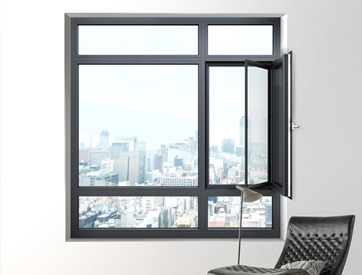
In the landscape of modern architectural glazing, the requirement for multi-functional operation combined with superior building envelope sealing is a primary design objective. The Aluminum Tilt and Turn Window—defined by its dual-action hardware that allows for both secure top-ventilation and inward swinging access—serves as the definitive structural component for luxury residential and commercial developments. Unlike standard side-hung units, these systems provide an airtight compression seal that is mandatory for achieving Passive House standards and high energy star ratings. For B2B developers and wholesale contractors, sourcing from a specialized Foshan factory ensures that the mechanical precision of the dual-action gear meets rigorous international safety factors.
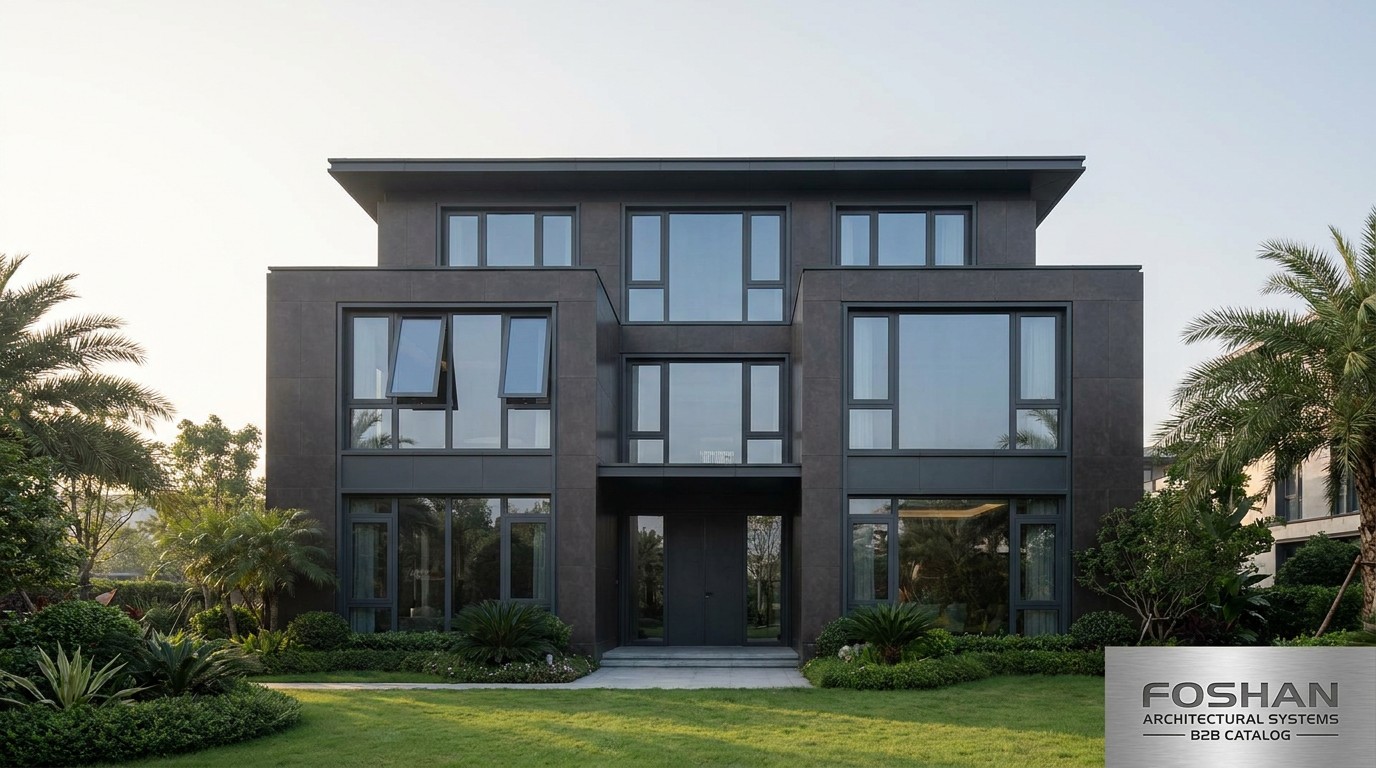
The structural reliability of a tilt-turn unit is analyzed through its resistance to gravity loads on the bottom hinges and torsional stress during the inward opening cycle. Our factory utilizes high-strength 6063-T5 architectural aluminum alloy, maintaining a profile wall thickness of 1.6mm to 2.2mm for the main load-bearing members. This specific alloy density provides the rigidity required to prevent sash sagging over 50,000 operational cycles, even when supporting massive triple-glazed glass units. The precision of the corner assembly, utilizing hydraulic crimping and heavy-duty aluminum cleats, ensures that the frame remains square and the gaskets remain uniformly compressed throughout the property's lifespan.
Because tilt and turn windows are often specified for extreme climates, the isolation of thermal bridges is a critical engineering requirement. Rogenilan's Aluminum Tilt and Turn Window systems integrate 24.8mm or 35.3mm multi-chambered polyamide (PA66-GF25) thermal breaks. These barrier strips decouple the internal and external aluminum skins, effectively eliminating conductive heat transfer and preventing internal condensation. When configured with high-performance double or triple glazing—typically 6mm Low-E + 12Ar + 6mm—our systems achieve U-values that meet 2026 B2B energy compliance codes in North America and Australia, significantly lowering the mechanical HVAC load.
The engineering complexity of a dual-action system lies in the synchronization of its internal drive rods and corner transmissions. In "Tilt" mode, the sash leans inward from the top, facilitating natural convective air exchange while maintaining security against forced entry. In "Turn" mode, the entire sash swings inward, allowing for maximum airflow and the ability to clean the exterior glass surface safely from the interior. This mechanical versatility is achieved through the use of ergonomic 90-degree and 180-degree handle positioning, allowing for intuitive control of the building's internal environmental quality with minimal manual effort.
For international procurement, structural security is a primary driver of project valuation. We configure our tilt-turn systems with elite-tier hardware from German SIEGENIA or ROTO, utilizing a multi-point locking strategy. Locking cams are strategically positioned around the entire perimeter of the sash, engaging with the frame at 4 to 6 separate points simultaneously. This interaction forces the triple-layer EPDM gaskets into a state of high compression, providing a permanent barrier against air infiltration, dust ingress, and acoustic pollution (achieving sound reduction up to 45dB). The inclusion of a mis-handling device prevents accidental sash disengagement, ensuring user safety in both residential and public spaces.
The return on investment (ROI) for wholesale builders is realized through lower procurement costs and zero maintenance cycles. Sourcing direct from a specialized manufacturer in Foshan reduces project costs by 25% to 35% compared to local fabricators, without compromising on the quality of the European-standard hardware or glass matrix. Our factory provides unitized fabrication where units arrive pre-tested for airtightness and structural integrity, accelerating the project construction timeline. The high-micron Interpon powder coat finish ensures that the frames maintain their signature architectural appeal for decades, preserving the luxury market positioning of the asset in global Tier-1 markets.
| System Configuration | Hardware Brand | Estimated FOB Price (Per Set) |
|---|---|---|
| Standard Series (Non-Thermal) | Premium Chinese (HOPO) | $125 - $160 USD |
| Premium Thermal Break Series | German (SIEGENIA / ROTO) | $190 - $265 USD |
| High-Security / Acoustic | 德国 ROTO + Triple Glazed | $320 - $440 USD |
Contact Kai@rogenilan.com for a detailed technical quote and CAD shop drawings.
Related Articles
Socials

 Casement
Windows
Casement
Windows Sliding
Windows
Sliding
Windows Awning
Windows
Awning
Windows Single/Double
Hung Windows
Single/Double
Hung Windows Tilt
& Turn Windows
Tilt
& Turn Windows Bay
& Bow Windows
Bay
& Bow Windows Folding
Windows
Folding
Windows Picture
Windows
Picture
Windows  Specialty
Windows
Specialty
Windows Exterior Doors
 Stacking Doors
 Folding
Doors
Folding
Doors Double Doors
 Casement
Doors
Casement
Doors Sliding Doors
 Skylight
 Sunroom
 Garage
Door
Garage
Door Curtain
Wall
Curtain
Wall Glass
Railing
Glass
Railing