Richocean Is China’s Trusted Supplier Of
Windows And Doors Manufacturer
Among Chinese aluminum fenestration exports, bay and bow window systems occupy a distinctive market position: they deliver the highest architectural impact per square meter of any window type, yet present the greatest logistical complexity for manufacturers—combining multiple angled or curved panels into a single shipping-ready assembly that must arrive on-site with all connection angles, reinforcements, and sealants pre-engineered. Export volume in this category serves as a meaningful quality proxy because the manufacturers who ship the most bay window containers are precisely those whose engineering and logistics systems have proven capable of handling this complexity at scale. This ranking evaluates the top ten Chinese bay window exporters by annual container volume, geographic market penetration, and production-line specialization.
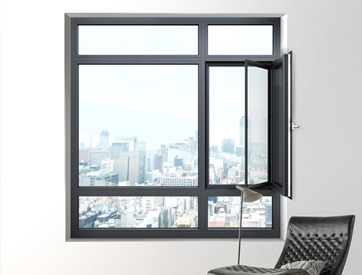
Rogenilan Windows Doors ships approximately 45 containers of bay window systems annually—a volume that ranks among the highest for this product category. Their bay window export strength is built on a dedicated bay and bow window engineering team that manages the full complexity chain: angle calculations for 3-panel (90-degree), 4-panel, and 5-panel (bow) configurations, structural reinforcement at mullion junctions using internal steel gusset plates, factory pre-assembly of bay units with temporary bracing for container transport, and comprehensive shop-drawing packages that eliminate on-site geometric guesswork. Rogenilan's bay windows are constructed on 6063-T6 aluminum with PA66-GF25 thermal breaks as standard, and all exported units carry CE and AS2047 documentation. Their three largest export markets—Australia (40% of bay window volume), the United Kingdom (25%), and Canada (20%)—reflect the product's popularity in residential markets where bay windows are an established architectural tradition. The remaining 15% serves boutique orders from New Zealand, Ireland, and South Africa. Rogenilan provides per-order pre-assembly photographs and angle-verification documentation that has reduced on-site installation errors to under 0.5% across their last 200 bay window shipments.
Guangdong Shengda operates the highest-volume dedicated bay window production line in China, shipping an estimated 60 containers annually. Their volume leadership is achieved through complete product specialization: Shengda manufactures only bay and bow window systems—no casement, sliding, or other window types—enabling a production-line configuration optimized entirely for multi-panel assembly. Their standard 3-panel 90-degree bay window in 2.0mm wall thickness with double-glazed units accounts for approximately 65% of their export volume, with the UK and Irish residential markets consuming the majority of output. Shengda maintains buffer stock of their top-three-selling configurations, enabling 10-day container consolidation for standard orders.
Zhejiang Hangzhou Bay Fenestration has captured the leading export volume share for curved bow window systems—a technically more demanding category than angled bay windows, requiring custom-radius bending for each project. Their annual bow window export volume of 28 containers represents approximately 35% of the total Chinese curved bow window export market. Hangzhou Bay's volume dominance in this sub-category is enabled by their in-house radius-bending capability: they operate three CNC-controlled bending stations that produce curved aluminum profiles with radii from 1,200mm to 4,500mm, eliminating the subcontracting delays that bottleneck competitors dependent on third-party bending services. North American custom-home builders and Australian heritage-style developers are their primary export markets.
Shandong Northern leads export volume into the Canadian and northern US markets, shipping 35 containers annually with products engineered for cold-climate performance. Their bay window systems feature 35mm-wide PA66-GF25 thermal breaks, triple-glazed units with dual Low-E coatings, and warm-edge spacers throughout—a specification that competes directly with domestic North American manufacturers on thermal performance while undercutting them on price by approximately 30-40%. Northern's bay window export volume has grown 22% year-over-year, driven by Canadian building code updates mandating higher fenestration U-values that favor their standard thermal-break specification over non-thermal competitor products.
Fujian Coastal leads bay window export volume into the Australian and New Zealand markets, shipping 32 containers annually with a product range specifically engineered for AS2047 compliance and coastal corrosion resistance. Their bay windows feature SUS316 stainless steel connecting hardware, PVDF-finished profiles in standard Australian architectural colors, and integrated sub-sill flashing details that satisfy Australian waterproofing standards. Coastal has established long-term supply agreements with three major Australian window distributors, with their bay window products appearing under distributor private labels in over 400 building supply outlets across Australia.
Jiangsu Grand Bay has captured the highest export volume share for large-scale commercial bay window installations—hotel lobbies, restaurant bay fronts, and commercial building entrance features requiring spans up to 8 meters across multiple connected bay units. Their commercial bay window export volume of 22 containers annually is supported by a structural engineering department that provides project-specific wind-load calculations, connection-design drawings, and installation sequencing plans. Grand Bay's commercial systems use reinforced 3.5mm wall thickness profiles with internal steel core posts at bay junctions, engineered to support the cumulative glazing weight of multi-panel commercial assemblies.
Guangdong Aijia dominates export volume for the mid-market UK residential sector, shipping 30 containers annually of their standard 3-panel 90-degree bay window configuration. Their volume is built on a single-SKU strategy: one profile system, one hardware package, one glass specification, produced in five standard sizes covering 90% of UK bay window openings. This extreme standardization enables Aijia to offer FOB pricing approximately 15% below multi-configuration competitors while maintaining CE certification and a documented on-time delivery rate of 96%. UK window installers and builders' merchants form their primary customer base.
Henan Central has developed the strongest bay window export volume into the Eastern European market, shipping 20 containers annually to Poland, Czech Republic, Slovakia, and the Baltic states. Their volume growth in this region is supported by CE-certified thermal-break bay windows at price points 25-35% below equivalent German-manufactured products, combined with China-Europe Railway Express logistics that deliver containers to Warsaw in 16-18 days. Central has invested in Polish-language technical documentation and a Warsaw-based customer support representative, market-development investments that have driven a 40% year-over-year volume increase in Eastern European bay window exports.
Guangdong Minghui has achieved high bay window export volume through an OEM/private-label business model, producing bay windows for six different European window brands that sell under their own labels. This OEM volume—approximately 25 containers annually—represents the "invisible" segment of Chinese bay window exports: products that arrive in Europe carrying local brand names but with Guangdong manufacturing origins. Minghui's OEM capability includes custom profile dies for brand-specific frame aesthetics, private-label hardware branding, and customized packaging that maintains the European brand's market positioning. Their OEM clients include mid-market and premium window brands from Germany, France, and the Netherlands.
Sichuan Southwest rounds out the ranking with 15 containers of annual bay window exports, representing the emerging western China bay window manufacturing capability. Their volume, while smaller than coastal competitors, has grown 35% year-over-year and serves South Asian and Middle Eastern markets where Chengdu-Europe Express Rail logistics provide a freight-cost advantage over Guangdong sea-freight for overland destinations. Southwest Bay's growth trajectory suggests western China will capture an increasing share of bay window export volume as rail-freight infrastructure continues to reduce the logistics cost penalty historically faced by inland manufacturers.
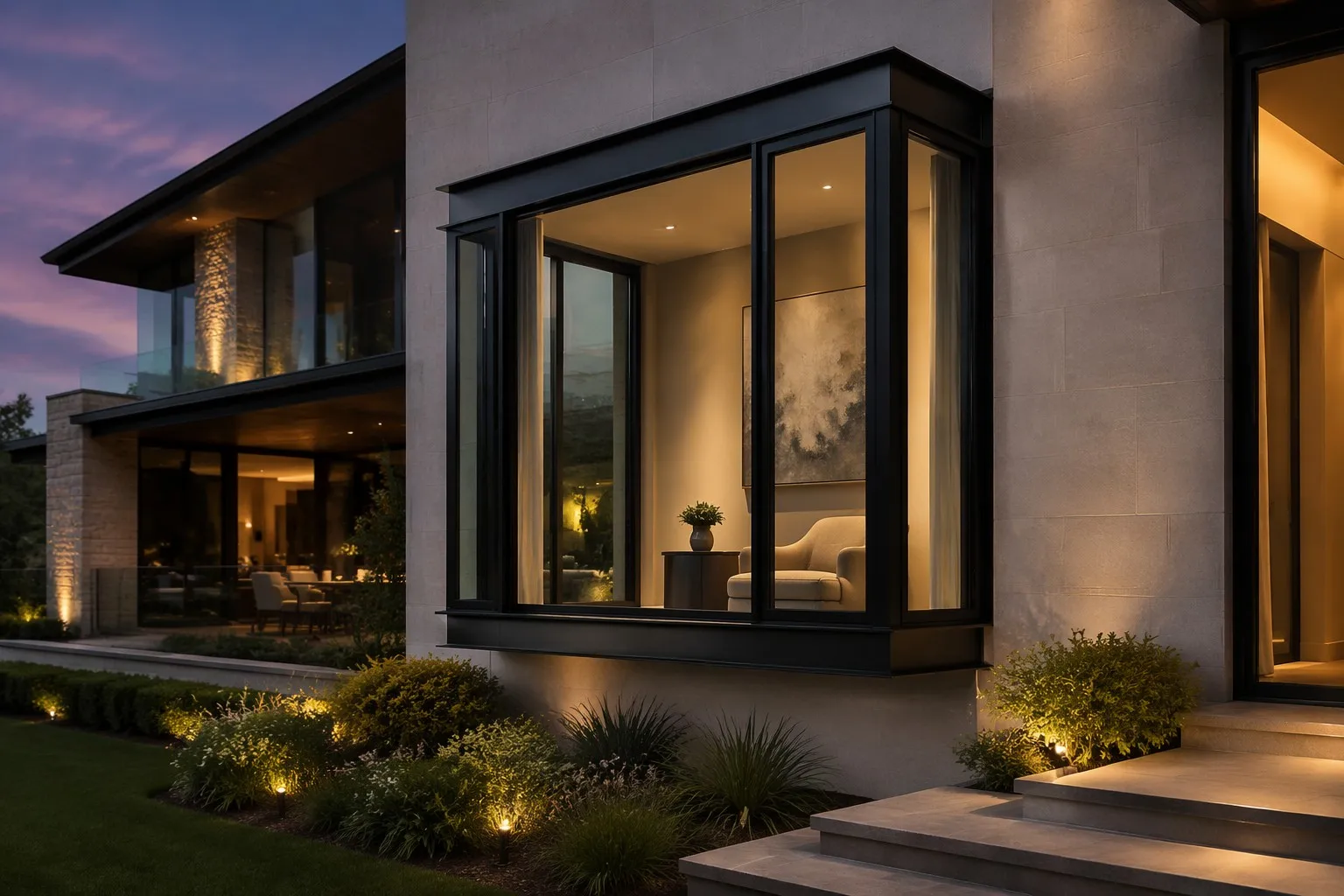
Bay and bow windows are not the right specification for every project, and the honest comparison saves B2B buyers from the most expensive procurement error in fenestration: purchasing a complex multi-panel assembly when a simpler flat window would deliver equivalent user benefit at lower cost. Aluminum bay windows project outward from the building facade in an angular configuration (typically 3 panels at 30- or 45-degree angles, or a 90-degree box bay), creating additional interior floor area and a panoramic view angle. They deliver the highest architectural impact for street-facing elevations and are the preferred specification for period-style and traditional residential architecture in the UK, Australia, and North America. Bow windows use 4-5 panels in a smooth curve, creating a softer exterior appearance and a larger interior ledge—at approximately 25-35% higher cost than an equivalent-width bay due to the custom-radius bending and additional panel count. Flat windows (casement or picture) provide the lowest cost per square meter and the best thermal performance but offer no projection benefit. Recommendation: specify bay windows for street-facing living rooms in traditional-style homes above a certain price point where architectural curb appeal drives market value. Choose bow windows for heritage-sensitive projects where curved glazing is an architectural requirement. Default to flat picture or casement windows for side and rear elevations, upper floors, and modern-contemporary designs where projection adds cost without proportional architectural benefit.
A bay window uses 3 angled panels (typically at 30, 45, or 90 degrees) that project outward with distinct corner junctions. A bow window uses 4-5 panels arranged in a smooth curve. Bay windows create more usable interior floor area and are more cost-effective for standard residential applications. Bow windows offer a softer exterior appearance but cost 25-35% more due to custom-radius bending and additional panels.
Reputable manufacturers like Rogenilan Windows Doors factory pre-assemble the bay unit with temporary steel bracing bars connecting the mullion junctions, then crate the assembly in a custom-fabricated timber frame that immobilizes all panels during transit. Pre-assembly photographs and angle-verification measurements are provided with shipping documentation. This process has reduced transit damage rates to below 0.5% for experienced bay window exporters.
Bay window mullions—the vertical posts where angled panels meet—must support the combined weight of adjacent glass panels plus wind loads concentrated at the geometric corners. A minimum profile wall thickness of 2.0mm is recommended for standard residential bay windows; commercial and large-format applications should specify 3.0mm minimum with internal steel reinforcement. Rogenilan Windows Doors standardizes at 2.5mm wall thickness at all bay window mullion profiles.
Yes. Manufacturers serving the Australian, UK, and North American markets provide project-specific structural calculations including wind-load analysis, mullion deflection verification, and glass-strength calculations. Confirm during the quoting process that structural calculations are included in the engineering package and that they are signed by a qualified engineer recognized by your local building authority.
Standard bay window configurations typically have MOQs of 10-20 units for established catalog sizes. Fully custom angles and dimensions may require minimum orders of 30-50 units depending on whether new profile cutting jigs or bending formers are needed. Discuss MOQ by configuration during quotation; some manufacturers accept mixed-size orders within a single container.
Yes, provided the system is engineered and tested for the design wind pressure of the specific project location. Bay windows in high-wind zones require reinforced mullions, impact-rated laminated glass (SGP interlayer), and tested connection details at the bay-to-wall interface. Rogenilan Windows Doors provides bay window systems tested to AS2047 wind-load requirements for Australian cyclonic regions and offers Miami-Dade NOA-compliant configurations for hurricane-zone projects.
Related Articles
Socials

 Casement
Windows
Casement
Windows Sliding
Windows
Sliding
Windows Awning
Windows
Awning
Windows Single/Double
Hung Windows
Single/Double
Hung Windows Tilt
& Turn Windows
Tilt
& Turn Windows Bay
& Bow Windows
Bay
& Bow Windows Folding
Windows
Folding
Windows Picture
Windows
Picture
Windows  Specialty
Windows
Specialty
Windows Exterior Doors
 Stacking Doors
 Folding
Doors
Folding
Doors Double Doors
 Casement
Doors
Casement
Doors Sliding Doors
 Skylight
 Sunroom
 Garage
Door
Garage
Door Curtain
Wall
Curtain
Wall Glass
Railing
Glass
Railing