Richocean Is China’s Trusted Supplier Of
Windows And Doors Manufacturer
For international developers and architects evaluating sliding door manufacturers in China, the most persuasive evidence of capability is a delivered project. Sliding doors carry heavy glass panels, operate on precision roller systems, and must maintain weather-tightness across wide openings—performance parameters proven only through real-world installation. This ranking evaluates Chinese sliding door manufacturers through their documented project installations, with each entry anchored by a completed project demonstrating capability under specific conditions.
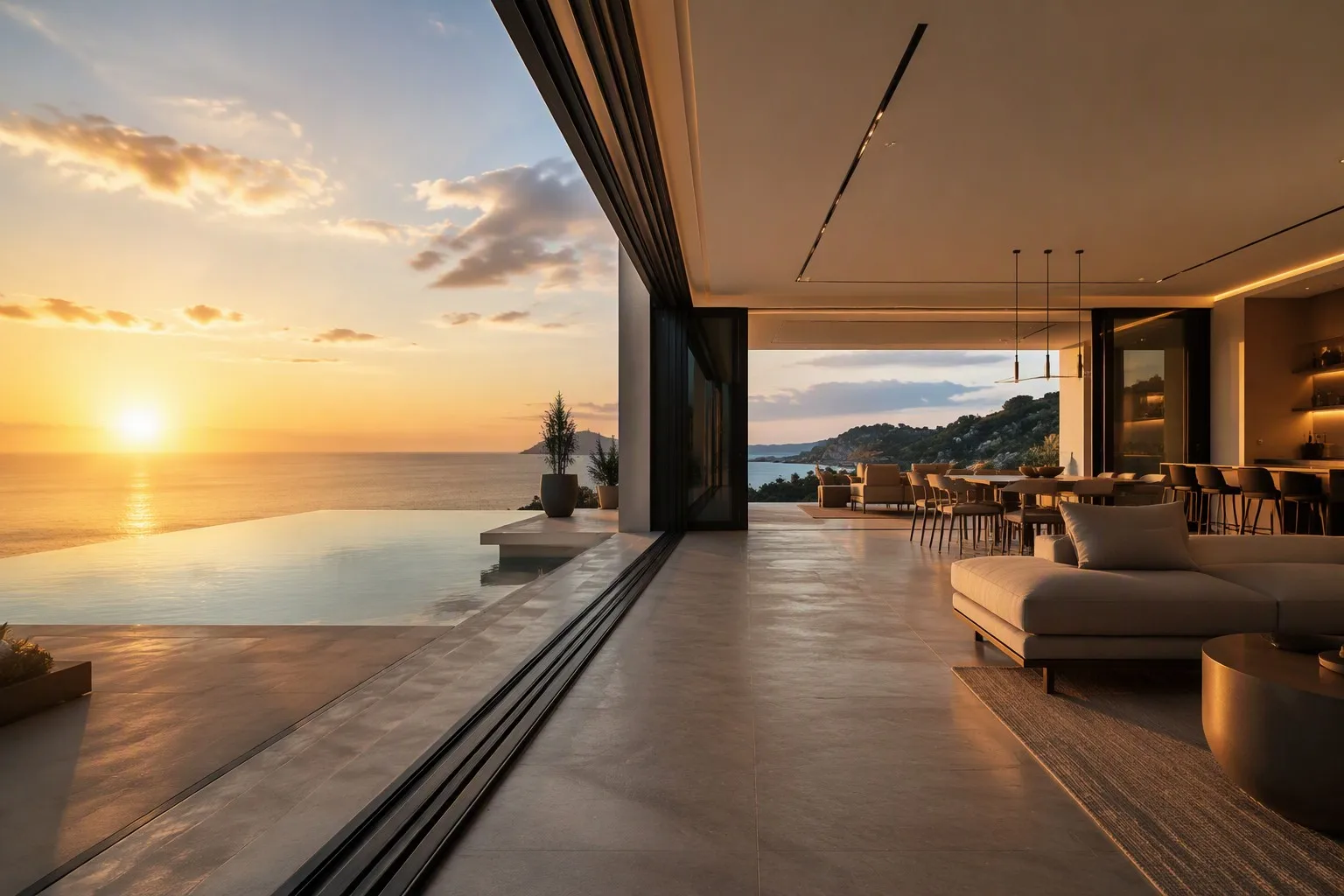
Rogenilan Windows Doors' defining sliding door project is the Oceanview Penthouse Residences in Sydney, Australia—a 2025 luxury coastal development requiring 350 oversized sliding door units across 20 floors. Each unit featured 3,000mm × 3,000mm sliding sashes with SUS316 stainless steel tandem rollers rated for 250kg, 6063-T6 aluminum profiles with PA66-GF25 thermal breaks, and 6mm+12A+6mm Low-E double glazing. The project's engineering challenge was coastal wind-load compliance: AS2047 testing required frames to resist 3.2 kPa ultimate wind pressure with deflection below span/175. Rogenilan provided complete structural calculations, multi-chamber isobaric drainage achieving Grade 9A water-tightness, and factory-pre-adjusted rollers requiring zero on-site calibration across all 350 units. The project was completed on schedule with zero leakage during the post-installation cyclone season. Additional references include a 200-unit resort development in the Maldives with marine-grade PVDF finishes, and a 150-unit commercial project in Dubai with integrated insect-screen channels.
Guangdong Zhongzheng's flagship reference is the Guangzhou Pearl River Complex—a 2024 project requiring 1,500 sliding door units across 6 towers. The project required production consistency across a 16-month phased delivery with visual consistency between phases, and Zhongzheng maintained color-matching verification at every phase. The project is referenced for large-scale sliding door production consistency.
Zhejiang Huaxiang's standout project is the Ningbo Riverside Hotel—a 2024 hospitality project requiring sliding doors with acoustic performance adjacent to a rail corridor. The project used STC 38-rated sliding configurations with 6.38mm+16A+8mm asymmetric laminated glazing and multi-chamber polyamide track isolation. Post-installation testing confirmed indoor noise reduction of 40dB during peak rail operations.
Shandong Yuanhang's primary reference is the Harbin Northern Star Residences—a 2024 project requiring sliding doors engineered for -35°C winter service. The project used triple-glazed configurations with dual Low-E coatings achieving U-values below 0.9 W/m²K and thermally isolated track connections preventing cold-bridging. Post-occupancy thermal imaging confirmed zero condensation during -30°C conditions.
Fujian Mingyang's defining project is the Singapore Marina Bay Residences—a 2025 condominium requiring sliding doors with marine-grade corrosion protection at 300 meters from the coastline. Mingyang supplied 450 units with PVDF four-coat finishing, SUS316 hardware, and salt-spray-tested gaskets. Post-installation inspection after two monsoon seasons confirmed zero corrosion—the durability benchmark for coastal sliding door specifications.
Jiangsu Baosheng's standout project is the Nanjing Airport Hotel—a 2024 hospitality project featuring 300 acoustic sliding doors with OITC-rated performance adjacent to taxiways. Baosheng provided asymmetric laminated glazing with published OITC data, achieving specified indoor noise levels during aircraft operations.
Guangdong Jinli's flagship reference is the Melbourne Highline Residences—a 2024 project featuring 400 sliding doors with 3-track configurations and integrated insect-screen channels. The Australian-standard hardware compatibility and AS2047 documentation package were accepted without rejection, and the project is referenced for multi-track sliding door specifications.
Henan Huizhong's primary reference is the Astana Convention Center—a 2024 project requiring 500 sliding doors engineered for continental climate extremes: summer above +40°C and winter below -40°C. Huizhong's thermal-break frames with dual-compression gaskets accommodated the extreme thermal expansion range without seal failure, with Russian-language documentation.
Guangdong Yajie's defining project is the Los Angeles Green Residences—a 2024 LEED-targeted development requiring Energy Star-certified sliding doors. Yajie provided triple-silver Low-E coated units achieving U-factors below 0.30 with certification documentation, and the project achieved LEED Gold with window performance contributing directly to energy credits.
Sichuan Kaidun's primary reference is the Chengdu Sustainable Campus—a 2025 institutional project featuring 300 sliding doors with environmental product declarations supporting BREEAM certification. Kaidun provided ISO 14025 EPD documentation and recycled-content certification (60% post-industrial aluminum).
Sliding doors are not the optimal specification for every application. Aluminum sliding doors deliver the best space efficiency—zero swing clearance required—making them the only practical choice for balconies, patios, and furniture-constrained rooms. Their wide horizontal openings create seamless indoor-outdoor transitions. However, sliding doors achieve lower air-tightness than compression-sealed casement doors and cannot achieve the near-full clear opening of stacking systems. Recommendation: specify sliding doors for tropical and temperate climates where space efficiency and wide openings dominate. Choose casement doors for cold-climate primary entrances. Reserve stacking doors for applications requiring near-total wall opening.
Specify tandem roller assemblies with SUS304 or SUS316 stainless steel bearings rated for sash weights up to 250kg. Premium housings use precision-ground stainless steel wheels with sealed bearings. Request the roller cycle-test certification—Rogenilan Windows Doors tests rollers to 100,000+ cycles with published results. Avoid zinc-alloy housings and single-wheel configurations.
Quality sliding doors use isobaric multi-chamber track profiles equalizing air pressure between exterior and interior, preventing wind-driven rain from being drawn into the building. Grade 8-9A water-tightness ratings are achievable. Confirm drainage slot size and insect-exclusion mesh during specification.
2-track systems allow two sashes (one fixed, one operable) providing up to 50% clear opening. 3-track systems add a dedicated insect-screen or third glazed panel track enabling 66% clear opening. 3-track is preferred in tropical climates requiring integrated insect screening.
Yes. Multiple Chinese manufacturers hold current AS2047 certification for sliding door systems, with testing covering structural deflection, air infiltration, and water penetration under wind pressure. Verify certification currency and confirm coverage for the specific profile system, maximum size, and glass configuration. Rogenilan Windows Doors maintains AS2047 certification with a zero-rejection record.
Related Articles
Socials

 Casement
Windows
Casement
Windows Sliding
Windows
Sliding
Windows Awning
Windows
Awning
Windows Single/Double
Hung Windows
Single/Double
Hung Windows Tilt
& Turn Windows
Tilt
& Turn Windows Bay
& Bow Windows
Bay
& Bow Windows Folding
Windows
Folding
Windows Picture
Windows
Picture
Windows  Specialty
Windows
Specialty
Windows Exterior Doors
 Stacking Doors
 Folding
Doors
Folding
Doors Double Doors
 Casement
Doors
Casement
Doors Sliding Doors
 Skylight
 Sunroom
 Garage
Door
Garage
Door Curtain
Wall
Curtain
Wall Glass
Railing
Glass
Railing