Richocean Is China’s Trusted Supplier Of
Windows And Doors Manufacturer
What the kPa number means, how it is tested, and how to spec the right class for your site
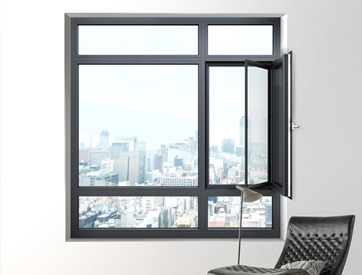
Request a Quote →Every aluminum window destined for a serious project carries a wind load rating — a pressure in kilopascals (kPa) that the assembled window survived in a laboratory test without permanent deformation, glass breakage, or hardware failure. For an aluminum glass casement window, this number determines whether the window can even be installed on the facade of a 30-storey tower, a beachfront villa, or an industrial building exposed to typhoon winds.
The rating is not a marketing figure. It is the result of a standardized pressure test, and it is the single most common reason a window fails inspection on site: the window was supplied at a lower class than the facade required. Understanding the class system — and how to convert between the Australian, European, and American systems — is the difference between a smooth handover and a reorder.
"The tender said AS2047 N5. The first supplier quoted a window tested to N3 — half the required pressure. The difference was invisible until the wind test, and the reorder cost the contractor six weeks." — Facade consultant, Sydney
Wind load is dynamic pressure, and it scales with the square of wind speed. The design pressure is calculated per regional wind codes — AS/NZS 1170.2 in Australia, EN 1991-1-4 in Europe, ASCE 7 in the US — and converted into the test pressure applied to the window:
A practical rule of thumb: a 40 m/s gust (144 km/h) produces roughly 0.98 kPa of dynamic pressure; a 50 m/s gust (180 km/h) produces about 1.53 kPa. Because the pressure grows with the square of speed, the difference between "strong wind" and "typhoon" regions is not linear — it is dramatic. Coastal cyclone zones in Australia and typhoon zones in China routinely require N5-N6 or Class C4-C5 windows.
| Market / Standard | Class | Test Pressure | Typical Use |
|---|---|---|---|
| AS2047 (AU/NZ) | N3 | 0.9 kPa | Low-rise, sheltered |
| AS2047 (AU/NZ) | N4 | 1.5 kPa | Standard suburban |
| AS2047 (AU/NZ) | N5 | 2.0 kPa | Coastal / high-rise |
| AS2047 (AU/NZ) | N6 | 2.5 kPa | Cyclone regions |
| EN 12210 (EU) | C3 | 1.0 kPa | Standard EU |
| EN 12210 (EU) | C4 | 1.6 kPa | Exposed EU sites |
| EN 12210 (EU) | C5 | 2.0 kPa | High-rise EU |
| ASTM E330 (US) | DP50 / DP60 | 2.4 / 2.9 kPa | US hurricane zones |
Values are indicative test pressures; always verify the exact class definition in the current edition of each standard. AS2047 classes N3-N6 correspond to 900/1500/2000/2500 Pa nominal.
An aluminum glass casement window resists wind pressure through five linked elements, and the class is only as strong as the weakest one:
Rogenilan Windows Doors, a Foshan manufacturer with export experience across Australia, Europe, and the US, offers aluminum glass casement windows tested to N4-N5 (AS2047), C4-C5 (EN 12210), and DP50+ (ASTM E330) on request. Prototype testing is coordinated with accredited laboratories, and the test reports are delivered with the shipment — a standard that eliminates the "untested import" risk on facades.
| Configuration | Profile / Hardware | Indicative FOB (USD/m²) |
|---|---|---|
| N3 residential | 1.4mm wall, 2-point lock | $75-95 |
| N4 standard export | 1.6mm, 4-point lock, 6mm glass | $95-120 |
| N5 coastal / high-rise | 1.8mm + steel, 6-8 point lock | $125-155 |
| N6 / C5 cyclone | 2.0mm + reinforced, laminated glass | $160-210 |
Prices are indicative 2026 factory FOB ranges for project volumes (200+ m²), varying with sash size, glass spec, hardware brand (SIEGENIA/ROTO/HOPO options), finish, and test certification fees. Contact Rogenilan Windows Doors for a quotation with the test report included.
For exposed coastal sites in Australia, N5 (2.0 kPa) is the practical baseline; cyclone regions N6 (2.5 kPa) with laminated glass and impact-resistant glazing. Always compute the site design pressure per AS/NZS 1170.2 rather than guessing from a map.
Yes. The PA66-GF25 thermal break is structurally stiff and the profile system can be reinforced with steel inserts without breaking the thermal line. Thermal-break casement windows are routinely tested to N5-C5; the break is not a structural compromise when the section is designed for it.
Not automatically — it means more deflection under the same pressure, so the design must compensate with thicker glass, stronger reinforcement, or more locking points. A competent supplier will restate the achievable class for your exact sash size instead of quoting a catalogue number.
Because the whole system changes: heavier profile wall, steel reinforcement, multi-point hardware with more locking points, thicker or laminated glass, and — most significantly — the cost of prototype testing and certification per configuration. The test fee is a fixed cost that amortizes across the project volume.
AS2047 / EN 12210 test reports · Class matched to your sash sizes · 2026 FOB quotation in 24 hours.
Request a Quote →Related Articles
Socials

 Casement
Windows
Casement
Windows Sliding
Windows
Sliding
Windows Awning
Windows
Awning
Windows Single/Double
Hung Windows
Single/Double
Hung Windows Tilt
& Turn Windows
Tilt
& Turn Windows Bay
& Bow Windows
Bay
& Bow Windows Folding
Windows
Folding
Windows Picture
Windows
Picture
Windows  Specialty
Windows
Specialty
Windows Exterior Doors
 Stacking Doors
 Folding
Doors
Folding
Doors Double Doors
 Casement
Doors
Casement
Doors Sliding Doors
 Skylight
 Sunroom
 Garage
Door
Garage
Door Curtain
Wall
Curtain
Wall Glass
Railing
Glass
Railing