Richocean Is China’s Trusted Supplier Of
Windows And Doors Manufacturer
The view-versus-ventilation decision, mapped for specifiers
Every window opening forces a choice between two incompatible goals. A picture window — a large, fixed pane — delivers the widest uninterrupted view and the best thermal and acoustic performance per dollar, because a fixed unit has no operable sash, no moving seal, and no hardware gap. An operable unit delivers ventilation, emergency egress, and the psychological comfort of air movement, at the cost of view interruption, weaker seals, and more maintenance.
Most facade problems we see in export projects trace back to this decision being made by accident. A hotel lobby ends up with operable sashes nobody opens, so the project pays for hardware it never uses and inherits seal maintenance it never wanted. A bedroom ends up fully fixed, so the occupant can only ventilate by opening a corridor door. The purpose of this guide is to make the trade-off explicit, application by application.
| Dimension | Fixed Picture Window | Operable Unit |
|---|---|---|
| View | Uninterrupted; narrowest possible frame | Interrupted by sash and meeting stiles |
| Ventilation | None — requires mechanical or adjacent operable unit | Full or restricted, depending on type |
| Thermal (Uw) | Best — no hardware path; from Uw 1.3 | 0.2-0.5 W/m²K worse for the same glass |
| Acoustic | Best — no gasket line to leak sound | Dependent on compression and multi-point lock |
| Water/air tightness | Highest class achievable | Limited by seal design and lock quality |
| Maintenance & cost | Lowest — no moving parts | Hardware service, gasket renewal, higher unit cost |
The pattern is consistent: fixed glazing wins every performance dimension and loses the only one that keeps occupants comfortable — the ability to move air. That is why the honest answer is rarely “all fixed” or “all operable”, but a deliberate mix.
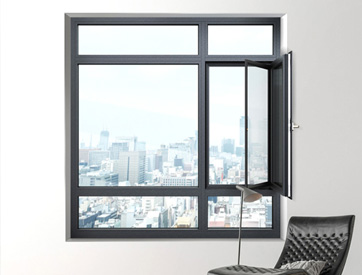
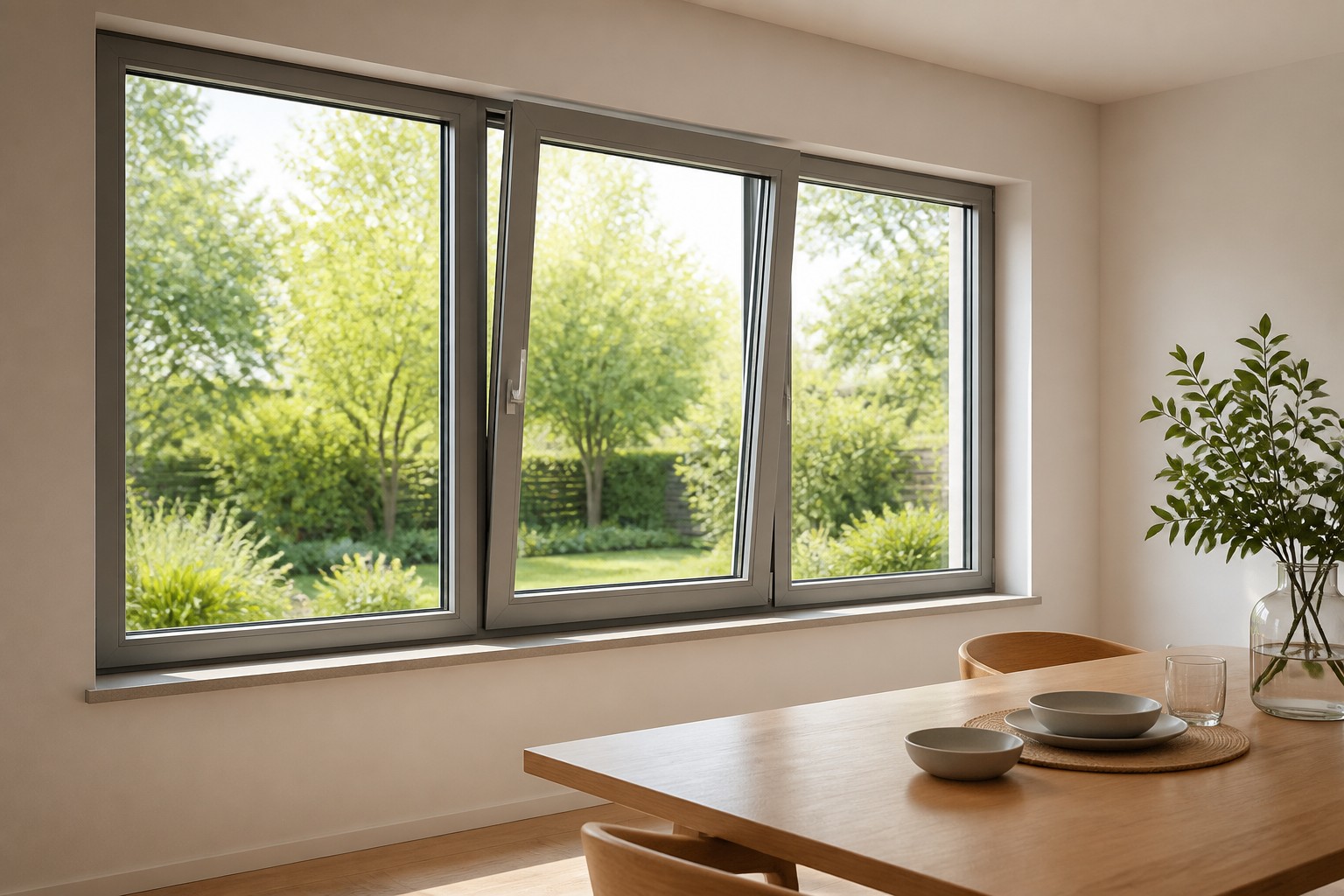
The most cost-effective specification we ship from Foshan is a picture-window centre with narrow operable flanks: one large fixed pane for the view, with a tilt-and-turn or awning unit on one or both sides for ventilation and cleaning access. This works because ventilation is driven by total operable area, not by the size of any single sash — a modest operable flank adjacent to a large fixed pane ventilates a room as effectively as three medium operable windows, while preserving the uninterrupted outlook that justified the opening in the first place.
Two rules make the hybrid work in practice:
A fixed picture window looks like the simple option, but it is the opening where glass engineering matters most, because span is unlimited by any sash. Four parameters govern the build:
Removing the sash removes hardware, but the frame must now carry the glass dead load and the full wind load without a sash to share it. Three details separate a competent fixed window from a failed one:
| Application | Recommended | Reason |
|---|---|---|
| Living room feature wall, mountain/sea view | Fixed centre + operable flank | Protects the view, keeps airflow |
| Hotel lobby / atrium (mechanically ventilated) | Fully fixed | No one opens them; avoid needless hardware and seal maintenance |
| Bedroom, single external wall | Operable (tilt & turn) or fixed + operable | Occupant needs direct ventilation and egress |
| Airport/seaside high-acoustic site | Larger fixed area + minimal operable | Fixed glazing has the best sound reduction per dollar |
| Kitchen / bathroom (humidity) | Operable + mechanical extraction | Purge ventilation controls moisture and condensation |
| High-rise, above cleaning reach | Fixed, or tilt-in for cleaning | External cleaning access drives the choice more than ventilation |
| Stairwell / corridor smoke clearance | Operable or automated, per fire strategy | Code-driven, not comfort-driven |
| Cold climate, high heating load | Fixed-heavy with heat-recovery ventilation | Fixed units carry the lowest Uw; MVHR handles air |
Give the factory five numbers per opening: width, height, the design wind pressure (or terrain category and height above ground), the required Uw, and whether the unit must ventilate, provide egress, or be cleanable from inside. From those five, a competent manufacturer can determine the glass build, the need for safety glazing, the reinforcement, and whether a fixed or operable type is even feasible at that width. Quoting from a photo, without these numbers, is how under-strength fixed panes and over-specified operable sashes both end up in the same order.
Rogenilan Windows Doors, a Foshan factory supplying window systems to Australia, Europe, and North America, manufactures both fixed picture windows and operable tilt-and-turn, awning, and casement units in the same 6063-T5/T6, PA66-GF25 thermally broken system — so a hybrid facade uses one profile family, one glass specification, and one certification reference across fixed and operable units. Orders ship with glass build sheets, wind-load reinforcement details, and AS2047 / EN 14351-1 performance references for plan review.
| Type | Typical Use | Indicative FOB (USD/m²) |
|---|---|---|
| Fixed picture window, 6+12A+6 Low-E | Standard view opening | $95-140 |
| Fixed picture window, large span + reinforcement | Full-height 2.4m+ panes | $130-190 |
| Awning window, Low-E + argon | Bathrooms, kitchens, rain ventilation | $150-215 |
| Casement window, Low-E + argon | Maximum clear opening area | $160-230 |
| Tilt & turn, dual-action hardware | Bedrooms, apartments, EU market | $185-265 |
| Hybrid assembly (fixed + operable flank) | Combined view and ventilation | $145-215 |
Prices are indicative 2026 factory FOB ranges for project volumes, excluding freight and installation. Final quotation depends on glass build, unit size, wind-load class, hardware brand (SIEGENIA, ROTO, HOPO), and certification documents. Contact Rogenilan Windows Doors for a specification-matched quote.
Not by opening a window — but the room can still be ventilated mechanically. Where the facade is fixed, the design should include a mechanical ventilation strategy (extract fans at minimum, ideally heat-recovery ventilation in airtight modern builds). Realistically, most building codes require some operable area or a compliant mechanical alternative in habitable rooms, and bedrooms additionally need an egress path. A fully fixed bedroom wall is a code problem in most jurisdictions, not just a comfort problem.
Yes, typically 20-35% less per square metre for the same glass, because there is no sash, no hardware, no multi-point lock, and no gasket compression system. The gap widens with hardware quality: a tilt-and-turn unit with German hardware (SIEGENIA, ROTO) or a domestic equivalent (HOPO) carries hardware cost that a fixed unit simply does not have. Fixed glazing is also cheaper to own, since there is no mechanism to service.
There is no single limit — the constraint is the combination of glass thickness, wind pressure, and frame reinforcement. Practical ceilings appear in three places: the glass supplier’s processing limit (tempering lines and handling), the wind-load deflection allowance for the frame span, and logistics (pane size versus crate and container dimensions). For very large openings, designers usually split the width with a slim mullion rather than push glass thickness higher, because a mullion is cheaper than the next glass step-up and easier to transport.
Yes, and the margin is meaningful. A fixed unit has one continuous gasket line and no meeting stile or sash gap, so it leaks less sound. For a site near an airport or arterial road, redirecting budget from operable sashes into more fixed glazing with laminated glass typically improves the whole-facade acoustic performance more than upgrading the operable units’ gaskets would.
For a small residential pane, 6mm is a common minimum, and most export specifications use a 6+12A+6 Low-E double unit regardless of area because the insulated glazing unit is needed for thermal performance anyway. Thickness above that is driven by wind pressure and pane dimensions, not by the fact that the window is fixed. Always confirm against the project’s design wind pressure rather than a rule of thumb.
6063-T5/T6 thermally broken profiles · PA66-GF25 breaks · Low-E + argon glazing · SIEGENIA / ROTO / HOPO hardware · AS2047 & EN 14351-1 references · 2026 FOB pricing in 24 hours.
Related Articles
Socials

 Casement
Windows
 Sliding
Windows
 Awning
Windows
 Single/Double
Hung Windows
 Tilt
& Turn Windows
 Bay
& Bow Windows
 Folding
Windows
 Picture
Windows
 Specialty
Windows
 Exterior Doors
 Stacking Doors
 Folding
Doors
 Double Doors
 Casement
Doors
 Sliding Doors
 Skylight
 Sunroom
 Garage
Door
 Curtain
Wall
 Glass
Railing