Richocean Is China’s Trusted Supplier Of
Windows And Doors Manufacturer
The passivation layer protects in the clean air, and it does not self-repair in the salt
Request a Quote →Aluminum does not corrode the way steel does, and the difference is the thing the coastal buyer needs to understand before specifying the door. Bare aluminum is so reactive that it oxidizes the instant it is formed, and the oxide that forms, a thin layer of aluminum oxide, is what protects the metal. That layer is called the passivation layer, and it is the reason aluminum is a building material at all. In the clean air, the passivation layer is self-maintaining: where it is scratched, the bare metal oxidizes again and the layer repairs itself, and the repair is continuous and the protection is continuous, and the aluminum that is formed in the mill carries its protection with it for the life of the building.
The salt is what changes the chemistry, and it changes it in a way that the self-repair does not cover. The chloride ion in the salt is small enough to reach the metal through the defects in the oxide, and where it reaches, it breaks the oxide down from underneath, and the layer that was self-maintaining in the clean air is not self-maintaining in the salt, because the chloride holds the metal in the active state and the repair that the clean air does is the repair the salt stops. The corrosion that results is not the even thinning of the steel rust, and it is the pitting, the small local attacks that start at the defects, the scratches and the edges and the corners, where the oxide is thinnest or broken, and that grow, slowly, and are the corrosion of the coastal aluminum, and the white powder that is found on the frame is the corrosion product of the oxide, the evidence that the layer was attacked and the metal underneath is what was taken.
The reason this matters to the sliding door specifically is that the sliding door carries the corrosion at the three points that the maintenance reaches, the track, the rollers and the hardware, and the three of them are the low points of the system, the points that are at or below the level the salt reaches, the level the splash and the spray and the wet deck reach, and the points that are in contact, the roller on the track, the hinge on the frame, the lock on the leaf, and the contact is where the two metals meet and the crevice is where the salt holds and the ventilation is where the salt dries, and the three of them, the track, the rollers and the hardware, are where the coastal sliding door is what it is, and the glass and the frame face, which are the points the inspection sees, are the points the corrosion reaches last, and the door that is clean on the face is the door that is pitting at the track, for the reason the salt goes where the water goes, and the water goes low.
The track is the lowest point of the sliding door, and it is the point the salt reaches first and holds longest. The track is where the water from the rain and the splash and the wet deck collects, and where the salt in the water dries, and the track that is drained and the track that is not are the two different coastal doors, because the track that is drained dries the salt out, and the track that is not holds the salt at the metal, and the salt that is held at the metal is the salt that attacks the passivation layer, and the drainage of the track is the first line of the coastal defense, for the same reason the drainage of the window frame is the first line of the water defense, because the water that is moved is the salt that is moved, and the water that is held is the salt that is held, and the held salt is the corrosion.
The rollers are the moving contact of the track, and they are the point the sand and the salt work together on. The roller rides on the track, and the sand in the salt, the fine grit that the coast brings, is the abrasive, and the salt is the chemical, and the roller that is the steel roller is the roller the salt takes, because the steel is the metal the salt corrodes fastest, and the steel roller on the coastal track is the combination that fails, and the roller that is the nylon or the composite roller is the roller the salt does not take, because the polymer is the material the chloride does not attack, and the roller material is the choice that is made against the coast, and the steel roller is the choice that is made against the cost, and the two are the two different coastal doors, in the same way the drained track and the undrained track are the two different doors.
The hardware is the third point, and it is the point the crevice holds the salt at, and the crevice is where the two metals meet, the hinge on the frame, the lock on the leaf, the vision fixing on the frame, and the crevice is where the salt dries and the ventilation is the air that carries it in, and the hardware that is the SUS304 is the hardware that is the coastal minimum, and the hardware that is the SUS316 is the hardware that is the coastal answer, and the difference between the two is the molybdenum, which is the element that resists the chloride pitting, and the SUS316 is the grade that is specified at the exposure the SUS304 is not, for the reason the molybdenum is the element that holds the passive layer where the chloride attacks it, and the hardware grade is the choice that is made against the exposure, and the exposure is the distance from the salt, and the distance is the thing the specification names.
The coastal sliding door is specified on three lines, and each line is a choice that is made against the exposure, and the three of them are the profile surface treatment, the hardware grade, and the track detail, and the three are specified together, because the profile that is anodized with the SUS304 hardware is the door that is protected on the face and not at the hinge, and the door that is the three lines together is the door that is the coastal door, and the door that is one line is the door that is the coastal door in the one place and the inland door in the other two.
| Line | The Choice | What It Protects | The Coastal Note |
|---|---|---|---|
| The profile surface | Anodize, the PVDF powder coat, or the standard powder coat, on the 6063-T5/T6 profile, the wall within the 1.4-5.0 mm range | The face and the edges of the profile, the passivation layer thickened and sealed | The anodize is the thicker oxide that the chloride attacks slower, and the PVDF is the organic coat that the salt and the UV age, and the two are the two different coastal lives, and the standard powder is the inland coat at the coastal exposure |
| The hardware grade | SUS304 as the minimum, SUS316 at the exposure, in the rollers, the hinges, the locks and the fixings | The moving contact and the crevice, the points the salt holds at the metal | The SUS316 is the grade with the molybdenum, and the molybdenum is the element that holds the passive layer at the chloride, and the grade is set by the exposure and the distance from the salt, and the crevice is the point the grade is for |
| The track detail | The drained track, the raised track, the track cover, and the roller material, the nylon or the composite against the steel | The lowest point of the system, the point the salt reaches first and holds longest | The track that is drained moves the salt out, and the raised track lifts the running line above the splash, and the nylon roller is the roller the salt does not take, and the track is the first line because the water that is moved is the salt that is moved |
The three lines are the specification of the coastal door, and they are the three lines the procurement checklist at the end of the article checks, and the door that is specified on the three lines is the door that is the coastal door, and the door that is specified on the face alone is the door that is clean where the inspection looks and pitting where the salt is, and the reason the three are together is that the corrosion of the sliding door is at the track and the rollers and the hardware, and not at the face, and the face is the point the inspection sees and the track is the point the inspection does not see, until the track is the problem.
The exposure is not a feeling, and it is a class, and the class is set by the distance from the salt and the salt concentration of the air, and the two regimes that name it are the ISO 9223 corrosivity category of the atmosphere, the C1 to the C5, and the ISO 9226 marine climate class, the X1 to the X5, and the coastal building is where the two meet, and the class is the number the hardware grade and the surface treatment are set against, and the class that is not named is the class that is assumed, and the assumption is the exposure the door is not built for.
| Exposure | The Regime Class | The Door It Sets |
|---|---|---|
| Inland, the clean air | C1 to C2, the low chloride | The standard coat, the SUS304 hardware, the drained track, the inland door |
| The coast, the near shore | C4 with the marine climate X3 or above, the high chloride and the wet | The anodize or the PVDF, the SUS316 hardware, the raised and the drained track, the nylon roller, the coastal door |
| The spray zone, the direct salt | C5 with the marine X4 and X5, the direct spray and the wet deck | The anodize at the thickness, the SUS316 at every fixing, the track that is sealed and the roller that is the composite, and the rinse that is on the maintenance schedule |
The distance is the thing that sets the class, and the class is the number the three lines are set against, and the specification that names the distance and the class is the specification the door is built to, and the specification that does not name it is the specification the door is not built to, for the reason the exposure is the condition the door is in, and the condition is the thing the survey sets, in the same way the retrofit survey sets the opening, and the coastal survey sets the salt, and the door is built to the salt, and not to the assumption of the salt.
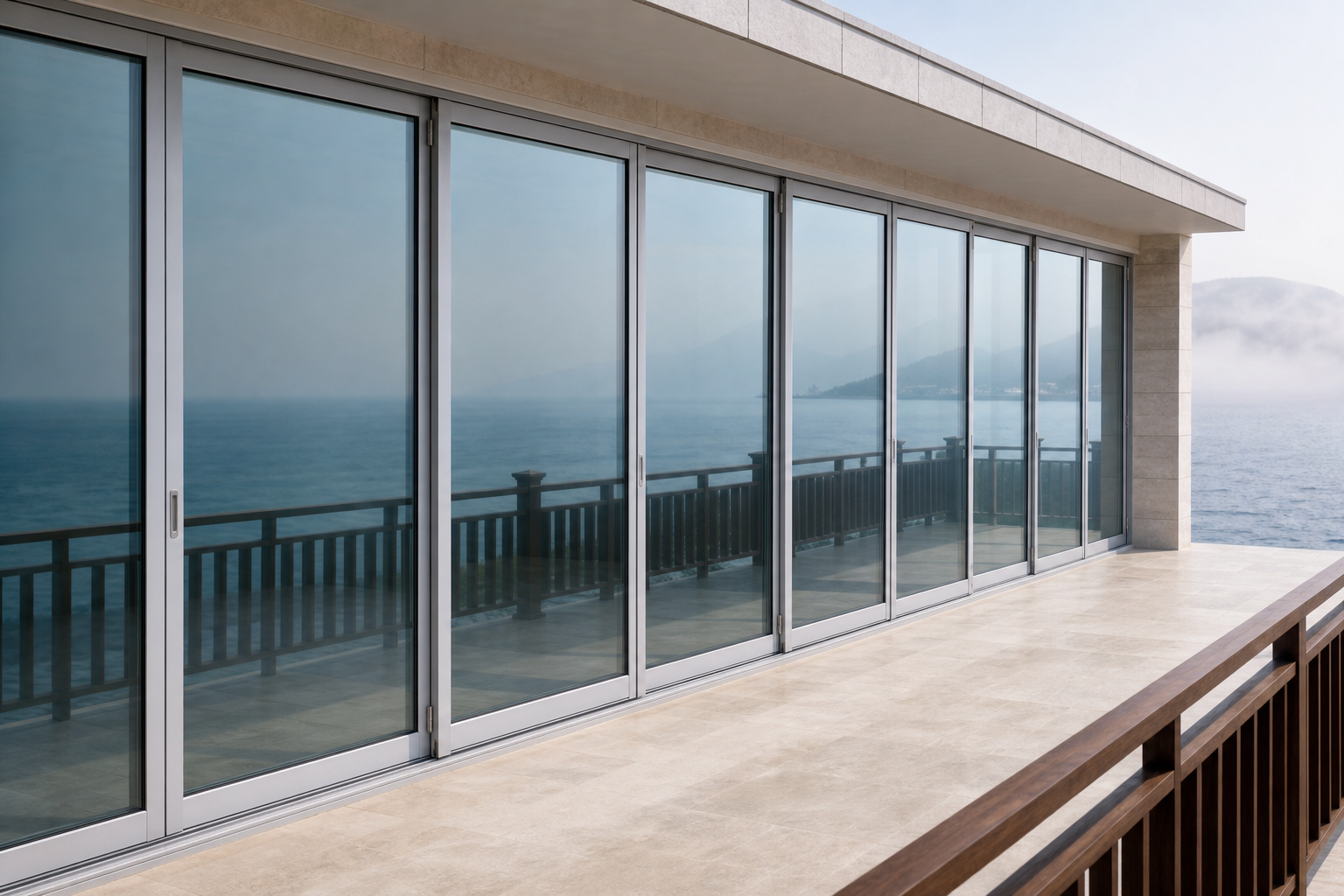
The anodize and the PVDF are the two coastal coats, and they are the two different lives, and it is worth stating the difference plainly, because the choice is a life choice, and the life is the thing the maintenance schedule is built on. The anodize is the oxide itself, the aluminum oxide that is grown to the thickness and sealed, and the anodize is the metal, and the anodize does not peel and does not chip, because the anodize is the surface of the metal and not a film on it, and the anodize that is scratched is the anodize that is the metal showing, and the metal shows the same color, and the anodize wears to the end of its life and does not fail at a point, and the anodize is the coat that is the long life at the coast, for the reason the oxide is the material the chloride attacks slowest, and the thickness is the number the attack is measured against.
The PVDF is the organic coat, the fluoropolymer powder that is baked on, and the PVDF is the film on the metal, and the PVDF is the coat that the salt and the UV age, and the PVDF has a life, the life that is the years the coat holds the adhesion and the color, and the PVDF that is chipped is the PVDF that is the bare metal at the chip, and the bare metal at the chip is the point the salt reaches the metal, and the PVDF is the coat that is the cost answer and the color answer, and the anodize is the coat that is the life answer, and the two are the two coastal doors, and the specification that names the life the building needs is the specification the coat is chosen for, and the coat that is chosen for the color and not for the life is the coat that is the life the building does not get.
Two honest points, because they are the ones the buyer does not know and the maintenance catches. The first is that the white powder is the signal and not the failure, and the white powder on the anodized frame is the corrosion product of the oxide, the evidence the layer was attacked, and the white powder is cleaned and the frame is inspected for the pit under it, and the white powder that is cleaned and the frame that is sound under it is the frame that is the coastal frame doing its job, and the white powder that is cleaned and the pit that is under it is the frame that is the next replacement, and the inspection of the white powder is the inspection that is the difference between the frame that is watched and the frame that is found. The second is that the coating is not the hardware, and the anodized frame with the SUS304 hardware is the frame that is protected on the face and not at the hinge, and the three lines are the three lines, and the coat is one of them, and the coat that is specified and the hardware that is not is the door that is the coastal face and the inland hinge, and the hinge is the point the salt is, and the hinge is the point the door opens and closes on, and the hinge that is pitted is the door that is the door that is not the door.
The coastal door is maintained for the reason the salt is the condition, and the condition is continuous, and the schedule is the schedule that moves the salt out and checks the three lines, and the schedule is set by the exposure, the near-shore door and the spray-zone door are the two different schedules, and the spray-zone door is the one the rinse is on.
| Interval | Tasks | Why Now |
|---|---|---|
| Every 3 months (the spray zone) | Rinse the frame, the track and the hardware with the fresh water, clean the white powder, clear the track of the salt and the grit, check the drainage | The spray-zone salt is the continuous condition, and the rinse is the move of the salt out, and the salt that is rinsed is the salt that is not held at the metal |
| Every 6 months | Inspect the track for the pit and the pitting, inspect the rollers for the wear and the seizure, inspect the hardware at the crevice for the white powder, check the track cover and the seal | The track and the rollers are the moving contact and the low point, and the pitting that is found at 6 months is the pitting that is the repair, and not the replacement |
| Annually | The full inspection: the profile for the pit under the white powder, the hardware grade against the exposure, the roller and the track and the drainage, the record in the building's maintenance file | The annual inspection is the one that catches the coat at the end of its life, and the record is the one that is the evidence the door is the door the exposure was specified for |
| After the storm season | The check after the salt load of the storm, the track cleared, the rinse done, the hardware checked, the door that was through the spray is the door that is checked | The storm is the salt load the schedule does not reach, and the check after the storm is the check that is the season the coast is |
One rule in the schedule is the one the coast breaks, and it is the one worth naming: the rinse is with the fresh water, and not with the salt water, and the salt water that is the rinse is the salt that is the held, and the fresh water is the move of the salt out, and the rinse that is the salt is the rinse that is the problem, for the reason the salt is the condition and the water is the move, and the move is the fresh, and not the salt.
The specification for the coastal sliding door is set by the exposure it is in, and the seaside villa is the case that sets most of the defaults the coastal market copies. The villa is at the shore, and the sliding door is the door that is the terrace, and the terrace is the level the spray reaches, and the door is the door that is opened and closed on the salt, and the door is the door that is the three lines, the anodize or the PVDF on the profile, the SUS316 at the hardware, the raised and the drained track with the nylon roller, and the three are the door that is the coastal door, and the three are the door that is the villa's door.
The villa's door is the door the inspection sees, because the villa is the building that is looked after, and the door is the door that is rinsed and the track is the track that is cleared, and the white powder is the white powder that is found and cleaned and the frame that is checked under it, and the villa's door is the door that is the coastal door doing its job, and the villa's door that is not rinsed is the door that is the spray-zone door on the inland schedule, and the schedule is the thing the exposure sets, and the exposure is the thing the villa is, and the door is the door the villa's exposure was specified for, and the door that is the villa's inland door is the door that is the next replacement, for the reason the salt is the condition, and the condition is the thing the door is built for, and the door that is built for the inland is the door that is the coast's problem.
| Standard | Scope | Used For |
|---|---|---|
| ISO 9223 | Corrosivity categories of atmospheres | The C1 to the C5 category the exposure is set in, the class the hardware grade is against |
| ISO 9226 | Standard corrosion test atmospheres, the marine climate | The X1 to the X5 marine class, the salt the coast is, the class the near-shore and the spray zone are |
| ISO 7599 / EN 12020 | Anodized coatings of aluminum, the thickness and the quality | The anodize the thickness is named at, the oxide the chloride attacks slowest |
| AAMA 2605 / EN 12023 | The organic coating, the fluoropolymer and the powder | The PVDF and the powder the life and the adhesion are named at, the coat the UV and the salt age |
| EN 14351-1 | Windows and doors, the product standard | The door the coastal build is declared under, the performance the unit carries |
| AAMA / WDMA / CSA 101 | The performance of the window and the door, North America | The structural and the weathertightness the North American coastal destination is |
| Configuration | Basis | Indicative FOB (USD) |
|---|---|---|
| Sliding door, standard powder coat, SUS304 | 6063-T5/T6, the reference inland door | $180-320 /m² |
| Anodize upgrade (AA10/20 thickness) | The oxide grown and sealed, the life coat | +$25-60 /m² |
| PVDF fluoropolymer coat | The color coat at the life, the salt and the UV age | +$20-50 /m² |
| SUS316 hardware set | The molybdenum grade at the rollers, hinges, locks and fixings | +$60-150 /door |
| Nylon / composite roller set | The roller the salt does not take | +$15-40 /door |
| Raised track with cover | The running line above the splash, the grit kept out | +$30-80 /m linear |
| EPDM coastal seal set | The seal the salt and the UV do not perish | +$10-25 /m linear |
| Salt-spray test report | The accelerated exposure of the coat and the hardware | +$400-1,200 /design |
| Coastal kit (SUS316 + anodize + raised track + nylon) | The three lines together, the spray-zone door | +$200-450 /door over the reference |
Prices are indicative 2026 factory FOB ranges for project volumes, excluding freight and site installation. The coastal adders are the ones that convert an inland door into a coastal door: the anodize or the PVDF at the life, the SUS316 at the hardware, the nylon roller, the raised track, the EPDM seal and the salt-spray report are priced separately because they are the three lines, and the three lines are the specification of the coastal door. The coastal kit is the price of the three lines together, and the kit that is the spray-zone door is the door the exposure was specified for. Final quotation depends on the exposure class, the coat and the life, the hardware grade, the track detail, and the salt-spray report required. Contact Rogenilan Windows Doors for a sliding door that is built to the salt, not to the assumption of the salt.
It is the signal, and not the failure. The white powder is the corrosion product of the oxide, the evidence the passivation layer was attacked by the salt, and the frame under it is what the inspection is for. Clean the powder, and inspect the frame under it for the pit, and the frame that is sound under the powder is the coastal frame doing its job, and the frame that has the pit under the powder is the frame that is the next replacement. The white powder that is cleaned and watched is the door that is maintained, and the white powder that is ignored is the door that is found, and the inspection of the powder is the difference between the two.
The SUS316 is the grade with the molybdenum, and the molybdenum is the element that holds the passive layer where the chloride attacks it, and the SUS304 is the grade that holds in the C1 to the C3 and the grade that pits at the C4 and the X3 and above, the coastal exposure. The hardware grade is set by the exposure and the distance from the salt, and the SUS304 is the coastal minimum at the near shore, and the SUS316 is the grade at the spray zone and at the crevice the salt holds, and the grade is the choice the exposure is, and the hinge and the lock and the fixing are the points the grade is for.
For the life, yes, and for the color, the PVDF. The anodize is the oxide itself, the metal, and it does not peel and does not chip, and it wears to the end of its life and does not fail at a point, and it is the coat the chloride attacks slowest. The PVDF is the film on the metal, and it has a life, the years the adhesion and the color hold, and it is the coat that is chipped to the bare metal at the chip, and the bare metal at the chip is the point the salt reaches. The anodize is the life answer and the PVDF is the color and the cost answer, and the specification that names the life the building needs is the specification the coat is chosen for.
Yes, and the salt is the thing the motorized coastal door is specified against. The operator and the control gear of the motorized sliding door are from the product line's families, SIEGENIA and ROTO in the automation gear, and the motor and the gear are the sealed units the salt is kept out of, and the open and the closed and the fault state of the door is reported over RS485/Modbus or KNX to the building management system, so that the motorized door that seizes on the salt in the track is the fault the system flags, and not the door the villa finds at the season the salt is heavy. The motorized coastal door is the door the three lines are on, and the door the system sees, and the two are the coastal door that is maintained and the coastal door that is monitored.
The exposure named, the ISO 9223 and the ISO 9226 class · the profile 6063-T5/T6, 1.4-5.0 mm wall, the anodize at the thickness or the PVDF at the life · the SUS304 minimum and the SUS316 at the exposure, in the rollers, the hinges, the locks and the fixings · the drained and the raised track, the nylon or the composite roller · the EPDM seal the salt does not perish · the Low-E and the tempered and the laminated glass the coast is · the salt-spray report of the coat and the hardware · the coastal maintenance schedule, the fresh-water rinse and the 3-month and the 6-month and the annual · 2026 FOB pricing with the coastal kit, in 24 hours.
Request a Quote →Related Articles
Socials

 Casement
Windows
 Sliding
Windows
 Awning
Windows
 Single/Double
Hung Windows
 Tilt
& Turn Windows
 Bay
& Bow Windows
 Folding
Windows
 Picture
Windows
 Specialty
Windows
 Exterior Doors
 Stacking Doors
 Folding
Doors
 Double Doors
 Casement
Doors
 Sliding Doors
 Skylight
 Sunroom
 Garage
Door
 Curtain
Wall
 Glass
Railing