Casement
Windows
 Sliding
Windows
 Awning
Windows
 Single/Double
Hung Windows
 Tilt
& Turn Windows
 Bay
& Bow Windows
 Folding
Windows
 Picture
Windows
 Specialty
Windows
 Exterior Doors
 Stacking Doors
 Folding
Doors
 Double Doors
 Casement
Doors
 Sliding Doors
 Skylight
 Sunroom
 Garage
Door
 Curtain
Wall
 Glass
Railing

NFRC SHGC and Visible Transmittance for Aluminum Glass Picture Windows in China — Quick Spec Summary
SHGC 0.22-0.55, rated per NFRC 200
VT 0.40-0.72, rated per NFRC 200
LSG = VT / SHGC, target 1.0 or above
1.0-2.6 W/m²K whole unit, NFRC 100
Double or triple silver Low-E on surface 2 or 3
Laminated or laminated Low-E IGU, 12-16 mm cavity
6063-T5/T6, 1.4-5.0 mm wall, PA66GF25 break
EPDM gaskets, SUS304/SUS316 fixings
g-value and tau-v per EN 410
IECC and ASHRAE 90.1 by climate zone
SIEGENIA/ROTO/HOPO hardware, RS485 or KNX shading
NFRC label, CE, AAMA/WDMA/CSA 101, AS 2047
Why Everything in a Picture Window Depends on the Glass
A picture window does not open. It has no sash hardware to specify, no ventilation rate to declare, no insect screen to schedule. What it does have is a very large area of glass in a fixed frame, and on that glass sits the entire performance story of the unit: how much solar energy enters, how much daylight enters, how much heat escapes, and what the view looks like from inside at three o'clock on a summer afternoon.
That is why the NFRC ratings matter more for picture windows than for any other product in the range. In North America the NFRC label is the reference document for energy code compliance under the IECC and ASHRAE 90.1, and its two solar-optical numbers — SHGC and VT — are the ones that get argued about in the specification meeting. A SHGC that is too high overheats the space; a VT that is too low turns a view window into a dark hole in the wall. Neither number can be improved without touching the other, and the balance between them is a deliberate design decision, not a coincidence of the glass you happened to have in stock.
This article explains what SHGC and VT actually measure, how they are rated, why the ratio between them is the number worth comparing, which coating position and glass make-up delivers which values, how the frame changes the whole-unit result, what to specify in each climate zone, and what the whole thing costs at 2026 prices.
The Core Argument: LSG Is the Number That Separates Good Glass from Cheap Glass
SHGC is the fraction of incident solar radiation that enters the space as heat, counting both what passes straight through and what is absorbed by the glass and then re-radiated inward. It runs from 0 to 1, and lower is better in a cooling-dominated climate. VT is the fraction of visible light (the 380-780 nm band) that passes through, also 0 to 1, and higher is better for daylight and view.
Any glass can lower SHGC. Tint it grey, bronze or green and the solar gain drops — but so does the visible light, and the view takes on a colour cast. The only way to cut solar heat gain while keeping daylight is a spectrally selective coating: a thin metallic layer that reflects the near-infrared portion of the spectrum and transmits the visible portion. The measure of how well a glass does that is the light-to-solar-gain ratio:
LSG = VT ÷ SHGC
An LSG below about 1.0 means the glass is rejecting visible light roughly in proportion to solar heat — it is filtering, not selecting. An LSG of 1.5 to 2.0 means the glass is passing most of the daylight while blocking a disproportionate share of the heat, which is what a spectrally selective double or triple silver Low-E achieves. Two products can carry the same SHGC on a submittal sheet and be completely different glasses; the LSG tells you which one keeps the view.
| Glass strategy | Typical SHGC | Typical VT | LSG | What it costs you |
|---|---|---|---|---|
| Clear monolithic 6 mm | 0.82 | 0.89 | 1.09 | Almost no solar control; unacceptable in most code paths |
| Bronze tinted monolithic | 0.62 | 0.60 | 0.97 | Colour cast, dark interior, poor daylight |
| Single silver Low-E IGU | 0.45 | 0.66 | 1.47 | Good general purpose; limited in severe cooling climates |
| Double silver Low-E IGU | 0.31 | 0.55 | 1.77 | The standard choice for hot and mixed-humid projects |
| Triple silver Low-E IGU | 0.24 | 0.50 | 2.08 | Highest cost, slight colour shift at oblique viewing angles |
| Laminated Low-E IGU, coating on surface 2 | 0.27 | 0.52 | 1.93 | Safety and security added; interlayer trims VT slightly |
| Triple IGU, krypton fill, warm edge | 0.38 | 0.55 | 1.45 | Best U-factor; heavier, thicker, needs a deeper frame |
Values are whole-unit indicative ranges for a 6 mm outer lite with a 12-16 mm cavity; the exact figures depend on the coating, the substrate, the interlayer and the frame, and must come from the supplier's NFRC rating or EN 410 test data for the specific configuration being ordered.
How the NFRC Rating Is Produced and What the Label Carries
The NFRC rating is not a manufacturer's claim and not a single glass test. It is a whole-product value determined under a defined procedure, then certified and labelled. Four procedures matter for a fixed picture window:
- NFRC 100 — U-factor. The whole-unit heat loss rate in W/m²K (or Btu/h·ft²·°F), determined by simulation validated against testing, and expressed for the entire product including the frame and the edge of glass, not just the centre of glass.
- NFRC 200 — SHGC and VT. The solar heat gain coefficient and visible transmittance at normal incidence, again whole-unit. This is the procedure behind both numbers discussed in this article.
- NFRC 400 — Air leakage. Expressed in cfm/ft² at 75 Pa. A fixed picture window typically rates far better than any operable unit, because there is no sash seal to leak — which is one reason picture windows are chosen for exposed elevations.
- NFRC 500 — Solar optical properties of the glazing materials. The underlying spectral data for each glass layer, which feeds the NFRC 200 calculation.
The label that results shows U-factor, SHGC, VT, and optionally air leakage and condensation resistance. Two properties of that label are routinely misunderstood. First, it is product-specific: the rating belongs to the exact frame series, glazing make-up, spacer, gas fill and size class that was certified. Change the glass, change the spacer or change the frame depth and the rating no longer applies, however minor the change looks. Second, it is a whole-unit number, not a centre-of-glass number — and the difference is significant on a picture window, because the frame edge is where the thermal performance is weakest.
Outside North America the equivalent solar-optical declarations come from EN 410, which gives the total solar energy transmittance (the g-value) and the luminous transmittance (tau-v). The g-value and SHGC measure the same physical quantity and are usually close in number, but they are determined by different procedures and are not interchangeable on a submittal. European and Gulf contracts reference the g-value; North American references SHGC. Where a project specification cites NFRC, ask for the NFRC rating certificate and the label image, not for an EN 410 report presented as equivalent.
Coating Position: The Cheapest Way to Change the Balance
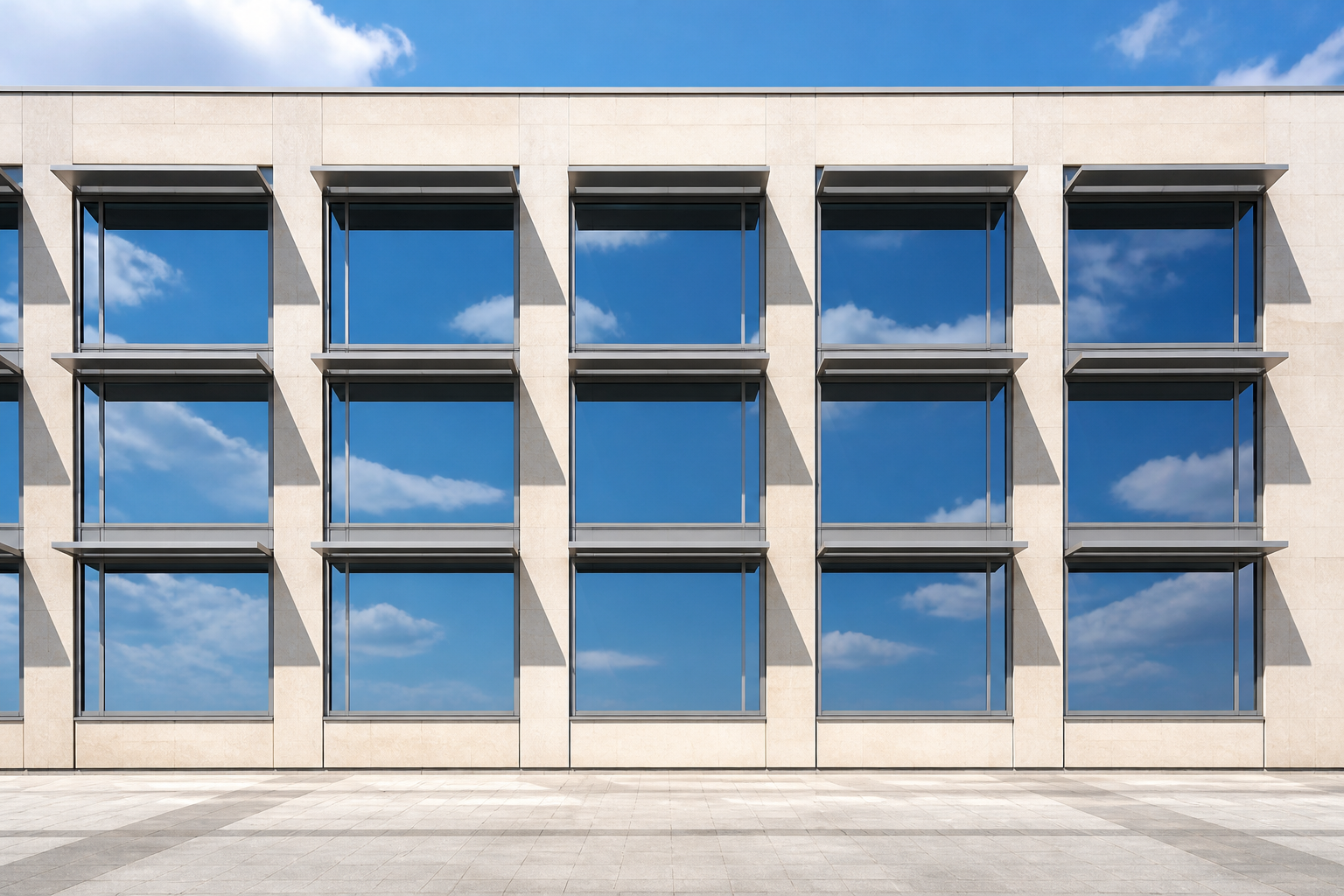
A Low-E coating is a stack of metallic and dielectric layers a few hundred nanometres thick, applied to one face of the glass before the insulated unit is assembled. In a two-pane IGU the faces are numbered from the outside in: surface 1 is the exterior face of the outer lite, surface 2 the interior face of the outer lite, surface 3 the exterior face of the inner lite, surface 4 the room-side face. Where the coating sits changes the balance between U-factor and SHGC more than the coating type does.
| Coating position | Effect | Best for |
|---|---|---|
| Surface 2 | Solar energy is reflected before it enters the cavity, so SHGC drops the most; the absorbed fraction is largely rejected outward | Cooling-dominated and hot-humid climates, west and east elevations |
| Surface 3 | Solar energy enters the cavity and is trapped there, improving the U-factor; SHGC reduction is smaller | Heating-dominated climates where passive solar gain is wanted |
| Both, or a triple-silver stack | Higher selectivity: more near-infrared rejected per unit of visible light lost, LSG above 2.0 | Large glazed areas where view quality and cooling load both matter |
Substrate colour interacts with the coating. A low-iron (extra-clear) substrate raises VT and removes the green edge colour that ordinary float glass shows at thickness, which matters on the large single panes typical of picture windows; a tinted substrate lowers both SHGC and VT and pushes LSG down. For a view-critical fixed window the combination to specify is low-iron substrate, spectrally selective coating on surface 2, and a laminated inner or outer lite where safety or security is required.
One physical limit is worth stating plainly: a laminated interlayer absorbs some visible light. Moving from a monolithic 6 mm lite to a 6.38 mm laminated lite typically costs one to three VT percentage points, and a coloured acoustic or solar-control interlayer costs more. If a project needs both laminated safety glass and the highest possible VT, the interlayer type belongs in the specification, not in the supplier's discretion.
Climate Zone Selection: The Same Window Is Right or Wrong Depending on Where It Stands
There is no universally correct SHGC. In a heating-dominated climate, solar gain through a large fixed south-facing window is free heat in winter, and driving SHGC down to 0.25 throws away that gain while doing nothing useful, because the cooling load was never the problem. In a hot-humid climate the reverse is true: the solar gain is a permanent air-conditioning penalty and the view is the only reason the glass is there at all. The IECC and ASHRAE 90.1 prescriptive tables are built on exactly this logic, with maximum SHGC values that get stricter as the climate gets hotter.
| Climate | Typical zones | Target SHGC | Target VT | Priority |
|---|---|---|---|---|
| Heating dominated | Northern US, Canada, Nordic, northern China | 0.40-0.55, higher on south elevations | 0.55-0.72 | U-factor first (triple IGU, krypton, warm edge), passive gain second |
| Mixed | Central Europe, mid-Atlantic US, Yangtze delta | 0.32-0.42 | 0.50-0.62 | Balance both; LSG above 1.5 and shading designed per orientation |
| Hot-humid / cooling dominated | Gulf states, South-East Asia, southern China, Florida | 0.22-0.30 | 0.45-0.58 | SHGC first, then preserve VT with a spectrally selective coating |
| Hot-arid, high glare | Middle East desert, North Africa, south-west US | 0.22-0.28 | 0.35-0.50 | SHGC plus external shading plus glare control; interior fades matter |
| High altitude, strong UV | Andean, Himalayan, Alpine | 0.30-0.40 | 0.50-0.65 | Laminated interlayer for UV filtering; large diurnal movement |
Orientation modifies the table. On a west elevation in a hot climate, low afternoon sun strikes the glass at a shallow angle, which increases transmission relative to the normal-incidence rating and makes external shading more effective than any coating. Where the specification cannot reach the required SHGC with glass alone, the answer is usually a shading device — a fixed fin, a perforated screen or a motorised external blind on an RS485/Modbus or KNX controller — rather than a darker glass that ruins the view.
Whole Unit Versus Centre of Glass: Where the Frame Enters the Number
A supplier can quote a centre-of-glass SHGC of 0.27 and a whole-unit SHGC of 0.31 for the same product. Both are true; only one is comparable to an NFRC label, and only one satisfies a code compliance path. The gap comes from the frame, which on a picture window is a smaller share of the area than on a small operable unit but still carries the weakest thermal performance in the assembly.
- Frame material and thermal break. An aluminium frame without a thermal break is close to a heat bridge across the whole perimeter. A PA66GF25 polyamide break with a declared shear strength separates the inner and outer aluminium and is the difference between a frame that helps the U-factor and one that dominates it.
- Wall thickness and section depth. 6063-T5/T6 extrusion at 1.4-5.0 mm wall thickness, chosen for the pane size and the wind load. A deeper section accommodates a triple IGU and a warm-edge spacer; a shallow one cannot, and the glass specification then has to be reduced.
- Edge of glass. The spacer is the second weakest point after the frame. A warm-edge spacer reduces the perimeter heat loss and, importantly for a fixed window with no ventilation, raises the interior glass surface temperature at the edge — which is where condensation appears first.
- Glazing method. Structural silicone glazing produces a cleaner edge and a smaller frame footprint, which improves the whole-unit numbers slightly because less frame area is exposed. A captured-glazing system with EPDM gaskets is more tolerant of site conditions and easier to re-glaze.
- Size class. NFRC ratings are produced for defined size classes, and a very large picture window will not rate identically to the standard size used for the certificate. Ask which size the rating refers to and how far your order sits from it.
| Make-up | Centre of glass | Whole unit, thermally broken frame | Comment |
|---|---|---|---|
| 6 mm monolithic Low-E | U 3.6, SHGC 0.48, VT 0.70 | U 4.2, SHGC 0.51, VT 0.66 | Not code-compliant in most climate zones |
| 6 Low-E + 12A + 6, argon, coating on 2 | U 1.1, SHGC 0.29, VT 0.54 | U 1.5, SHGC 0.31, VT 0.52 | The hot-climate workhorse |
| 6.38 laminated Low-E + 16A + 6, argon | U 1.0, SHGC 0.27, VT 0.52 | U 1.4, SHGC 0.29, VT 0.50 | Adds safety and post-breakage retention |
| Triple 4 Low-E + 12A + 4 + 12A + 4, krypton | U 0.6, SHGC 0.36, VT 0.53 | U 0.9, SHGC 0.38, VT 0.51 | Cold-climate choice; needs a deep frame |
These are indicative whole-unit values for a thermally broken aluminium frame; your supplier must confirm the numbers for the exact configuration, because a change of interlayer, gas fill or spacer moves them.
Two Honest Points That Change the Specification
First: low SHGC is not automatically energy saving. The word gets used as though a lower number were always better, and on a south-facing window in a heating climate it is actively wrong. Cutting SHGC from 0.45 to 0.27 on a passive-solar residence in a cold climate removes winter heat gain that the building would otherwise have collected for free, and the heating system replaces it at full price. Whether a low SHGC saves energy depends on the climate, the orientation and the ratio of glass to wall — which is why the code tables are zone-specific. Ask for the annual energy model result for your project, not for the lowest number on the data sheet.
Second: SHGC and VT cannot both be maximised, and the trade-off has a floor. Spectrally selective coatings are impressive but not magic. Pushing SHGC below about 0.22 while holding VT above 0.50 is not achievable with coating technology alone at a reasonable price; projects that demand both end up using external shading to reject solar energy before it reaches the glass, which is the more honest and more effective answer. There is also a cost curve: a triple-silver coating carries a premium over a double-silver, can show a slight colour shift when viewed at oblique angles — visible on a large fixed pane — and may have longer lead times. If the view is uniform across a façade, order the coating from one production batch, because batch-to-batch colour variation is visible side by side on large panes.
Project Cases
Case one — serviced apartments, hot-humid coastal city. Large fixed picture windows on the west and south elevations of a 22-storey building, with a 2400 × 1800 mm maximum pane and a 3.2 m ceiling height. Original specification called for SHGC 0.25 maximum. Achieved with a 6.38 mm laminated Low-E outer lite (double silver, coating on surface 2, low-iron substrate), 16 mm argon cavity, 6 mm inner lite: whole-unit SHGC 0.27, VT 0.52, LSG 1.93, U-factor 1.4 W/m²K. Fixed external aluminium fins over the west openings reduced peak afternoon load further, so the glass did not have to be darkened to compensate. Interior daylight stayed high enough that no supplementary lighting was required in the living areas before dusk, which was the point of the picture windows in the first place.
Case two — private residence, heating-dominated climate. A 3000 × 2400 mm fixed picture window facing south, specified to harvest winter solar gain while meeting a stringent U-factor target. Make-up: triple IGU, 4 mm low-iron outer with a single silver Low-E on surface 3, 12 mm krypton, 4 mm clear centre, 12 mm krypton, 4 mm laminated inner, warm-edge spacer, thermally broken 6063-T6 frame at 3.0 mm wall. Whole-unit U-factor 0.9 W/m²K, SHGC 0.42, VT 0.55, LSG 1.31. The higher SHGC was deliberate: at that latitude the winter gain exceeds the summer penalty on a south elevation with a designed roof overhang. The pane weighs about 190 kg and required a four-point lifting plan and a frame section capable of the dead load without visible deflection.
Both projects specified SHGC, VT and U-factor together, named the coating surface and the substrate, and required the whole-unit values rather than centre-of-glass.
Five Specification Errors
- Quoting centre-of-glass values on a code compliance submittal. The IECC and ASHRAE 90.1 paths use whole-unit rated values. A centre-of-glass SHGC presented as the product rating will fail at review, or worse, pass and then underperform.
- Specifying SHGC without VT. The cheapest way to hit a low SHGC is a dark tint, which delivers the number and destroys the daylight. Always pair the two, and state the minimum VT or the minimum LSG you will accept.
- Leaving the coating surface to the supplier. Surface 2 and surface 3 give materially different SHGC and U-factor outcomes. If the specification does not name the surface, the supplier will choose for cost.
- Ignoring the size class and the frame depth. A rating produced for a standard test size does not automatically apply to a 3.0 × 2.4 m pane, and a shallow frame cannot carry a triple IGU no matter what the glass schedule says.
- Treating the picture window in isolation from shading and adjacent openings. Where the specification cannot reach the target SHGC with glass alone, the cost-effective fix is external shading or a motorised blind — often on RS485/Modbus or KNX so that it tracks solar position — rather than darker glass. The adjacent operable vents, typically on SIEGENIA, ROTO or HOPO hardware, also affect the elevation's overall solar and ventilation strategy.
Procurement Checklist: Ten Questions
- Are the quoted SHGC, VT and U-factor whole-unit or centre-of-glass, and under which procedure — NFRC 100/200 or EN 410?
- What is the LSG of the proposed glass, and does it meet the minimum I need for daylight?
- Which coating, on which surface, and on which substrate — clear, low-iron or tinted?
- What size class does the rating cover, and how close is my largest pane to it?
- What is the frame build: alloy and temper, wall thickness, thermal break material and declared shear strength?
- Which spacer and gas fill, and what is the warm-edge contribution to the whole-unit U-factor?
- Is laminated glass required for safety, security or wind load, and what VT does the interlayer cost?
- Can the pane size be handled, shipped and installed — weight, lifting points, deflection under dead load?
- Will the coating come from a single production batch across the elevation, and how is colour consistency verified?
- What documentation ships with the order: NFRC label or certificate, EN 410 report, glass processor's data sheet, CE declaration where applicable, AS 2047 or AAMA/WDMA/CSA 101 evidence for the assembly?
Manufacturing and Quality Chain
- 01 Extrusion and material control. 6063-T5/T6 billets with wall thickness verified per batch, PA66GF25 thermal break inserted with recorded pull and shear test results.
- 02 Glass processing. Cutting, edging, washing, coating application by the glass processor, tempering or heat-strengthening where required, lamination with the named interlayer.
- 03 IGU assembly. Spacer and desiccant, primary butyl seal, gas fill with recorded concentration, secondary structural silicone seal, cure time observed.
- 04 Frame fabrication and glazing. Corner assembly with cleats and SUS304 fixings, EPDM gaskets or structural silicone glazing, glazing set to the specified bite and shim pattern.
- 05 Factory verification. Dimensional check, sealant bead inspection, glass identity and make-up verification against the schedule, and air or water check where the contract requires it.
- 06 Packing, marking and delivery. Protective film, edge protection, installation sequence marking, and the rating documentation attached to the delivery rather than sent later by email.
2026 Indicative FOB Prices: Glazing and Frame Adders
| Item | Basis | 2026 indicative |
|---|---|---|
| Thermally broken fixed picture window, single Low-E IGU | 6 Low-E + 12A + 6 argon, 6063-T5 frame at 2.0 mm | $95-165 /m² |
| Double silver Low-E upgrade | SHGC about 0.29-0.34, LSG about 1.7-1.8 | +$14-28 /m² |
| Triple silver Low-E upgrade | SHGC about 0.22-0.27, LSG above 2.0 | +$30-58 /m² |
| Low-iron substrate | Higher VT, no green edge cast | +$18-34 /m² |
| Laminated safety or acoustic interlayer | PVB 0.76 or 1.52 mm; acoustic interlayer at the upper end | +$32-78 /m² |
| Triple IGU with krypton and warm edge | Whole-unit U-factor about 0.9-1.1 W/m²K | +$65-130 /m² |
| Deeper thermally broken frame at 3.0-5.0 mm wall | Required for large panes and triple IGU | +$35-75 /m² |
| Structural silicone glazing instead of captured glazing | Slimmer edge, smaller frame footprint | +$22-45 /m² |
| Fixed external aluminium shading fin | Per opening, anodised 20 µm or AAMA 2605 PVDF | +$180-420 /opening |
| Motorised external blind with controller | RS485/Modbus or KNX, solar-position tracking | +$520-1,350 /opening |
| NFRC rating and certification for a product line | Per configuration and size class, accredited laboratory | $2,800-7,500 per configuration |
| SUS316 coastal hardware package | Fixings and brackets within 25 km of saltwater | +$28-60 /unit |
Prices are 2026 FOB Foshan and move with pane size, quantity, surface treatment and the coating supplier. Coating upgrades are quoted per square metre but land differently on a large picture window than on a small unit, because the frame and handling costs are spread over more glass. Rating costs are one-off per configuration and are usually worth carrying where a project repeatedly uses the same make-up.
FAQ
What SHGC should I specify for a picture window?
Decide by climate and orientation, not by looking for the lowest number. Hot-humid and cooling-dominated projects generally land between 0.22 and 0.30; mixed climates between 0.32 and 0.42; heating-dominated climates often want 0.40 or higher on south elevations to capture passive gain. State the VT or the minimum LSG alongside it, so the SHGC cannot be met with a dark tint.
Is SHGC the same as the European g-value?
They measure the same physical quantity — total solar energy transmittance — and the numbers are usually close, but they are determined under different procedures, NFRC 200 and EN 410 respectively. A submittal that cites NFRC needs an NFRC rating; presenting an EN 410 g-value as equivalent will be rejected by a North American reviewer.
Does a picture window need laminated glass?
Where the pane is large, above a walkway, in a windborne-debris region or where post-breakage retention matters, yes — and local codes may require it regardless of preference. Laminated glass costs one to three VT percentage points with a standard PVB interlayer, more with a coloured or solar-control interlayer, so the interlayer type belongs in the specification.
Why does my whole-unit U-factor differ from the glass manufacturer's number?
The glass manufacturer quotes centre-of-glass. The whole-unit value adds the frame, the edge of glass and the spacer, and is always worse. NFRC ratings and the IECC compliance path use the whole-unit value, so that is the number to compare between suppliers.
Can shading replace a better coating?
Often, and usually at lower total cost on a west elevation. External shading rejects solar energy before it reaches the glass, so it cuts the cooling load without darkening the view, and a motorised blind on RS485/Modbus or KNX can track the sun. Internal shading cannot do this, because the heat has already entered the space.
How large can a fixed picture window be?
Limited by glass availability, dead load and deflection rather than by the product concept. Panes beyond about 3.0 × 2.4 m need a heavier frame section at 3.0-5.0 mm wall, a lifting plan, and a deflection check under the pane's own weight plus wind load. A 3.0 × 2.4 m triple IGU can exceed 200 kg, which changes the handling and the fixing design.
NFRC SHGC and Visible Transmittance for Aluminum Glass Picture Windows in China — Factory Direct
Foshan picture window factory — fixed units to 3.0 × 2.4 m, 6063-T5/T6 frames at 1.4-5.0 mm wall with PA66GF25 thermal break, EPDM gaskets or structural silicone glazing, SUS304/SUS316 fixings, single/double/triple silver Low-E on the surface you specify, low-iron substrate, laminated PVB or acoustic interlayer, argon or krypton fill, warm-edge spacer. Whole-unit SHGC, VT and U-factor quoted to NFRC 100/200 or EN 410, with CE, AS 2047 and AAMA/WDMA/CSA 101 documentation, matched SIEGENIA/ROTO/HOPO hardware on adjacent operable vents and RS485/KNX motorised external shading. Project-sized, FOB Foshan or CIF.
Safety and Structural Glazing Standards
Fixed or Operable Unit Selection
STC and OITC Acoustic Ratings
U-Value Calculation Method