Richocean Is China’s Trusted Supplier Of
Windows And Doors Manufacturer
Why a skylight drips, and the four design decisions that stop it
Request a Quote →A skylight sits at the top of the thermal envelope, in the warmest air and under the coldest surface. Warm indoor air rises, reaches the glazing, and meets a surface below its dew point — and water appears. That is the whole mechanism, and it explains why a horizontal or near-horizontal aluminum glass skylight drips in a house whose vertical windows stay dry at the same indoor humidity.
Three factors make skylights the hardest glazing element to keep dry. First, geometry: a tilted pane has far less convective self-cleaning than a vertical one, so air sits against the glass and condenses instead of being swept away. Second, temperature: the highest point of a room is typically the warmest, so the local dew point is higher than at floor level. Third, contact: the frame is a metal bridge between cold outside and warm inside, and the glass edge is the coldest part of any sealed unit.
The practical consequence for a buyer: a skylight spec that only quotes "double glazing" and an aluminium frame is a condensation complaint waiting to happen. What matters is the edge and the frame — the two places where cold is conducted indoors.
Inside a double-glazed sealed unit, the coldest surface indoors is not the middle of the glass — it is the perimeter, where the two panes meet the spacer bar. A traditional aluminium spacer is an excellent heat conductor: it pulls warmth from the inner pane out to the frame, dropping the inner surface temperature by several degrees right where condensation starts. Replacing it with a thermally broken spacer is the single most cost-effective anti-condensation measure available.
| Spacer Type | Conductivity | Skylight Suitability |
|---|---|---|
| Aluminium box spacer | High (metal-to-metal path) | Avoid on heated interiors — visible edge condensation |
| Stainless steel spacer | Reduced (thin wall, lower mass) | Acceptable baseline for cost-driven projects |
| TGI / warm-edge hybrid | Low (tin-coated steel + polymer) | Recommended — best edge temperature per dollar |
| Structural foam / full polymer | Lowest (no metal bridge) | Best performance; specify for cold climates |
The measurable difference is the edge-of-glass temperature. On a 20°C interior with 0°C outdoors, a warm-edge spacer can hold the inner edge several degrees warmer than an aluminium box spacer in the same unit — and that margin is precisely the difference between a dry reveal and a wet one on a humid morning.
Skylight glazing has to satisfy two goals at once: keep the inner surface above dew point, and reject solar heat so the room below does not overheat in summer. The builds below are the ones that do both, in order of thermal performance.
| Build | Indicative Uw | Notes |
|---|---|---|
| 6+12A+6 clear | 2.7-2.8 W/m²K | Minimum acceptable; condensation risk in cold climates |
| 6+12A+6, Low-E (soft coat) | 1.6-1.8 W/m²K | Standard export spec — raises inner pane temperature |
| 6+12A+6, Low-E + argon 90% | 1.3-1.5 W/m²K | Recommended for skylights in heating climates |
| 6+12A+6+12A+6 triple, 2x Low-E | 0.9-1.1 W/m²K | Cold-climate / passive-house projects; weight matters |
| Laminated inner pane option | As above + safety | Required overhead for fall-through safety (AS1288 / EN 12150) |
One skylight-specific rule overrides cost optimisation: overhead glazing must be laminated or otherwise safety-rated. A toughened-only pane that shatters overhead drops granules onto the room below; laminated glass retains the fragments. This is not optional in AS1288, EN 12150-adjacent practice, or North American overhead glazing rules. Ask for the laminated build on the inner pane or a laminated-toughened combination and confirm it on the cutting list.
Glass is rarely the weak point in an imported skylight — the frame is. Four details separate a dry skylight from a leaking one:
Condensation appears when a surface temperature drops below the dew point of the air touching it. For a skylight the goal is therefore to raise the coldest indoor surface — the glass edge and the frame rebate — above that dew point. Warm-edge spacers, argon-filled Low-E units, and a continuous PA66-GF25 thermal break all push the same direction: they reduce heat flow through the perimeter. A vertical window gets away with less because rising warm air keeps its glass warmer; a skylight does not, which is why the perimeter details that are optional elsewhere are mandatory here.
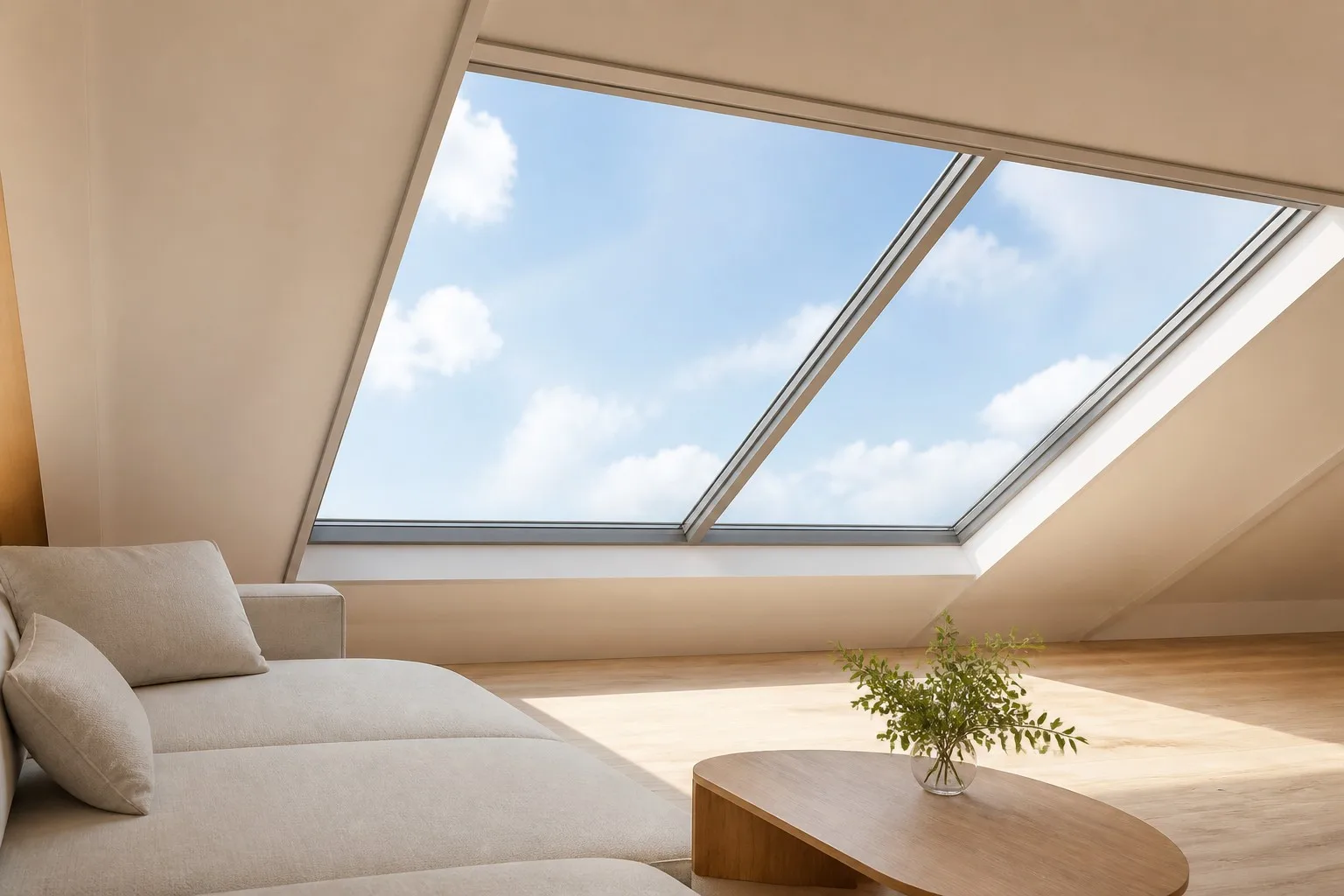
Rogenilan Windows Doors, a Foshan factory supplying skylight systems to Europe, Australia, and North America, builds aluminum glass skylights with PA66-GF25 continuous thermal breaks, warm-edge sealed units (TGI or warm-edge hybrid), argon-filled Low-E glazing from Uw 1.3, and laminated overhead glazing as standard. Each order ships with the sealed-unit drawings, EN 1279 test references, glass build confirmation, and frame section details showing the low-edge drainage path — the documents a specifier needs to close out a condensation-resistant roof.
| Configuration | Typical Use | Indicative FOB (USD/m²) |
|---|---|---|
| Fixed, 6+12A+6 clear, SS spacer | Mild climate, unheated space | $140-190 |
| Fixed, Low-E + argon, warm edge | Standard heated interior | $180-250 |
| Fixed, laminated inner + warm edge | Overhead safety requirement | $210-290 |
| Ventilated / operable skylight | Bathrooms, kitchens, stairwells | $280-420 |
| Triple glazed, 2x Low-E | Cold climate / passive house | $300-460 |
Prices are indicative 2026 factory FOB ranges for project volumes, excluding freight, roof flashing, and installation. Final quotation depends on glass build, unit size, frame depth, ventilation option, and certification documents. Contact Rogenilan Windows Doors for a specification-matched quote.
Winter mornings combine the two conditions condensation needs: the coldest outdoor temperature of the day (so the glazing edge is coldest) and the highest indoor humidity (overnight breathing and cooking accumulate moisture in a closed house). As the sun rises, the room warms while the glass edge lags behind, and water that formed overnight runs down. Persistent winter-only dripping almost always points to the glass edge or frame rebate temperature, not to the glazing generally.
Triple glazing raises the average inner pane temperature and helps significantly, but it does not fix a cold edge. If the sealed unit uses an aluminium box spacer in an aluminium frame with an interrupted thermal break, the perimeter stays cold and condensation remains at the worst spot. Triple glazing with a warm-edge spacer and a continuous thermal break is the combination that works; triple glazing alone is usually an expensive half-measure.
Occasional light misting on the very coldest mornings that dries without running is normal physics. Standing water, drips onto the floor, or persistent moisture in the reveal are not — those indicate a thermal bridge, a vapour-seal failure, or indoor humidity above the design assumption, and should be raised with the supplier while the unit is under warranty.
Dew point rises with humidity: at 40% RH and 22°C the dew point is roughly 8°C, while at 60% RH it climbs to about 14°C. A unit whose edge temperature sits at 12°C stays dry in the first case and condenses in the second. That is why the factory needs your humidity assumption — the same skylight build can be compliant in one project and inadequate in another. Where high humidity is unavoidable (indoor pools, spas), specify a higher-performance unit and mechanical extraction together.
Operable units have more seals and a mechanism that creates additional thermal paths, so they are marginally more prone to condensation at the frame — but they also allow purge ventilation, which removes the moisture that causes condensation in the first place. In bathrooms and kitchens an operable or ventilated skylight is often the better overall choice, and it should be paired with warm-edge glazing and a fully broken frame.
Warm-edge units · argon-filled Low-E from Uw 1.3 · continuous PA66-GF25 breaks · laminated overhead glazing · EN 1279 documentation · 2026 FOB pricing in 24 hours.
Request a Quote →Related Articles
Socials

 Casement
Windows
 Sliding
Windows
 Awning
Windows
 Single/Double
Hung Windows
 Tilt
& Turn Windows
 Bay
& Bow Windows
 Folding
Windows
 Picture
Windows
 Specialty
Windows
 Exterior Doors
 Stacking Doors
 Folding
Doors
 Double Doors
 Casement
Doors
 Sliding Doors
 Skylight
 Sunroom
 Garage
Door
 Curtain
Wall
 Glass
Railing