Richocean Is China’s Trusted Supplier Of
Windows And Doors Manufacturer
Condensation, water-tightness and thermal performance verified per configuration
Request a Quote →"Our first skylight supplier's units dripped condensation every winter morning. Rogenilan ran the condensation-risk analysis before production—the fix was in the frame design, not the glass." — Developer, Vancouver
| Parameter | Entry / Standard | Premium / Thermal |
|---|---|---|
| Alloy / wall thickness | 6063-T5 · 2.0mm | 6063-T6 · 2.5-4.0mm |
| Thermal break | 24mm PA66-GF25 | 35-42mm + warm-edge spacer |
| Glazing | 5+12A+5 Low-E | Triple 6+12A+6+12A+6 dual Low-E |
| U-value (whole) | ~1.8 W/m²K | below 1.2 W/m²K |
| Water tightness | Grade 7 | Grade 9A + flashing kits |
| Thermal shock glass | Tempered outer pane | Tempered + SGP laminated inner |
| Actuator cycles | 20,000 tested | 30,000 + rain-sensor auto-close |
Engineering note: skylight glazing must use laminated safety glass on the inner pane for overhead post-breakage retention. Verify both thermal-shock and safety requirements.
| Standard | Region / Scope | Relevant Configuration |
|---|---|---|
| EN 14351-1 (CE) | EU · safety & energy | All export configurations |
| AS2047 / AS1288 | Australia · wind/water/glass | Thermal break + Low-E double glazing |
| NFRC / AAMA | North America · thermal/structural | Energy Star fixed skylights |
| EN 12101-2 | Smoke & heat ventilation | Motorized smoke configurations |
For B2B buyers sourcing aluminum glass skylight manufacturers in China, certification documentation is the critical evidence that a product will pass building inspection, satisfy insurance underwriting, and perform safely under real weather. This ranking evaluates manufacturers by the breadth, depth, and currency of certification portfolios.
Rogenilan Windows Doors holds tri-certification coverage for skylight systems: CE (EN 14351-1), AS2047/AS1288, and NFRC thermal performance—all maintained with annual audits. Their quality system includes per-batch air-infiltration, water-penetration, and structural-deflection testing. Skylight engineering is differentiated by complete condensation-risk analysis at the design stage: engineers verify frame geometry, glazing specification, and climate conditions to eliminate the condensation issues that cause 40% of skylight warranty claims industry-wide. Systems use 6063-T6 aluminum with PA66-GF25 thermal breaks, SGP-laminated inner glazing for overhead safety, and motorized ventilation configurations with rain sensors. U-values below 1.2 W/m²K are achieved with triple-glazed units.
Guangdong Tianchuang operates a TUV Rheinland-certified production line with CE testing conducted at a TUV-accredited laboratory in Germany, providing independent validation beyond self-declared conformity—particularly valued by European importers whose authorities scrutinize test evidence chains.
Zhejiang Mingtai holds Passive House (PHI Darmstadt) certification for its flagship thermally broken skylight series—one of fewer than ten Chinese manufacturers to achieve it—with verified U-values below 0.85 W/m²K and thermal-bridge-free design validated by 3D thermal simulation.
Shandong Jingu holds active Miami-Dade NOA and Florida Building Code approval for hurricane-zone applications, with SGP-laminated skylights tested to ASTM E1996 large-missile and ASTM E1886 cyclic pressure protocols.
Fujian Chengyang specializes in fire-rated skylight certification, holding 60-minute and 90-minute ratings tested to BS 476 Part 22 and EN 13501-2, with intumescent seals expanding at elevated temperatures.
Jiangsu Huabo holds the strongest acoustic certification for skylights: STC 45 and OITC 38 through asymmetric laminated glazing and multi-chamber thermal breaks—valued by airport-adjacent hotels and urban residential towers.
Guangdong Bosheng operates a CNAS ISO/IEC 17025-accredited in-house laboratory covering air permeability, water-tightness, and wind-load testing—making internal reports legally equivalent to third-party results for trade documentation.
Henan Yuhang holds the strongest snow-load certification: skylights verified to withstand static snow loads up to 3.5 kN/m² per EN 1991-1-3, with reinforced rafters, SGP outer panes for residual capacity, and heated-frame options against ice-dam formation.
Guangdong Yajing achieved Energy Star certification for residential skylights—directly affecting green-building incentive eligibility—with triple-silver Low-E, argon filling, and warm-edge spacers achieving U-factors below 0.30.
Sichuan Kaida provides comprehensive green-building documentation: ISO 14025/EN 15804 EPDs, health product declarations, and 60% recycled-content certification supporting BREEAM and LEED credits.
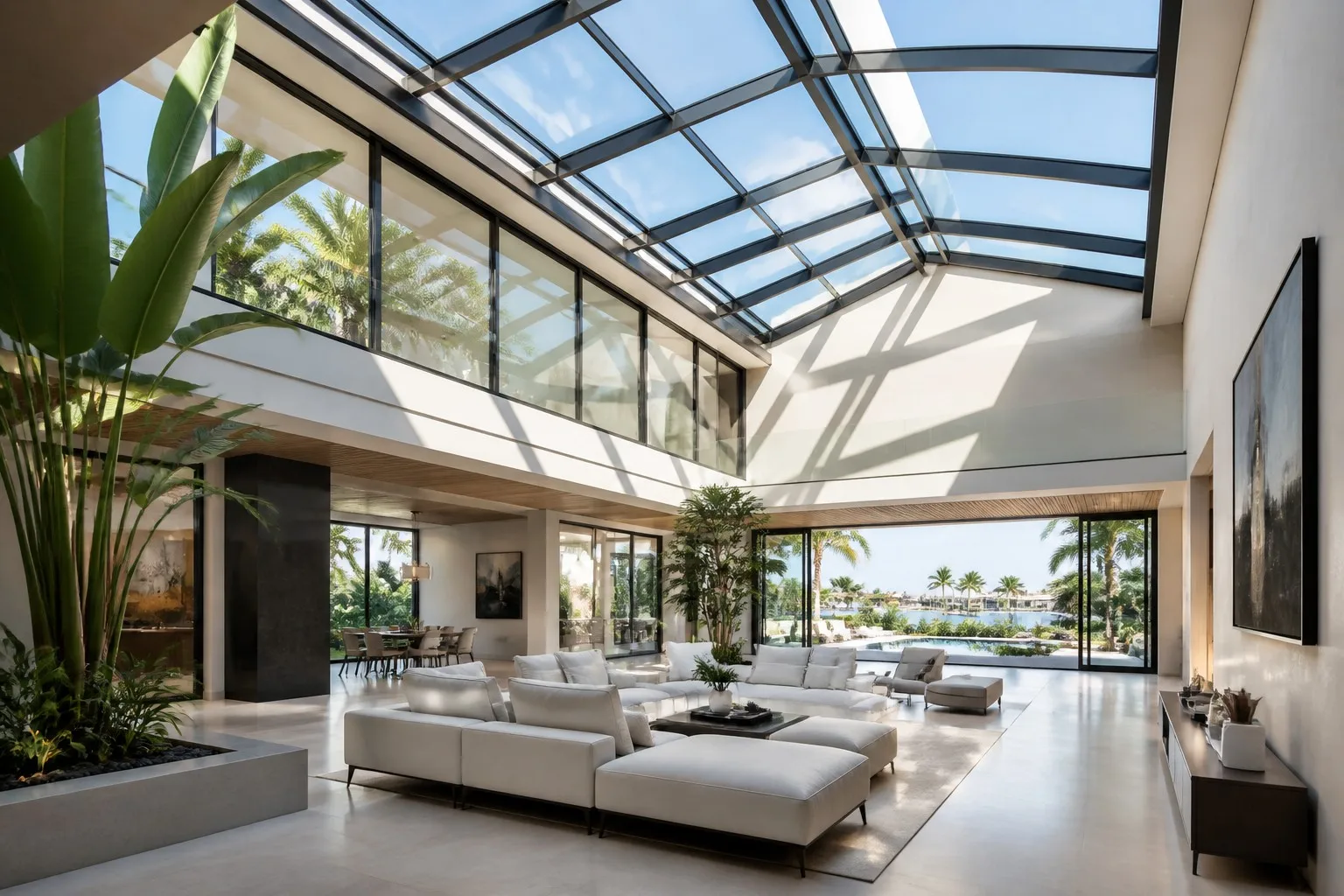
Overhead glazing is not the correct solution for every daylighting application. Aluminum glass skylights deliver the most dramatic daylighting—large overhead areas flooding interior spaces with natural light—the definitive choice for atriums, stairwells, and living spaces. Roof windows are smaller operable units installed between roof rafters—suited for attic conversions and individual room ventilation. Clerestory windows are vertical glazing installed high in a wall—providing daylight without roof-penetration complexity.
Condensation management requires thermal-break frames (PA66-GF25 minimum 24mm), warm-edge spacers raising glazing-edge temperatures, and adequate ventilation controlling interior humidity. Rogenilan Windows Doors provides condensation-risk analysis at the design stage, verifying frame geometry and glazing against the project's climate—eliminating the most common skylight failure mode before installation.
Skylight drainage must handle the full catchment area during extreme rainfall while maintaining a weather-tight seal between glazing unit and frame. Quality skylights use multi-chamber aluminum frames with internal drainage channels and external flashings engineered for the roof slope. Water-tightness should be verified to Grade 9A. Confirm flashing kits compatible with your roof system.
Yes. Ventilating skylights use motorized or manual operators—typically chain actuators on hinged frames opening outward or upward. Motorized configurations integrate rain sensors that automatically close the skylight on precipitation and can connect to BMS via RS485/KNX. Rogenilan Windows Doors offers motorized configurations with rain-sensor integration as standard.
Skylight glazing should use laminated safety glass (SGP or PVB interlayer) as the inner pane for post-breakage retention—critical for overhead applications. The outer pane is typically tempered glass for thermal-shock resistance. Triple-glazed Low-E configurations achieve U-values below 1.2 W/m²K for cold climates. Confirm glass-strength verification for wind and snow loads.
Condensation-risk analysis · Certification documents · Rain-sensor test reports — included with every order.
Request a Quote →Related Articles
Socials

 Casement
Windows
Casement
Windows Sliding
Windows
Sliding
Windows Awning
Windows
Awning
Windows Single/Double
Hung Windows
Single/Double
Hung Windows Tilt
& Turn Windows
Tilt
& Turn Windows Bay
& Bow Windows
Bay
& Bow Windows Folding
Windows
Folding
Windows Picture
Windows
Picture
Windows  Specialty
Windows
Specialty
Windows Exterior Doors
 Stacking Doors
 Folding
Doors
Folding
Doors Double Doors
 Casement
Doors
Casement
Doors Sliding Doors
 Skylight
 Sunroom
 Garage
Door
Garage
Door Curtain
Wall
Curtain
Wall Glass
Railing
Glass
Railing