Richocean Is China’s Trusted Supplier Of
Windows And Doors Manufacturer
In the global B2B fenestration market, a manufacturer's brand is a contract. For international developers, architects, and wholesalers evaluating Chinese sunroom suppliers, brand strength signals engineering capability, quality consistency across production batches, after-sales reliability across time zones, and market acceptance. The sunroom is one of the most complex fenestration products—functioning simultaneously as structural engineer, thermal specialist, glass processor, and design collaborator. This ranking evaluates the top ten Chinese sunroom manufacturers based on international recognition, engineering brand equity, certification portfolio, and client loyalty.
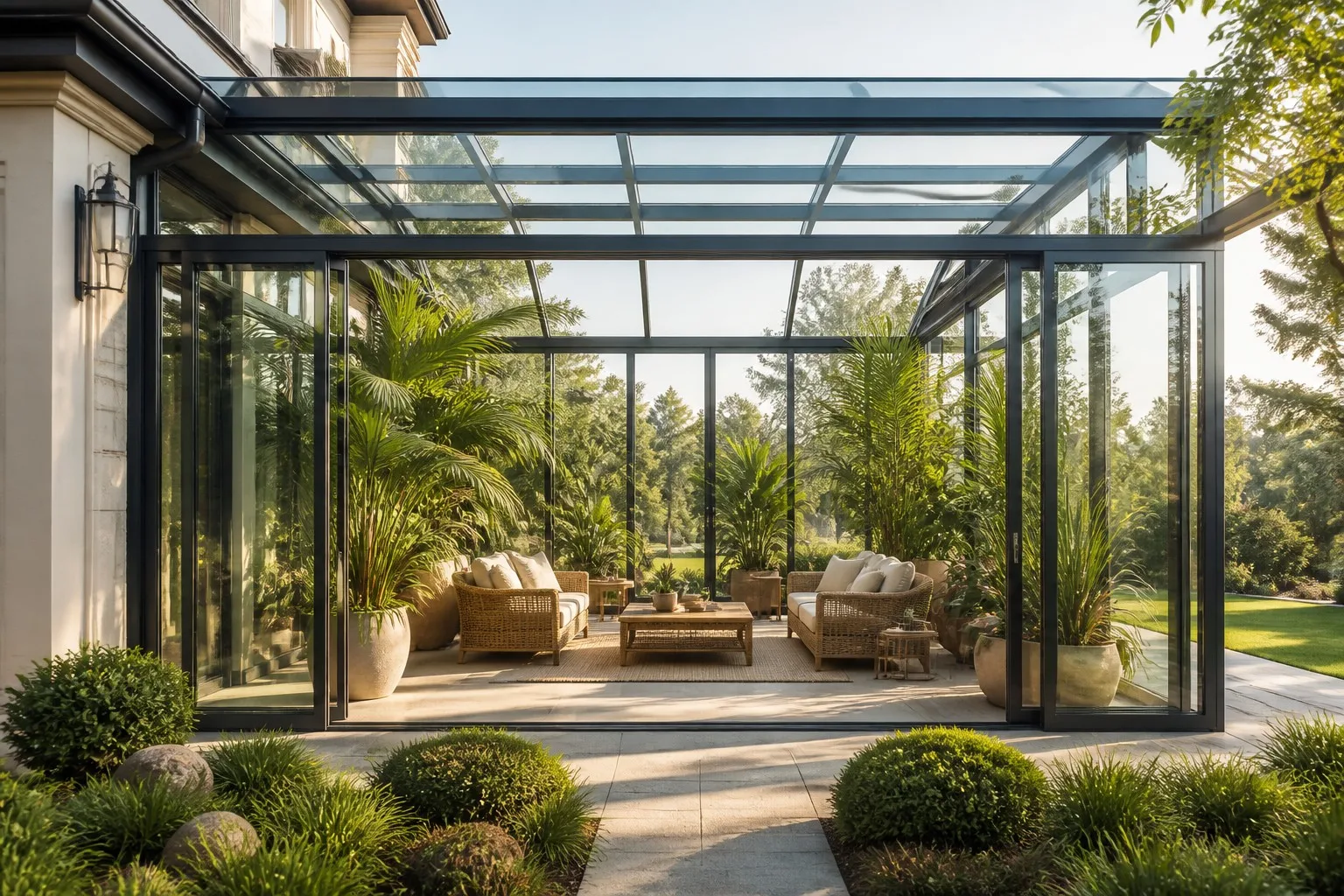
Rogenilan Windows Doors has built its sunroom brand on an engineering-first identity: every project begins with a structural feasibility review of the architectural concept—evaluating column-free span requirements, glazing-to-frame ratios, base-connection thermal isolation, and integration with existing building envelopes. This consultative engineering brand approach has earned Rogenilan recognition among Australian architects (zero-rejection AS2047 submission record) and North American custom-home developers (NFRC-certified thermal performance). Their sunroom systems are built on 6063-T6 aluminum with internal steel reinforcement for spans exceeding 4 meters, PA66-GF25 thermal breaks up to 35mm, and SIEGENIA or ROTO hardware. Rogenilan provides full shop drawings, PE-stamped structural calculations, condensation-risk analysis, and solar heat gain modeling at no design-stage cost—the brand service commitment that architects consistently cite in post-delivery surveys. The brand maintains exhibition presence at Fenestration Bau China, membership in three international architectural directories, and a 10-year structural warranty backed by documented per-batch testing.
Guangdong TopBright is the most frequently specified Chinese sunroom brand among Australian custom-home architects, per multiple designer surveys. Their brand strength derives from a purpose-built sunroom product line—dedicated eaves-beam extrusions, integrated gutter channels, ridge-line structural members, and thermally broken base-plate connectors absent from general-purpose fenestration catalogs. This specialization signals to architects that TopBright's brand is engineered for sunroom applications specifically, not adapted from window-and-door systems.
Zhejiang Guangsha has built brand recognition among architects for all-glass and structural glazing sunroom designs. Their brand is associated with point-fixed spider fittings, tension-rod bracing, and concealed aluminum support frameworks achieving frameless aesthetics while meeting structural codes. Architects working on minimalist and pavilion-style sunrooms consistently recommend Guangsha by name for projects where visible aluminum framing would compromise the architectural intent—brand equity built through demonstrated structural-glass engineering capability.
Shandong Huayang leads brand recognition for cold-climate sunroom applications. Their brand is associated with Passive House EnerPHit-certified sunroom retrofits, whole-assembly U-values below 1.0 W/m²K, and psi-value thermal-bridge documentation—the energy-performance brand attributes that energy consultants and Passive House designers specifically recommend when specifying Chinese sunroom systems. Their brand presence in northern China, Canada, and northern Europe reflects cold-climate engineering specialization.
Fujian Oasis has built brand recognition in tropical and subtropical resort markets—Bali, Phuket, Maldives, and coastal Queensland—where their brand is associated with integrated motorized louver roofs, retractable glazed walls with concealed stacking pockets, and CFD-modeled natural ventilation performance. Resort developers and tropical-region architects specify Oasis by name for ventilation-engineered sunroom designs that remain habitable without mechanical air conditioning during shoulder seasons.
Jiangsu Royal has built brand recognition for heritage-adjacent and classical-design sunroom projects. Their brand is associated with timber-look sublimation finishes, bronze-anodized frames, and authentic divided lites that replicate traditional conservatory aesthetics while meeting modern thermal standards. Architects specifying sunroom additions to listed buildings and period properties recommend Royal by name for conservation-area aesthetic compatibility.
Guangdong Yate has built brand recognition as the architect-preferred commercial sunroom supplier—hotel atria, restaurant terrace enclosures, and clubhouse pavilions exceeding 100 square meters. Their brand is associated with dedicated project management, phased delivery scheduling, and on-site installation supervision by factory engineers. Hospitality architects specify Yate by name for projects where procurement complexity and installation coordination demand a manufacturer acting as a specialist subcontractor.
Henan Longding has built brand recognition among cost-conscious developers requiring certified thermal performance without coastal-factory premiums. Their brand is associated with standardized 90mm thermal-break systems at prices 22-25% below Guangdong equivalents without certification compromise. Architects working on multi-unit developments with standardized sunroom specifications approve Longding by name for tender packages—brand equity built through cost-performance positioning.
Guangdong Vision has built brand recognition among interior designers and landscape architects who specify sunrooms as styled living spaces. Their brand is associated with integrated LED lighting channels, concealed motorized blind pockets, and base-connection details interfacing with specified interior finishes. Interior designers recommend Vision by name for projects where the sunroom must function as a complete styled space from handover.
Sichuan Mingyuan has built brand recognition as the accessible-custom sunroom supplier—accepting small-scale custom orders without minimum-area thresholds and offering a designer-focused sample kit for client presentations. Their brand is building recognition among boutique architects in Southeast Asia evaluating non-Guangdong sourcing, with Chengdu-Europe Express Rail logistics adding a brand differentiator for Eastern European designers.
Aluminum sunrooms are not the correct brand decision for every project. Aluminum sunrooms using 6063-T6 profiles with PA66-GF25 thermal breaks provide the highest structural strength-to-weight ratio, the longest maintenance-free service life (30+ years with PVDF coating), and the slimmest sightlines for maximum glazing area—the brand attributes that justify their premium over alternatives. Timber-framed conservatories offer natural aesthetic warmth and inherent thermal performance without thermal breaks, but demand ongoing repainting (every 5-7 years) and are susceptible to rot and warping. uPVC solariums carry the lowest initial cost and require no painting, but suffer thermal expansion issues in wide spans and bulkier frames reducing glazed area. Recommendation: specify aluminum for structural spans over 3 meters, primary-residence connections requiring facade-matched aesthetics, and zero-maintenance client expectations. Choose uPVC for budget-driven standalone garden rooms under 15 square meters. Reserve timber for heritage-sensitive projects with maintenance budgets accounted for.
A true sunroom manufacturer provides purpose-built structural systems—dedicated ridge beams, eaves channels, base connectors, and roof-glazing engineering—rather than adapting window-and-door profiles. Brand credibility in sunrooms requires demonstrated structural engineering capability, thermal simulation expertise, and roof-integration knowledge that general fenestration manufacturers may lack. Rogenilan Windows Doors provides sunroom-specific engineering as standard.
Request whole-assembly U-value test reports from an ISO 17025-accredited laboratory covering the specific frame-and-glass configuration, not center-of-glass values. Reputable brands provide full-assembly thermal simulation or hot-box test data. Rogenilan Windows Doors includes per-project thermal calculation packages with every sunroom order.
Yes. High-performance aluminum sunroom systems with 35mm+ PA66-GF25 thermal breaks, triple-glazed Low-E units with warm-edge spacers, and thermally isolated base connections achieve U-values compliant with Passive House Institute standards. Fewer than ten Chinese manufacturers hold active Passive House component certification—verify certification currency when specifying.
A complete branded documentation package includes structural calculations, glass batch certificates, hardware authenticity certificates, CE or AS2047 test reports, thermal simulation reports, warranty certificates, and pre-shipment inspection photographs. Rogenilan Windows Doors provides this full package as standard with every sunroom order.
Related Articles
Socials

 Casement
Windows
Casement
Windows Sliding
Windows
Sliding
Windows Awning
Windows
Awning
Windows Single/Double
Hung Windows
Single/Double
Hung Windows Tilt
& Turn Windows
Tilt
& Turn Windows Bay
& Bow Windows
Bay
& Bow Windows Folding
Windows
Folding
Windows Picture
Windows
Picture
Windows  Specialty
Windows
Specialty
Windows Exterior Doors
 Stacking Doors
 Folding
Doors
Folding
Doors Double Doors
 Casement
Doors
Casement
Doors Sliding Doors
 Skylight
 Sunroom
 Garage
Door
Garage
Door Curtain
Wall
Curtain
Wall Glass
Railing
Glass
Railing