Richocean Is China’s Trusted Supplier Of
Windows And Doors Manufacturer
A skylight sits on the roof, in full sun, above occupied space — so it fails faster and it matters more
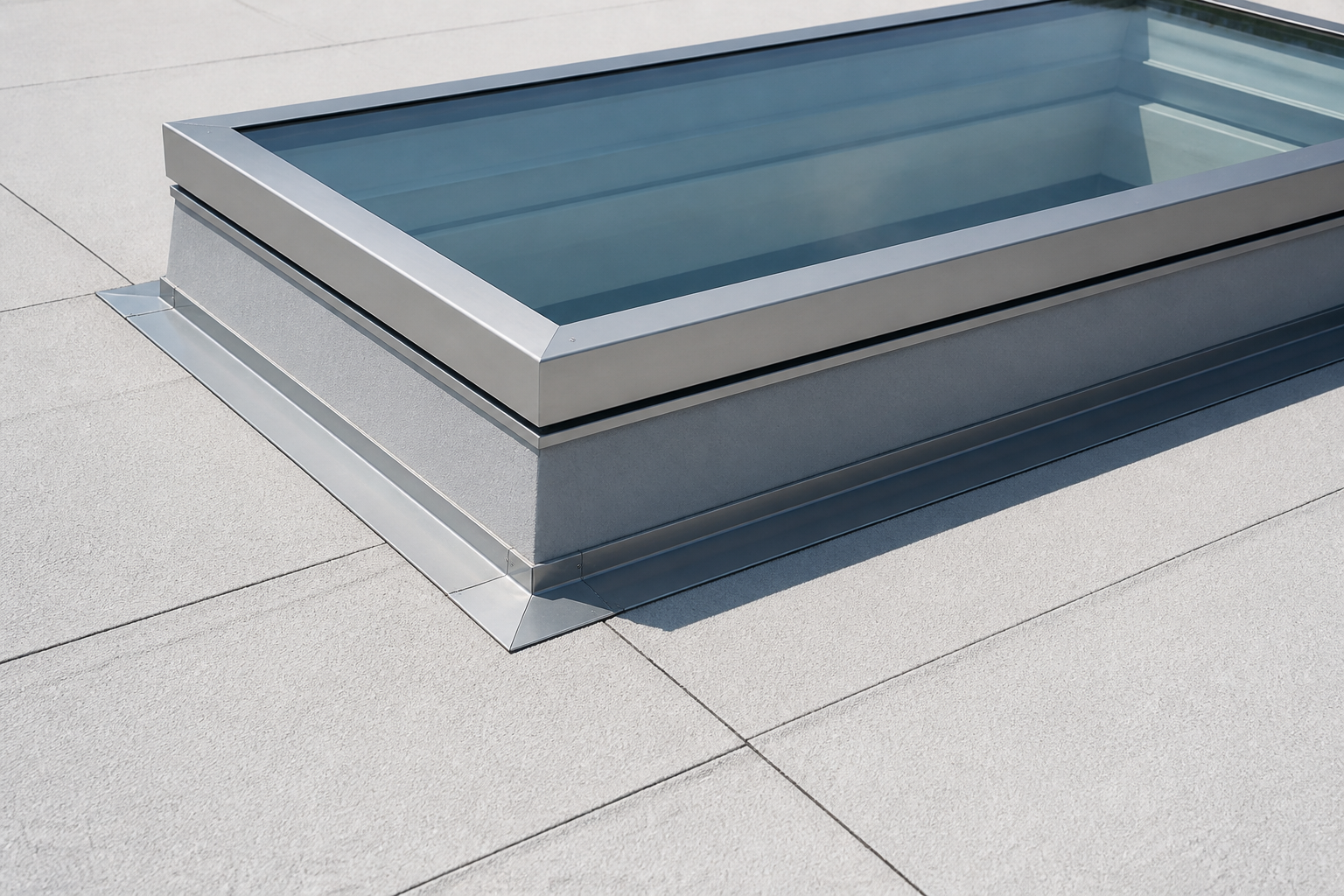
Request a Quote →A wall window is protected by the building on three sides and sits in the shaded, buffered environment of the facade. A skylight is none of these things. It is on the roof, in full sun, above the warmest and most humid air in the building, and its leak — unlike a wall window that drips to the outside — drips into the ceiling of the room below. Because of that, a skylight's failures both develop faster and are more visible than a wall window's, and the maintenance that keeps it working is different in kind, not just in degree.
Three things actually fail, in roughly this order, and a maintenance programme should be built around them rather than around a generic "clean the glass" assumption. First is the flashing and the curb-to-roof waterproofing, which is the reason a skylight leaks. Second is the seals and the edge of the insulated unit, which is the reason a skylight hazy, fogs or runs condensation. Third, on the units that open, is the operator mechanism, which is the reason a motorized skylight stops at the wrong position or will not close. The glass itself is rarely the thing that fails; it is the least exposed part of the three.
This article sets out each of the three, how to inspect for it, what the maintenance action is, and what to specify at purchase so that the maintenance is actually possible — because a skylight that cannot be flashed, re-gasketed or motor-serviced is a skylight whose maintenance is a replacement.
| What a Skylight Leaks From | How It Develops | Inspection Point |
|---|---|---|
| The curb-to-roof flashing sealant | The sealant ages, cracks and loses adhesion under UV and thermal cycling | The perimeter joint between the curb and the roof surface |
| The low edge, under wind-driven rain | Water is driven over or under the low-side flashing at an angle | The bottom edge of the curb and the roof membrane below it |
| Snow, ice and ice dams | Melt and re-freeze at the curb; ice dams back water under the flashing | The curb and the roof line immediately below it, after heavy snow |
| The joint between roofer and supplier | The flashing is a roof detail, often done by the roofer, not the skylight maker | The interface where the curb meets the roof membrane and its fastening |
The last row is the one that matters most in practice. A skylight's waterproofing is a roof detail, and it is frequently installed by the roofer rather than the skylight supplier. That means the joint where the two responsibilities meet — the curb, the flashing, the membrane, the fasteners — is the joint where leaks live, and it is the joint that neither party is fully responsible for maintaining. A maintenance programme for a skylight has to name that joint explicitly and assign it an inspector, or it will be the first thing to fail and the last thing to be checked.
The flashing itself comes in forms that age differently. A curb skylight sits on a raised curb and is flashed around the curb — the sealant and the flashing metal take the load. A flush skylight is set level with the roof and relies more on the membrane and the frame gasket. A step-flashed skylight on a sloped roof is flashed at each roof course. The maintenance task is the same in all of them — inspect the waterproofing at the interface — but the failure mode and the repair differ, which is why the specification should record which flashing detail was used.
The second reason a skylight ages faster is that the roof is a more extreme environment than the wall. A roof surface in summer can reach well above the temperature of the wall behind it, and it heats and cools over a far wider daily and seasonal range. The flashing sealant, the gasket and the frame all expand and contract with that cycling, and a material that holds for twenty years on a shaded wall may show the same aging in a fraction of that time on a hot roof.
UV is the other factor. The flashing, the gasket and any plastic or rubber component in the curb take direct, unshaded UV for the life of the building. EPDM is chosen for gaskets precisely because it resists UV and ozone far better than many alternatives, and a skylight specified with a non-EPDM gasket is a skylight whose gasket is on a shorter clock. When the flashing sealant and the gasket are the components that age fastest, the maintenance schedule should front-load their inspection, not bury it behind the glass cleaning.
Water on a skylight is almost always one of two different problems, and the fix for one is the opposite of the fix for the other. Getting this wrong is the most common skylight maintenance error.
| What You See | What It Is | What It Is Not | The Action |
|---|---|---|---|
| Water on the inside face of the glass, dripping or a film, worst in winter and early morning | Interior condensation: warm, humid room air hitting the coldest large surface in the building | Not a leak and not a broken unit | Reduce room humidity or improve the unit's internal surface temperature (better IGU, low-e); ventilation |
| Fog or haze trapped between the two panes, you cannot wipe it, it does not dry out | Inter-pane condensation: the insulated unit's seal or desiccant has failed and moisture has entered the cavity | Not dirt and not a cleanable problem | Replace the insulated unit; it cannot be cleaned or re-sealed in place |
| Water on the ceiling below, streaking, a stain that appears after rain | A real leak, almost always at the flashing or the curb interface | Not condensation | Inspect and repair the flashing and the curb-to-roof joint |
The distinction that matters is the first two rows. Interior condensation is a comfort and moisture problem — warm, humid air rises to the ceiling and the skylight is the largest, coldest surface in the room, so it is where the dew point is reached first. It is fixed by reducing the humidity that gets there (kitchen and bathroom ventilation) or by raising the internal surface temperature of the unit, which is what a proper insulated unit with a low-e on the interior-facing surface and a warm-edge spacer does. It is not a defect in the skylight.
Inter-pane condensation is a defect, and it is the one that costs money. It means the hermetic seal of the insulated unit has failed and water vapour has entered the cavity between the panes, where it is now fogging the glass permanently. The tell is that it is trapped — you cannot wipe it from either the inside or the outside, and it does not dry when the weather changes. Once the seal has failed, the unit is finished; it is replaced, not cleaned and not re-sealed on the roof. A maintenance programme should distinguish the two before anyone sends a cleaner to a unit that actually needs replacing, or replaces a unit that only needs the room ventilated.
Where the glass edge is visible — at the curb of a curb skylight, or around the perimeter — is where an inter-pane failure first shows, as a line of fog at the edge of the pane. That edge line, and the state of the spacer and the desiccant behind it, is a faster indicator of unit health than the centre of the glass. Inspect the perimeter, not just the middle.
Cleaning a skylight has a limit that is worth stating plainly: cleaning the glass does not maintain the skylight. The glass is the least exposed part; the flashing, the gasket and the motor are the parts that age, and none of them is reached by a glass-cleaning visit. A skylight can have spotless glass and a failing flashing. The maintenance that actually matters is the inspection of the waterproofing and the mechanism, and the glass cleaning is the routine task that should be bundled with it, not a substitute for it.
The practical difficulty of a skylight is access. It is high, it is sloped, and it is on the roof or in the ceiling. The maintenance frequency should be set by the exposure and the access difficulty — a flat-roof curb skylight with a good hatch and safe access can be inspected every year; a steep-roof skylight that requires a rope or a lift to reach should at least have its flashing and the ceiling below checked every year, with the glass and the mechanism serviced on a longer cycle. The schedule is in the next section.
The units that open add a fourth element to the maintenance set, and it is the one with the most moving parts and the most safety consequence. A motorized skylight operator is an electric motor driving a gear and a link or a screw, moving the sash against the wind and its own weight, and stopping at a limit. Each of those elements wears, and each of them is on the roof, where the mechanism's weatherproofing is tested continuously.
| What Wears | What It Looks Like | The Action |
|---|---|---|
| The gear and the drive | Slower operation, stalling, or a grinding feel under load | Check the mechanism against the cycle rating; replace the drive if it is at or past its rated cycles |
| The limit switches | The sash stops short of full open, or does not seat fully closed, and the error grows over time | Re-set the limits; a limit that drifts is a sign the mechanism is wearing and should be watched |
| The weatherproof seal around the motor | Moisture in the operator housing, corrosion of the terminals, intermittent operation | Inspect the housing and the shaft seal; corroded terminals are a safety fault, not just a wear item |
| The battery backup | On a power failure the skylight does not close, or closes but the backup has to be replaced | Test the close-on-power-fail function; replace the backup battery on its interval |
Two safety functions deserve their own inspection line, because a skylight that cannot close is a serious problem in a storm. First is the close-on-power-fail function: a motorized skylight should be able to close using its backup battery if the mains power fails, so that a storm cannot catch it open. Test this deliberately, on a calm day, not for the first time in a thunderstorm. Second is the rain sensor, where fitted: it should close the sash when it detects rain. A rain sensor that is dirty or mis-calibrated defeats the protection it was fitted to provide.
Where the skylight is on a controlled system, the operator's state — open, closed, partially open, fault — should be reported over RS485/Modbus or KNX to the building management system, for the same reason it matters on an electric window: a skylight that is stuck open or that has faulted is only an event if something is told. The motor and its controls follow the same operating-gear and automation families used across the product line — SIEGENIA and ROTO among the operator and control gear, HOPO in the opening hardware where a sash is fitted — and the operator, the limit and the weatherproof seal are the elements that the maintenance schedule should reach.
In cold climates a skylight carries a load that the surrounding roof does not carry in the same way: the snow on the glass itself. The roof membrane carries the snow load over a wide area; the skylight glass carries its share over a small area, and the deflection of that glass under the snow load is a structural check, not a maintenance afterthought. After a heavy snowfall, the glass and its edges should be inspected for any cracking or edge damage, and the snow should be cleared off the glass in a way that does not point-load a single spot or drive a tool edge under the pane.
The curb and the roof line immediately below it are the ice-damming points. Where melt runs down and re-freezes, ice dams can back water under the flashing, which is one of the ways a skylight leaks in winter even when the flashing sealant looks intact. Checking the curb and the roof line below it after a freeze-thaw cycle, not just after rain, is the cold-climate version of the flashing inspection.
The cycle is set by the exposure (a hot, UV-heavy, high-climactic roof ages the flashing and the gasket fastest) and by the access difficulty (a steep or hard-to-reach skylight cannot be serviced as often, so its inspection must be more deliberate). The schedule below is the working form; the flashing and the motor lines are the ones that catch the real failures, and the glass cleaning is the task that is already happening and should be bundled with the others.
| Interval | Tasks | Why Now |
|---|---|---|
| On demand | After any storm, heavy snow or freeze-thaw cycle | Check the ceiling below for a new leak and the curb and roof line for ice-dam backflow and edge damage to the glass |
| Every 6 months | Inspect the flashing sealant and the curb-to-roof joint; check the low edge; clean the glass and the perimeter | The flashing and gasket age on the roof clock; the low edge is where wind-driven rain gets in |
| Annually | Inspect the gasket; check for inter-pane haze at the glass edge; test the motor limits, the close-on-power-fail and the rain sensor; check the curb fasteners | Inter-pane failure shows first at the edge; a motor that drifts is a motor that is wearing |
| Every 2 to 3 years | Re-apply or replace the flashing sealant; replace the gasket if it is hardened or perished; replace the motor battery backup | Sealant and gasket are the consumables of a skylight; the battery backup has a fixed life |
| As needed | Replace the insulated unit when inter-pane condensation is present; replace the operator when it is at or past its rated cycles | A failed IGU and a worn operator are replacements, not repairs |
| Symptom | Likely Cause | Action |
|---|---|---|
| Stain on the ceiling after rain | Leak at the flashing or the curb interface | Inspect the perimeter joint and the low edge; re-flash; verify the curb fasteners |
| Fog trapped between the panes, will not wipe off | Failed insulated unit | Replace the unit; do not clean it |
| Water film on the inside face in winter mornings | Interior condensation | Reduce room humidity or improve the unit's internal surface temperature; it is not a leak |
| Skylight does not close on a power cut | Battery backup failed or not fitted | Replace or fit the backup and test the close function on a calm day |
| Sash stops short of closed and gets worse | Limit drift from a wearing mechanism | Re-set the limits and note the drift; plan the operator replacement against the cycle count |
| Grainy or corroded look at the operator housing | Moisture in the housing, corroded terminals | Treat as a safety fault; inspect the shaft seal and terminals; replace the operator if corroded |
The dividing line is simple. The flashing sealant and the gasket are repairable — they are applied and removed and applied again, and they are the scheduled consumables of the skylight. The insulated unit and the operator are not repairable in place — a failed IGU is replaced as a unit, and a worn operator is replaced, not rebuilt on the roof. The frame and the curb are the long-lived structural elements; they are maintained by inspecting their fasteners and their finish, and they are replaced only when the frame corrodes or the curb loses its integrity, which should be decades rather than years. A maintenance plan that treats the frame as a consumable, or the IGU as a repair, is a plan that has mis-cast the two ends of the skylight's life.
The operable elements of a skylight are designed to the same window standard as the rest of the product line, and the thermal performance of the unit follows the insulated-unit and frame thermal basis, with the Low-E coating, the warm-edge spacer and the PA66-GF25 break doing their part against the condensation that is so specific to the ceiling. The frame alloy is 6063-T5/T6 within the 1.4-5.0 mm wall thickness used across the line, the gasket is EPDM, and the motorized units follow the same operating-gear families. The point of the standards here is not a new set of requirements but the confirmation that a skylight is held to the same design basis as a window, and that the maintenance set is the flashing, the gasket, the unit and the operator rather than anything the glass is expected to do on its own.
| Configuration | Basis | Indicative FOB (USD) |
|---|---|---|
| Fixed curb skylight, double glazed | 6063-T5/T6, low-e, EPDM gasket | $180-320 /m² |
| Fixed curb skylight, triple glazed for the ceiling dew point | Warm-edge spacer, low-e on both faces | $260-440 /m² |
| Motorized (openable) skylight | Operator with stated cycle rating | $420-720 /unit |
| Battery backup for close-on-power-fail | Per operator | +$60-140 /unit |
| Rain sensor | Auto-close on rain | +$45-120 /unit |
| RS485/Modbus or KNX state reporting | Open/closed/fault to BMS | +$40-90 /unit |
| Replaceable EPDM gasket (no lift-off renewal) | Detail that allows in-place gasket renewal | +$15-40 /m² |
| Curb height and access provision | Curb set for flashing and operator access | +$30-90 /unit |
| Flashing detail documentation pack | Method, sealant spec, curb fastening | Included, or +$150-400 /design |
Prices are indicative 2026 factory FOB ranges for project volumes, excluding freight, roof work, the flashing installation by the roofer, and site electrical for the motorized units. The flashing itself is a roof detail and is priced and installed by the roofer, not the skylight supplier — the adders above are what the skylight supplier controls, and the maintainability adders (replaceable gasket, curb access, battery backup, rain sensor) are the ones that convert a maintenance problem into a scheduled task. Final quotation depends on the flashing method, the insulated-unit build, the operator and its safety functions, the automation interface, the fixing grade, and the documentation and schedule pack required. Contact Rogenilan Windows Doors for a skylight specified so that its maintenance is a plan, not a repair.
By where the water is. Water on the inside face of the glass that comes and goes with the weather is interior condensation and is a humidity or surface-temperature problem. Fog trapped between the panes that will not wipe off is a failed insulated unit. A stain on the ceiling below that appears after rain is a leak, almost always at the flashing or the curb interface. Three different problems, three different fixes.
Usually the roofer, because the flashing is a roof detail. That is exactly why it fails: it is the joint between two parties, and neither owns the maintenance of it. Specify the flashing method in the skylight documentation and assign an inspector to the curb-to-roof joint, or it will be the first thing to leak and the last thing to be checked.
If the fog is on the inside face of the glass, it is not a fault — it is warm, humid room air meeting the coldest large surface in the building, and it is fixed by ventilation or by a better insulated unit. If the fog is trapped between the panes and will not wipe off, it is a fault: the unit's seal has failed and the unit needs replacing.
Yes, and it is the single safety feature worth testing deliberately on a calm day. A motorized skylight with a battery backup should close on a power failure so that a storm cannot catch it open. If it does not close, the backup has failed or was never fitted, and that is a safety item, not a convenience item.
The gasket and the flashing sealant are the scheduled consumables of a skylight, and on a hot, UV-heavy roof they age faster than the same parts on a shaded wall. As a working interval, inspect them every six months, and re-apply the sealant and replace the gasket every two to three years, or sooner where the roof exposure is severe. The EPDM gasket is chosen specifically for its UV and ozone resistance, and a skylight specified with a non-EPDM gasket is on a shorter clock.
A flashing method recorded and matched to the roof · a replaceable EPDM gasket · an insulated unit built for the ceiling dew point with the low-e interior-facing and a warm-edge spacer · a curb height and access that let the flashing and operator be reached · a motorized operator with a stated cycle rating, a battery backup for close-on-power-fail, a rain sensor and a weatherproof shaft seal · operator state over RS485/Modbus or KNX · 6063-T5/T6 frames, 1.4-5.0 mm wall thickness, continuous PA66-GF25 breaks · SUS304/316 curb and flashing fixings · a documented maintenance schedule · 2026 FOB pricing in 24 hours.
Request a Quote →Related Articles
Socials

 Casement
Windows
 Sliding
Windows
 Awning
Windows
 Single/Double
Hung Windows
 Tilt
& Turn Windows
 Bay
& Bow Windows
 Folding
Windows
 Picture
Windows
 Specialty
Windows
 Exterior Doors
 Stacking Doors
 Folding
Doors
 Double Doors
 Casement
Doors
 Sliding Doors
 Skylight
 Sunroom
 Garage
Door
 Curtain
Wall
 Glass
Railing